|
Manassas National Battlefield Park Chapter 10: Stonewalling the Mall |

|
|
Chapter 10
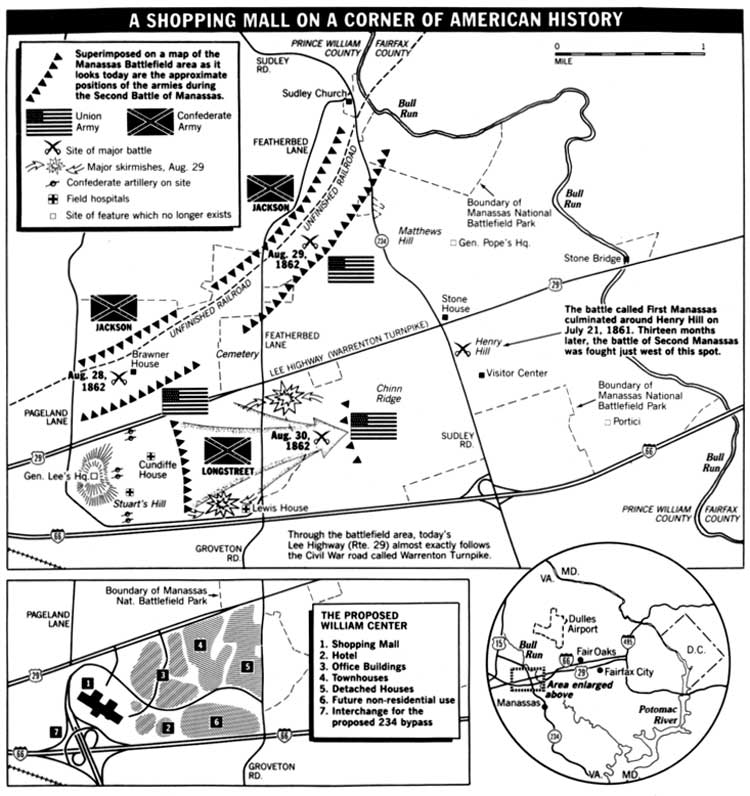
STONEWALLING THE MALL "It is not easy for a Republican, particularly a conservative Republican, to advocate the taking of land, particularly when that is bound to be expensive, but it seems warranted in this emergency case," said Gordon J. Humphrey, a senator from New Hampshire in response to the January 1988 announcement by the Hazel/Peterson Companies of the addition of a regional shopping mall to the William Center's residential-office complex. In Humphrey's opinion, the mall and its accompanying traffic and parking lots would turn the Manassas National Battlefield Park into "little more than a pastoral backdrop for another metropolitan concrete complex." To prevent this, Humphrey supported a legislative taking bill, which would automatically put the land under federal ownership, leaving resolution of its cost to later discussions. Senator Humphrey's remarkable stand, especially under the Reagan administration's call for less government interference in local affairs, demonstrates the far-reaching effects of this third battle of Manassas. [1] These effects have been enduring. Manassas battlefield park became a household word in the late 1980s and continues to have star power. Congressional budget battles threatening to shut down the federal government prompt news reporters to trek out to Manassas and show viewers what they would lose if this park (and others like it) were forced to close. This name recognition has had other effects. Public interest in Manassas has translated into millions of dollars donated to battlefield preservation efforts and expanded membership in preservation organizations. Congress has aided the work of private groups by protecting sites and expanding boundaries at existing parks. The Manassas mall controversy raised public awareness about historic preservation in ways no other previous issue had. Initial Reaction In late January 1988 Bob Kelly, Hazel/Peterson's vice president for public relations and the company's principal contact person for the park, casually announced to Swain and park management assistant Susan Moore that Hazel/Peterson Companies wanted to build a regional shopping mall on top of Stuart's Hill. As Moore remembered it, Kelly just dropped by park headquarters and said "Oh, by the way, we've changed our plans slightly. Will this cause you any concern?" Swain and Moore immediately recognized the import of this news: more traffic needing more interchanges and upgraded roads, a highly visible megastructure on top of the hill. The proposed campuslike office park set within a heavily landscaped setting and joined by residential homes and a small community shopping center had now become a bustling shopping mecca for northern Virginia. Swain "cried foul" as the Park Service evaluated its response to this change in plans. [2] Til Hazel and his company proposed to build a 1.2 million-square-foot mall, anchored by five major department stores, as the centerpiece of the 542-acre William Center. Hazel/Peterson obtained the services of the Edward J. DeBartolo Corporation, one of the country's leading owners and operators of shopping centers, for the project. Construction was expected to start in two years, once stores had been signed up. To show the importance of the mall, William Center literature proudly boasted that in its first ten years of operation, the mall and the other nonresidential components of the tract would generate $27.3 million in net fiscal benefits for the county. After twenty years, Hazel/Peterson estimated the total fiscal benefit to be almost $180 million, a healthy infusion into county coffers. [3] Mindful of these tax revenues, Prince William officials welcomed the idea of having a huge shopping mall built on the William Center property. Supervisor Robert Cole relished the prospect that his county would no longer have to "stand in the shadow of Fairfax County," an adjacent county that had experienced a massive building boom in recent years. With the mall in place, other quality development, including corporate offices and headquarters, would logically follow, ensuring the economic health of the western portion of the county. Although the chairman of the board of county supervisors, Kathleen K. Seefeldt, voiced concerns over the shape of the resulting transportation network, she remained generally in favor of the mall. [4] The mall announcement caught the NPS off guard. Swain remembered the feeling as playing a "bait and switch game" and wondered if Hazel/Peterson had always intended to build a mall but waited to announce it until after the rezoning had been approved. In fact, Hazel had wanted to include a mall in the William Center development from the start and had sought the planned mixed-use district zoning because this zoning category permitted such a retail center. The PMD description allowed for unspecified retail development. Hazel waited to make the mall announcement until a developer had been identified and signed onto the project. This delay in fully disclosing the extent of development planned for the William Center left Swain and many others feeling deceived. As Annie Snyder wrote in early February, western Prince William County residents felt "deceived, cheated and defrauded" by the Hazel/Peterson Companies. For many, the developer showed an apparent disregard for the good faith agreements it had made with the Park Service and the Northwest Prince William County Association (NWPWCA). [5] For the Park Service and mall opponents, adding a regional shopping mall to the original campuslike office park created an entirely new situation, one that threatened the existing Manassas battlefield park. First, the Park Service and county residents believed that William Center traffic would increase considerably with the mall, with as many as 80,000 cars per day traveling to the shopping center. Lee Highway and Route 234 through the battlefield park would he especially attractive for handling this traffic, thereby putting the battlefield park in jeopardy. Hazel disagreed, saying that only the sixteen shopping days preceding Christmas would bring this level of mall visitation. The rest of the year, the mall would generate lighter traffic than office complexes, which create heavy rush hour demands. Second, the Park Service worried about the road widenings the increased mall traffic would necessitate, specifically at the Stone House intersection. Third, building a mall on top of Stuart's Hill would make the complex visible from many points in the battlefield park. Swain had worked hard to reduce this type of visual intrusion in his 1986 negotiations with Hazel/Peterson. The mall proposal made those negotiations seemingly immaterial. [6] Finally, for many residents, the regional mall seemed incompatible with the historical and environmental value of the surrounding countryside. Malls represented blatant twentieth-century commercialism and materialism. They ate up land with acres of parking lots. It seemed that a mall could be built anywhere, whereas the few remaining pieces of open land should be saved. Many mall opponents also questioned the plan's economic soundness. Fair Oaks, a similarly sized mall, was located only eight miles east of the William Center site. Tyson's Corner, with two huge shopping centers, was not far from Fair Oaks. With so many regional shopping opportunities located close by, the Manassas mall might be the economic loser. [7] Seeking a way to address this situation, NPS Director Mott turned to Prince William County. Mott reinvoked his call for partnerships between federal and local governments. In a 5 February letter to Kathleen Seefeldt of the board of supervisors, Mott asked the county to join with the Park Service to consider the impact of the mall on both the county and the battlefield park. Mott knew that the landscape surrounding the battlefield park would inevitably change and that the Park Service could not acquire all lands, and he understood the "heavy burdens born by county officials in rapidly developing areas," yet he believed that through partnerships, county officials and the Park Service could achieve mutually beneficial goals. By reducing the visual impact of outside developments, the park's historic integrity would be preserved, and the county would have a valuable resource. "In the spirit of full and friendly" cooperation, Mott asked Seefeldt to give the mall proposal a "thorough review." [8] Mott may have been honest in his attempt to forge a working relationship with the county, but he exacerbated the situation by publicly releasing the letter at the same time he mailed it to Seefeldt. Seefeldt sent an angry reply, accusing Mott of trying to "inflame" citizens and prevent a rational and substantive discussion of the issues. Seefeldt called Mott's gesture toward partnerships with local government "neither useful nor wise" and questioned the Park Service's commitment to preservation. She contended that Prince William officials were "extremely proud" of their county's heritage and had done "nothing, nor will it, to desecrate or damage" the battlefield. In addition, Seefeldt questioned the Park Service's stewardship of its own park in light of the 1986 dumping of the gas station debris on Henry Hill and the continuing proposal to cut down acres of mature trees to restore the historic scene. In her opinion, the mall would bring more visitors to the battlefield park, and thus the two facilities would likely "complement each other, and not necessarily compete." Hazel/Peterson's "extensive measures" to place buffers and upgrade roads would help ensure the historic integrity of the park. [9] It is likely that Prince William County officials would have opposed Mott's call for partnerships regardless. They considered the tax benefit of the William Center development to be better for the county than the economic value the battlefield park provided. Seefeldt and the other county supervisors had already indicated to the press their favorable response to the mall proposal. According to the county attorney, the mall fit within the restrictions of the planned mixed-use district, which allowed for retail business. In addition, the county's 1982 comprehensive plan had designated the tract for an office park development, which Hazel/Peterson's plans included. Citizen input had helped formulate the county plan, and the board believed that the William Center development fit the county's long-term future, as determined by its own citizens. With the rezoning in place, Prince William officials could not revert to agricultural zoning without prompting a lawsuit from the developer. In the county's eyes, Hazel/Peterson had every reason to proceed with the office park and shopping mall. [10] Local citizens, seeking recourse within the county for opposing the mall, requested a new public hearing. On the basis of legality, the county declined the request. This decision created a split between mall supporters and opponents. To mall opponents living in Prince William County, "the jingle of cash registers" made the mall all the more palatable to county officials. Washington Post columnist Jonathan Yardley wrote on 1 February that "the deck has been stacked against [mall opponents] by the Board of County Supervisors, which is clearly hand in glove with the developers." The county would not be able to shake this perception. [11] Save the Battlefield Coalition The sense of deception local residents felt deepened as they realized the county would not interfere with the proposed development. Many mall opponents, led by Annie Snyder, swept into action. Snyder had been a fairly quiet participant in the local community for a few years because of health concerns. She had attended the numerous public hearings for the William Center development, but she stayed essentially behind the scenes helping the NWPWCA. The 29 January mall announcement drew her out of semi-retirement and into the forefront of the opposition against the mall. In swift order, Snyder assembled mall opponents at a 5 February public rally held at the Manassas National Battlefield Park. A standing-room-only crowd heard from NPS Chief Historian Edwin C. Bearss, former park historian John Hennessy, members of local organizations opposing the mall, and the former local supervisor who had cast the only vote against the 1986 Hazel/Peterson rezoning. The rally helped establish a sense of unified opposition against what Snyder considered the "raw deal" the county had accepted. [12] On the heels of this successful rally, Snyder assembled a powerful coalition of preservationists and began making a national issue out of the Manassas mall proposal. She drew on techniques she had learned from Francis Wilshin and had honed in her previous battles. To gain public support, she and her fellow members of the Save the Battlefield Committee, the group that she and Gil LeKander had organized to fight the 1969 national cemetery proposal, put together packets of information about the mall and the battlefield park and sent them to newspapers, concerned citizens, and interested organizations nationwide. She responded to calls from the press and saw her statements published in local papers and such national papers as the Washington Post. Snyder enlisted the help of the Civil War Round Tables and encouraged individual members to write their congressional representatives. She gathered together volunteers who opposed the mall and put them to work stuffing envelopes and circulating petitions. From the petitions, she gained a larger pool of volunteers, who stuffed more envelopes, wrote letters, and held fund raisers. One resident, David Arrington, donated stationery from his print shop. The header, "Rally Behind the Virginians!" accompanied by a silhouette view of the Stonewall Jackson statue symbolized the unified support that Snyder amassed. Soon national organizations and influential individuals began to take notice. [13] A week after the 5 February rally, Snyder sat at her dining room table with what became the founding members of a national coalition to fight the mall. To take into account this broad base of support, Snyder's Save the Battlefield Committee changed its name to the Save the Battlefield Coalition (SBC). Among those who attended these initial meetings was Tersh Boasberg, a well-respected preservation lawyer and Civil War aficionado. Boasberg laid out the broad outlines of how the group could successfully stall and eventually halt construction of the mall. Soon after the meeting, he obtained the pro bono services of Shea & Gardner, a highly regarded Washington law firm and took legal action against the mall. The most successful tactic for temporarily halting construction involved using the Clean Water Act's requirement to obtain permits before disturbing wetlands. The Save the Battlefield Coalition contended that at least fifty wetlands existed on the William Center tract. Boasberg also established legal contacts with the Department of the Interior, the Environmental Protection Agency, and other federal agencies, forcing them to respond to the coalition's concerns. [14]
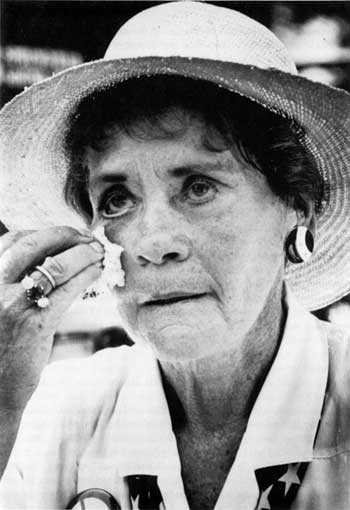
While Boasberg initiated legal proceedings, Bruce Craig brought into the fold the first national organization. Craig, who became an ardent supporter of Snyder's work after attending the 5 February rally, went back to the National Parks and Conservation Association (NPCA), where he worked as a cultural resources program coordinator, and convinced its president to make the NPCA the first national organization to oppose publicly the William Center project. Craig then convinced Ian Spatz from the National Trust for Historic Preservation to consider taking on the Manassas mall issue. From these discussions, the National Heritage Coalition formed in mid-May. Sponsored by the NPCA and the National Trust, this organization became an umbrella for Civil War, conservation, historic preservation, military, and other preservation-minded groups. The National Heritage Coalition pooled resources and helped make the Manassas mall a national issue. In the process, the coalition brought preservationists together in a way that had never been achieved in the past. [15] More people quickly enlisted in the Save the Battlefield Coalition. Jody Powell, former press secretary for President Jimmy Carter and head of a Washington public relations firm, had read the Washington Post's coverage of the mall and had told himself "this sounds outrageous." A phone call from Boasberg, whom Powell had met several months earlier, turned Powell's thoughts into action. Powell brought to the coalition his contacts with the media as well as the expertise to generate interest in the mall. Stories about the plight of the Manassas battlefield park soon rolled off the presses and onto the radio and television airwaves. [16] When the Manassas mall story went national, it centered on Annie Snyder and her Save the Battlefield Coalition. Snyder's "absolute forthrightness and ability to carry a message" made her a logical focus for the campaign. Her command of theater, including an uncanny ability to cry in public at just the right moment, inspired millions of Americans to consider the emotional side of the issue. For Snyder, the battlefield park was hallowed ground, where soldiers, many of whom were barely teenagers, lost their lives. She wanted to preserve the battlefield as a national park for all time, so that present and future generations could visit it and learn from it. Having the William Center mall so close to the parklands appeared as a real threat to the park's integrity. [17]
Snyder, as well as many prominent historians, had long believed that Stuart's Hill, site of the proposed mall, had enough historic significance to warrant inclusion in the battlefield park. Stuart's Hill had been Robert E. Lee's August 1862 headquarters, where he masterminded one of his most successful battles in the Civil War. Further research indicated that some minor skirmishing occurred on the eastern side of the William Center tract and that unmarked graves may have surrounded a field hospital used during the battle. This information added extra urgency to Snyder's opposition to the mall. Hazel/Peterson Companies hired a Civil War historian, Dr. James A. Schaefer, to conduct a historical investigation of the tract. Schaefer reported in August 1987 that no significant military actions occurred at the site, paving the way for the developer to proceed with construction. In 1988, however, Schaefer reassessed his conclusion and joined the preservationists, saying that it was ludicrous to consider Stuart's Hill as just another one of Lee's headquarters. Schaefer's reversal was prompted by the "keen sense of betrayal" he felt over the mall announcement, which had caught preservationists and the Park Service off guard. These historical opinions strengthened the conviction of Snyder and others that Stuart's Hill and the rest of the tract was hallowed ground and should have National Park Service protection. [18] Snyder's commitment to preservation of the Manassas battlefields and Stuart's Hill was joined by her wish to save the semirural area where she had lived for forty years. Her farm sat within a few hundred yards of the William Center development, close enough to hear the bulldozers and see the steady construction work. This churning of the earth, particularly around Stuart's Hill, disturbed Snyder greatly. She saw land as a resource, not a commodity. Open space, in her opinion, gave urban populations a place to recreate and commune with nature. Undeveloped land provided ecological benefits to the surrounding communities. She wanted to preserve some of these advantages before unchecked development overwhelmed all of northern Virginia. [19] Unlike many of her neighbors, Snyder did not believe that progress in and of itself was beneficial for Prince William County. She weighed the economic value of a particular development against the natural resource benefits of preserving the land. In the case of the campuslike office park Hazel/Peterson had proposed in 1986, Snyder had resisted pulling out her public relations artillery to fight the project. She did not welcome Hazel/Peterson with open arms, but she did work with the NWPWCA to obtain proffers and make the William Center as compatible as possible with the surrounding landscape. But for Snyder, all agreements were voided when Hazel/Peterson announced the addition of the regional shopping mall. The mall represented the kind of unchecked damaging growth that she had long opposed. For the sake of the battlefield park and for the sake of the rural countryside embracing the park, she resolved to fight. [20] Park Service and Interior Negotiations Aside from Mott's letter to Seefeldt, the National Park Service delayed taking a formal position on the mall issue until the end of April. As the Save the Battlefield Coalition gathered national attention, the NPS quietly reviewed the situation and determined that mall traffic through the battlefield park at the Stone House intersection represented the most serious threat to the historical integrity of the park. To accommodate the expected surge in vehicular traffic, Prince William County officials favored widening the two crossroads—Lee Highway and Route 234. This proposed widening would destroy whatever historic presence the intersection still had. The park would be effectively divided into quadrants, and interpretive efforts would suffer because visitors would be constantly crisscrossing the intersection to get to the historic park areas. The proximity of this traffic to the Stone House would also severely endanger its structural integrity. [21]
Director Mott presented this information to Secretary of the Interior Donald Hodel and asked for his assistance in reopening communication with the county and the developer. Mott rightly believed that the Park Service had to continue negotiations with the interested parties to ensure protection of the battlefield park. The NPS's active negotiations with Hazel/Peterson during the 1986 William Center rezoning had set the tone of the agency's involvement and made it difficult for the Service to stay on the sidelines with regard to the mall proposal. The neutral stance taken during the 1973 Marriott theme park proposal had been replaced by discussion and cooperation. Mott and Hodel sat down and discussed the mall situation with Prince William County representatives, Hazel/Peterson, the Virginia state highway authorities, the state historic preservation officer, congressional representatives, and the U.S. Department of Transportation. These initial meetings resulted in a compromise that Hodel and Mott announced on 28 April 1988. [22] At the April press conference, Hodel and Mott noted that the proposed widening of the Stone House intersection would destroy the historical integrity of the battlefield park. As an alternative, they described how mall traffic could be rerouted. The compromise, which they emphasized was still a general concept and not an accomplished fact, involved relocating the mall to a lower elevation, thus making it less visible from the park. Deciduous trees would help screen the development from the road, at least during the warmer months. The Park Service would provide text for Stuart's Hill interpretive displays, to be placed prominently near the buildings, to assist visitors in understanding its significance to Second Manassas. Hazel/Peterson would build two-story office buildings on the remainder of Stuart's Hill. The NPS would support efforts to route traffic out of the park, including building the Route 234 bypass, with a major interchange at the William Center tract, to accommodate north-south traffic, and widening Interstate 66, to remove east-west traffic from Lee Highway. Lee Highway and Route 234 would then be closed to through traffic and returned to gravel as they existed during the Civil War. [23] The compromise plan excluded a key interest group, the Save the Battlefield Coalition. Prince William County officials accepted the offer for further negotiations, with Seefeldt commenting that "positive suggestions" had been made. Hazel/Peterson supported the proposed plan because it kept the mall and offered a solution to the traffic problem. Park Service officials agreed that the park's historical integrity would be best preserved by closing the roads, on which the compromise focused. Snyder and the Save the Battlefield Coalition, though, were outraged that Interior and the Park Service had not asked the preservationists, who had brought national attention to the issue, to the negotiating table. This affront seemed especially curious since the compromise plan implied that Stuart's Hill was of sufficient historic significance to warrant moving the mall and placing interpretive displays on the hill. Bolstered by this indirect admission, the Save the Battlefield Coalition rallied more attention to its cause. [24] Wanting to reach an agreement acceptable to everyone, including the Save the Battlefield Coalition, the Park Service and Interior invited the involved parties to a series of task force meetings. The first conference ended with the hope that the compromise could be implemented, but subsequent meetings deteriorated as it became clear that the federal government could not force a negotiated compromise. Several factors influenced this deadlock. The Department of the Interior and the Park Service had no trump to bring the opposing parties into line. Their delay in responding to Hazel/Peterson's proposal, waiting until the SBC had attracted national attention to the mall, impaired the federal government's ability to take control of the situation. This situation worsened on 19 May when the Save the Battlefield Coalition irretrievably divorced itself from Interior's compromise plan and at a national press conference announced its continued opposition to the mall. The historical significance of the tract became a key issue, with former park historian John Hennessy arguing that Lee's planning on Stuart's Hill was critical to the outcome of Second Manassas. [25]
Other reasons contributed to the deadlock over the Park Service's compromise plan. Hazel/Peterson exercised its legal right to proceed with construction on the site, twenty-four hours a day, seemingly bypassing any agreements that may have been made in the recent meetings. Coalition supporters wondered how the developer and Interior could be committed to reaching a compromise if Hazel's construction crews continued working at the site. And although everyone, including the SBC, agreed that closing Lee Highway and Route 234 was necessary to the long-term health of the park, they also recognized the high costs involved. Hefty financial commitments by state and federal highway authorities were needed, which SBC lawyer Boasberg acknowledged publicly during the 19 May press conference, and this increased skepticism about the feasibility of the Park Service's compromise plan. Finally, members of Congress became involved, effectively removing the mall issue from the control of the Interior Department and the Park Service. [26] Congressional Involvement In mid-January 1988 Mike Andrews (D-Tex.) gladly accepted the opportunity to tour the Second Manassas battlefield with his friend, noted Civil War historian Dr. Frank Vandiver. They tramped around the Brawner Farm and discussed the pivotal actions taken by the South to win a second resounding victory at Manassas. A few days later, while flying home to Houston, Andrews read in the Washington Post that the Hazel/Peterson Companies planned to build a shopping mall on Stuart's Hill. Astounded by the incongruity of having a regional mall where Lee had had his headquarters, Andrews called his colleague Bob Mrazek (D-N.Y) and enlisted his support in stopping the mall. [27] For Andrews, the mall threatened to change forever the nature of the Manassas National Battlefield Park. With this "monstrous behemoth development next door," Andrews believed that the park's integrity would be lost. Mall traffic on the fragile park roads would be "devastating, insurmountable," and a critical part of the battlefield—Stuart's Hill—would be destroyed. The fact that the battlefield was in a congressional district other than that of Texan Andrews or New Yorker Mrazek did not stop Andrews. In his opinion, everyone in the federal government had a responsibility to ensure the protection of national parks. And Andrews did not agree with Interior Secretary Hodel that the compromise plan of closing the roads and allowing construction of the mall would preserve the historic Manassas landscape. [28] Andrews and Mrazek first tried to talk with Til Hazel to resolve the controversy. Hazel's determined response, "no one is going to stop me from building this mall," convinced them to look elsewhere for support. They established contacts with the Save the Battlefield Coalition and exercised their legislative authority within the House of Representatives. In April they inserted language into a supplemental appropriations bill for the Department of Transportation that prohibited federal funds from being used to plan, design, or construct an interchange on I-66 at the William Center. Without the vital interchange, Andrews and Mrazek reasoned, the mall would not be able to survive and thus would not be built. Then, in May, they introduced H.R. 4526, which would have authorized the federal government to purchase the entire William Center tract and incorporate it into the Manassas battlefield park. [29] But H.R. 4526 did not offer much hope of meeting the immediate threat of Hazel/Peterson's twenty-four-hour construction crews at the William Center. Before the House Subcommittee on National Parks and Public Lands would hold a hearing on the bill and thus begin the review and approval process, its chairman, Bruce Vento (D-Minn.), required that Andrews and Mrazek obtain 200 cosponsors for the bill. The two junior congressmen walked the House floor every time there was a vote and convinced members to sign on, even as Virginia's congressional representatives kept silent. The media attention generated by the SBC and the resulting flood of letters from concerned citizens across the country to their representatives helped Andrews and Mrazek in their task. In short order, they had well over the needed 200 cosponsors. [30] Despite this initial success, H.R. 4526 faced an uphill battle. Congress was scheduled to recess in August and adjourn in October for election-year campaigning, leaving little time for discussion and passage of the bill. If, miraculously, the bill was passed and signed by the president, Hazel/Peterson would retain the right to develop the tract until Congress appropriated money for its acquisition and the Park Service completed a land protection plan justifying the purchase. Previous experience suggested that ultimate federal government acquisition of the William Center tract could be five years distant. This would give Hazel/Peterson time to construct the mall, irretrievably scar the landscape, and increase the land's value, making it prohibitively expensive. [31] Frank Wolf (R-Va.) broke the Virginia congressional delegation's silence and offered a solution. For Wolf, "if this land [was] so important," as demonstrated by the national outcry and the professional opinions of historians, then "the government should have it." On 25 May, Wolf introduced H.R. 4691, which utilized a rarely used procedure called a "legislative taking" to allow the federal government to take immediate control of the property and to compensate the landowners at a later date. Legislative takings had been used in 1968 and 1978 for the Redwood National Park in California and in 1974 for the Piscataway Park in Maryland. H.R. 4691 also included $30 million for studying the feasibility of rerouting Lee Highway and Sudley Road out of the battlefield park, thereby addressing some of the concerns of the Interior Department. Hearings in Vento's subcommittee proceeded in rapid fashion on both H.R. 4526 and H.R. 4691 on 21 June. [32] Congress's response to these bills depended on its reaction to the continuing war being played out in the national media over the William Center. By the end of May, Interior Secretary Hodel had joined the fray, publishing blistering attacks against Andrews, Mrazek, and other Democrats who had indicated support for H.R. 4526. In a letter to the Houston Chronicle, Hodel accused Andrews of using the Manassas battlefield issue to gain media attention at the expense of the U.S. taxpayers, who would have to foot the estimated $70 million bill for the William Center tract. Hodel accused Andrews of playing politics, although observers noted that none of the Republican sponsors of H.R. 4526 saw similar letters published in their districts. [33] Aside from attempting to make the controversy a partisan issue, Hodel did raise two important points for Congress to consider before passing the proposed legislation. First, the cost of the William Center tract continued to escalate as Hazel/Peterson Companies proceeded with nonstop construction work. When discussions with the Interior Department and the National Park Service on the compromise plan had deteriorated, Til Hazel followed his maxim, "never give up," and pushed ahead. He decided that if Congress passed the legislative taking, he would make it an "expensive take." Congress thus had to justify the expected high price for the land. [34] Second, Hodel wondered how far national park boundaries should extend to provide adequate protection of their natural and cultural resources. Hodel felt there had to be a reasonable limit that took cost into account. This issue had been debated during the previous boundary expansion attempts at the Manassas National Battlefield Park. Historical significance had been a primary factor, along with the desire to have the park shield itself by acquiring tracts between historic areas. With the William Center land, both its historical significance with regard to Second Manassas and the effect of large-scale development on the battlefield park warranted, in the eyes of SBC supporters, federal acquisition. Mott's call for partnerships between the federal government and local interests had shown its strengths and weaknesses during the William Center controversy. When Superintendent Swain had entered into negotiations with Hazel/Peterson Companies in 1986, the resulting office park complex addressed the Park Service's most serious concerns. But these negotiations proved insufficient once the developer announced the mall. Congress had to decide if it should rely on such partnerships in the future. [35] As Hodel tried to undercut the efforts of the Democratic members of Congress with his articles in local newspapers, the Save the Battlefield Coalition organized a huge rally at the battlefield park on a steamy Saturday in mid-July. This kept the mall issue in the media as Congress recessed for the Fourth of July holiday. The coalition ensured television coverage by using a special "TV blue" backdrop for the stage, which is most compatible with television cameras, and having as many celebrities as possible participate. These efforts paid off. As one of Jody Powell's associates at Ogilvy & Mather stated, the rally was "critical because we got such incredible media." An estimated 5,000 people joined Snyder, Powell, Representative Mrazek and other members of Congress, and radio and newspaper personalities for a day of speeches and commemoration. Willard Scott, an NBC-TV weather man, spoke on the meaning of the Manassas National Battlefield Park to him, a resident of Virginia and a Civil War enthusiast. Scott had long been interested in the outcome of the William Center controversy, aiding publicity by televising one of his weather broadcasts from the park during the controversy's early stages. [36]
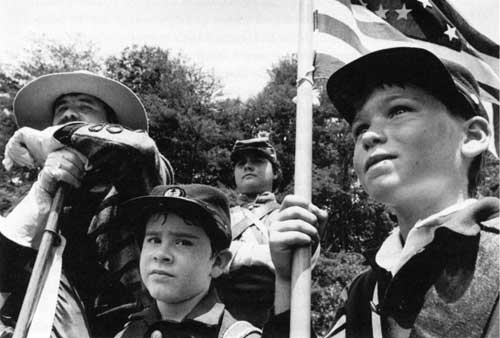
Celebrities helped draw media attention, but the incongruity of having a shopping mall—that bastion of twentieth-century materialism—next to the battlefield park drew ordinary people. They traveled from as far away as Ohio, California, and even Puerto Rico to sport buttons reading "Stonewall the Mall, Save Manassas" and participate in the protest. Civil War reenactors, braving the 104-degree heat in their heavy woolen uniforms, gave demonstrations for the crowd. Participants joined the SBC in a rendition of the organization's theme song, "Manassas There's No Need for You to Die, performed by the artists who had recorded it, Dusty Rose and Tom Lofgren. Written by David Lowe and released to area radio stations in May, this song created an emotional appeal that drew people together. Its last stanza, sung against the backdrop of a Civil War fife and drum, encapsulated the issue for many:
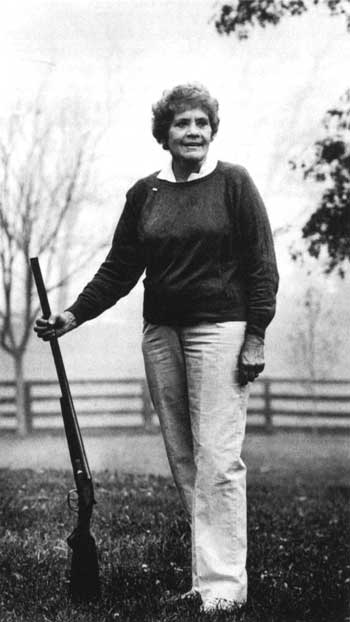
The bluntness of the image of a shopping mall standing where a Civil War soldier had fallen personalized the struggle and contributed to the rally's success. [37] This overwhelming support for saving the battlefield, along with the potential for political exploitation, drew an immediate response from one of Virginia's silent congressional leaders. Sen. John Warner had first declined an invitation to participate in the rally, but as the date neared and the publicity increased, he realized the political value of attending. He still did not intend to address the audience, but a lengthy conversation with Willard Scott changed Warner's mind. Responding to the crowd's enthusiasm, Warner promised to introduce legislation to preserve a portion of the William Center tract from development. When Congress reconvened in September, he laid out his plan: federal purchase of 136 acres, or one-quarter of the land, using a legislative taking; mall construction banned on the rest of the tract; $11.9 million to build an interchange on Interstate 66 for the Route 234 bypass; and a study of new roads needed to replace Lee Highway and Sudley Road, should they be closed to through traffic in the battlefield park. Warner later scaled back the amount of land to 80 acres by eliminating some of the buffer along Lee Highway and thereby reducing the estimated cost of his proposal. In the Senate subcommittee hearing Warner argued that his plan protected the most historic areas of the tract, allowed the developer to build the office park as originally proposed, addressed the Park Service's concerns about traffic through the battlefield park, and saved the taxpayers the high cost of buying the entire tract. [38] Some preservationists see Warner's announcement at the July rally as turning the tide toward acquisition. Having the senior member of the Virginia congressional delegation—and a Republican—admit that Stuart's Hill should be federal land strengthened the cause against the mall. In remarkably speedy fashion, in August before its recess, the House voted overwhelmingly for Andrews's and Mrazek's H.R. 4526, which had been amended to include Wolf's language of a legislative taking and the $30 million road study. The highly publicized rally and Warner's presence in the debate certainly influenced the outcome of this vote. [39] Legislative Taking The legislative taking gained momentum in the early fall: Sen. Dale Bumpers (D-Ark.), chairman of the Senate Subcommittee on Public Lands, National Parks and Forests, devoted his subcommittee's work to the mall controversy. Bumpers toured many western national parks during the summer recess. Amidst the magnificent scenery, he found several disturbing things. Condominiums and shopping centers abutted the Rocky Mountain National Park, threatening winter range critical to the park's wildlife populations. The Church Universal and Triumphant planned to develop lands adjoining Yellowstone National Park for their geothermal potential, possibly disturbing the most significant natural geyser basin in the world. Although, Bumpers admitted, Congress could not stop all these threats to the national parks, some land could be saved. [40] One piece of land that Bumpers could preserve was the William Center tract. He brought the House's legislative taking bill and Warner's compromise plan before his committee members. He set the tone of the hearing by flatly stating his support for the taking bill, later calling Warner's compromise a "fig leaf" offering. Bumpers had been reading James M. McPherson's Pulitzer Prize-winning account of the Civil War, Battle Cry of Freedom, and had talked with historic preservationists about the significance of the William Center land. He had also talked with Hazel/Peterson and Prince William County representatives, to gain an understanding of their reasons for allowing the mall to proceed. What he saw in the western national parks, though, confirmed that he had to take action before development made it impossible to act. The example at Gettysburg, where the battlefield park was surrounded by tacky commercial development, further prompted him to act. [41] Determining how to act became the issue at the 8 September subcommittee hearing. Interior Secretary Hodel reiterated his position that the most serious threat to the battlefield park came from the traffic problems on Lee Highway and Route 234, a situation the legislative taking proposal did not directly address. If Congress took the William Center land, traffic might temporarily be abated, but only until another development went in down the road. The estimated $70-million price tag for the William Center would be better spent, in Hodel's opinion, by redirecting traffic out of the park and converting the park roads to their historic nonpaved appearance. Hodel so strongly believed that the legislative taking was the incorrect action that he stated he would recommend a presidential veto it if it did pass the Congress. [42] Other people testified at the September hearing in support of Interior's compromise plan, which allowed mall construction and offered the Route 234 bypass as a solution to expected traffic increases through the park. Kathleen Seefeldt reminded Congress of the gravel trucks that barrel down the park roads and disturb places set aside for quiet reflection, such as the New York monuments located along Lee Highway. Congress could best protect the battlefield from such invasive noise, Seefeldt argued, by providing funding to build the Route 234 bypass. Seefeldt also noted that the county's growing population required the type of commercial development the William Center would offer. The tax revenues, estimated at $23 million a year, would allow the county to provide education, health, and other services to residents. Til Hazel reiterated the tax benefits of his development. No-growth residents who opposed the mall, he argued, had "thwarted all planning and growth and all effective development" in the county for twenty-five years, leaving the county without sufficient funding to support its burgeoning population. The William Center was a "quality project, [that would] serve Prince William and make a little money on the way." He saw Interior's plan as a "win-win" solution that Congress should support. [43] Further testimony revealed significant flaws in Interior's plan. James M. McPherson, Edwards Professor of American History at Princeton University, made the unequivocal statement that "the very fate of the nation" was at stake at Second Manassas. In his opinion, the William Center tract had "the same kind of historical significance as Seminary Ridge does at Gettysburg." Lee and his generals James Longstreet and J. E. B. Stuart had their headquarters on the William Center land. Forty thousand Confederate and Union troops had congregated on the tract over the course of the three days of the battle. Some skirmishes resulted. Two Confederate field hospitals had stood on this land, and "probably hundreds of Confederate and some Union soldiers [were] buried on this property." McPherson stated that there was no evidence that these bodies had ever been reinterred. [44] McPherson's testimony demonstrated that Interior's compromise plan was untenable because the historical significance of the William Center property warranted its protection. And there were other problems with the plan. William Leighty, the deputy secretary of transportation for Virginia, noted that the state had designated money in its six-year plan for design work on the 234 bypass, but not construction. This meant at least a six-year delay before the road work could begin. When questioned on the amount needed to build the bypass and widen I-66, Leighty stated that the cost would exceed $100 million. As the entire construction fund for all of northern Virginia was only $78 million, the state would require substantial federal assistance to complete the road program proposed by the Interior Department, but the compromise plan contained no specific provisions for financing road construction. In addition, the plan did not require that the mall's opening coincide with the road closures, thereby assuring the park's protection from mall traffic. Combined with McPherson's testimony, this information gave subcommittee members considerable reason to doubt the merits of Interior's compromise plan. [45] The death knell of the compromise plan was the petition urging a halt to mall construction signed by 75,000 people from across the nation, which Annie Snyder presented to Congress. The Save the Battlefield Coalition had collected these signatures in only seven months, whereas during the boundary expansion debate in the 1970s, it took four years to obtain 9,000 signatures. The Coalition's efforts against the William Center property had effectively reached a broad segment of the country in a remarkably short period of time. A local zoning question had been transformed into a national issue. The senators responded and voted in favor of the legislative taking, both in the subcommittee and the full Energy and Natural Resources Committee. Warner's compromise proposal to buy only a portion of the tract and prohibit mall construction was seen as insufficient for protecting the historically significant land included in the William Center. [46] On 7 October 1988, in the waning hours of the 100th Congress, Bumpers engaged in a debate on the legislative taking bill with James A. McClure (R-Idaho). Senators settled into their chairs after dinner as Bumpers began, with accompanying maps and charts, a decidedly Southern history lesson on the Civil War and Second Manassas. His "absolutely rhapsodic" retelling of the importance of a Southern win at Manassas captured the Senate's attention. In August 1862 General Lee thought the Confederacy's future rested on a victory at Manassas, as Britain and France had indicated that a decisive victory might lead them to provide much-needed industrial support to the South. Bumpers emphasized this fact to his spellbound audience. National Parks and Conservation Association representative Bruce Craig, who viewed the proceeding, stated that "it was one of the most amazing things where the floor of the Senate actually became a place for education and debate." Many senators made up their minds on this issue based on what they learned from Bumpers and McClure that night. [47] McClure, intending to defuse his opponent's argument with hard realities, instead added fuel to Bumpers's fire. The conservative Republican reminded his colleagues that "there is not a single battlefield free" from the pressures of development. One-hundred-foot microwave towers threatened Bolivar Heights and Antietam. Richmond, Virginia, was inching its way over the Civil War battlefield of Cold Harbor. At what point, asked McClure, will this battle over land end? McClure concluded with the observation that "perhaps the most significant battle of the entire Manassas Battlefield with respect to the William Center tract is that being fought now"—not the Civil War battles. And so McClure unknowingly summed up the position taken by mall opponents: the William Center property required federal protection because it represented one of the few places Congress could save from the seemingly relentless attack of development. The senators voted 50 to 25 for the legislative taking. [48] Victory in the Senate did not ensure success of the legislative taking. To avoid a certain presidential veto, the chairman of the House Ways and Means Committee, who was a friend of Mike Andrews, attached the taking legislation to the Tax Technical Corrections Bill. But negotiations between House and Senate conferees on the tax portion of this bill broke down just before Congress adjourned, without much hope of finding a compromise. On 21 October headlines announced what seemed to be the certain failure of the legislative taking. Then, at 1:00 A.M. the next day, the bill passed. On 2 November it reached the White House. On 10 November President Ronald Reagan signed the bill into law, without fanfare or comment. At that very moment, the 558-acre William Center tract became part of the Manassas National Battlefield Park. [49] Congress proved to be the essential factor in halting the mall and acquiring the William Center tract. Without congressional action, Til Hazel would have proceeded with his development. Prince William County officials offered no resistance to the mall proposal, affirming its legality. The Save the Battlefield's media campaign only made Hazel more determined to continue building, as evidenced by the twenty-four-hour, seven-days-a-week construction schedule that resulted in the near completion of three model homes. Public outcry was important in convincing individual members of Congress to support Andrews, Mrazek, Bumpers, Wolf, and Vento with the legislative taking. But all the media coverage and letters to Congress would not have stopped Hazel/Peterson if these members of Congress had not been convinced of the intrinsic importance of saving Stuart's Hill and the surrounding land from the impending development. Their commitment to preserving the William Center tract made the taking possible. [50] Was It Worth It? Two days after Reagan signed the tax bill and its legislative taking into law, Annie Snyder and one hundred devoted followers joined in a victory gathering of prayer and song on the William Center land. Since the beginning of the long fight, Hazel/Peterson's burly guards had blocked their entrance to the tract. As Bruce Craig remembered later, it was "very much an emotional feeling" finally to step on the land they had worked so long to save. A small plane flying overhead tried to break the solemnity of the event with its banner "The taking of private land is un-American." The image of the mall protesters and the plane highlights the mixed lessons from the incorporation of the William Center tract into the Manassas battlefield park. [51] The National Park Service gained a great deal from the legislative taking. First and foremost, it obtained control of a 558-acre tract of land its historians, beginning in the 1930s, had identified as having sufficient historical significance for inclusion in the battlefield park. Second, the Park Service learned the importance of working with outside jurisdictions to protect its lands. Rolland Swain's discussions with Hazel/Peterson in 1986 resulted in numerous concessions by the developer for the battlefield park.
The Park Service also learned a hard lesson. It needed to act quickly in response to the mall proposal and to include all parties in discussions: the county, the developer, the preservationists, members of Congress, and relevant state and federal officials. By excluding the Save the Battlefield Coalition, which had created a national communications network and support system, NPS and Interior forced the preservationists to defend their position without compromise. The taking became the only viable option. [52] For Swain and Susan Moore, who were on the front lines throughout, other lessons became apparent. They needed a way to use basic data effectively in analyzing the impact of development on the park. Swain took photographs of red helium-filled balloons to show how the building might be seen by park visitors. This method, the only one available in the Park Service at the time, was ineffective for convincing the county zoning board to impose height restrictions on developments. The newly emergent technology of the Geographic Information System (GIS), a system that uses computer imaging to show how a construction project would appear from different areas, makes a much more compelling argument for restrictions. Since 1988 GIS has become a staple tool for Park Service employees, although demand has often overwhelmed its availability. [53] Swain and Moore also learned the importance of having good zoning lawyers amid technical advice available to the Park Service. During the 1986 rezoning process, they could have used zoning law assistance to understand exactly what a planned mixed-use district allowed. This information would have helped them make informed assessments on potential development next to the park. When in negotiations with Hazel/Peterson before the mall announcement, Swain and Moore also could have used legal expertise to review the proffers and ensure the park's concerns had been addressed. A zoning lawyer could have pointed out that the PMD retail component might include a mall, thus enabling the Park Service to anticipate the development. [54] Finally, the Park Service learned the importance of taking the lead when confronting difficult issues. Long-range strategic planning following the Marriott controversy would have enabled the NPS to consider the impact of possible future developments and prepare a response before the situation became unmanageable. The lack of a proactive stance made a later controversy inevitable. When confronted with this type of situation, NPS continued its reactive position, with damaging consequences. Aside from a letter to Kathleen Seefeldt of the Prince William Board of County Supervisors, the Park Service remained silent until late April when Mott and Hodel presented their compromise plan. During this period, the Save the Battlefield Coalition established a nationwide media campaign and became, in effect, the voice of the Manassas National Battlefield Park. Interior's compromise plan contradicted what Snyder and her supporters believed about the mall—that the mall would destroy the historic integrity of the battlefield park—and left the public, educated by the SBC's media blitz, uncertain of the Park Service's ability to protect the land. Interior reinforced this perception by negotiating with the developer and the county, not the preservationists. [55] The $134 million that the federal government has paid for the William Center tract has left some observers wondering if the Park Service gained anything from the legislative taking. This amount, almost twice what was originally predicted, reflects the agreed upon value of improvements Hazel/Peterson made. Til Hazel later commented that for that same sum, the roads at the Stone House intersection could have been closed to traffic. Instead, the park has another piece of land, but the road situation continues to worsen. The federal government, however, would never have allocated such a sum for the battlefield park, for any project. The legislative taking required adequate compensation for the taken land, and Hazel set that price with his nonstop building. Superintendent Swain questioned the appropriateness of the legislative taking, especially considering its cost, because understanding Second Manassas does not require having that land, in his opinion. Betty Duley, a local resident, also noted that the Park Service had money to obtain more land but lacked the resources to care for its existing property, pointing to the rundown buildings and the lack of adequate patrols around the park. Duley and others believed that the NPS should have focused on capital improvements, not acquiring more land. [56] Others consider the money well spent and in accordance with the park's mission. Craig noted that every year Congress designates a considerable sum, reaching well into the hundreds of millions of dollars, for the Land and Water Conservation Fund, an account designated specifically for land purchases. Since the early years of the Reagan administration, only a small portion of this fund is spent to acquire parklands; most is left to accumulate, in effect to offset a portion of the country's budget deficit. If Congress used the fund to its full potential, Craig believed, expensive takings like the William Center property could be avoided. For Craig, Snyder, Powell, Bumpers, and other preservationists, owning the site from which Lee staged one of the most impressive Confederate victories justified the expense and accorded with the battlefield park's mission. [57] Prince William County officials believed they lost a great deal with the legislative taking. The anticipated jobs evaporated, the estimated $23 million in annual tax revenues was gone, and the promise of increased investment that would have spun off from the William Center was lost. The tract, designated in the county plan for economic development and thus tax generation, was removed from the tax rolls. With the county's growing population demanding more services, the legislative taking presented a host of economic issues for county officials. [58] The events leading to the acquisition of the William Center property profoundly influenced historic preservation in the United States. The mall announcement resulted in a highly publicized coalition of preservation groups: conservationists, Civil War enthusiasts, and historic preservationists joined hands. They created a united front, under the Save the Battlefield Coalition and the National Heritage Coalition, which proved unbeatable. Each organization involved in the fight benefited from the heightened visibility and increased membership. Some observers even thought that the national organizations gained more from the exposure than they contributed to the SBC in its particular fight against Hazel/Peterson. [59] The mall controversy and the expense of the legislative taking made clear to historic preservationists that they had to find alternative means for saving significant lands from development. This realization led to two related efforts: the introduction of the Heritage Preservation Conservation Act legislation and the establishment of Civil War battlefield preservation organizations both within the federal government and in the private sector. The example of the William Center controversy prompted Bruce Craig of the NPCA and Ian Spatz of the National Trust for Historic Preservation to draft the Heritage Preservation Conservation Act as a vehicle for addressing any future land-use conflicts adjacent to national parklands. Although it was never passed, the act would have established an overlay district adjoining a park where development would be restricted and would have provided other safeguards, such as authorizing the federal government to stop a construction project for a period of days while parties tried to negotiate a solution. If the government determined the land should be acquired, money would come from a special emergency fund. [60] Other successful preservation efforts have been directed toward saving unprotected Civil War battlefield sites. In June 1987, about thirty interested individuals met in Fredericksburg, Virginia, to assess the events at the Manassas battlefield and at the Chantilly battlefield, a site in Fairfax County under immediate threat from development. They realized that a private-sector organization specializing in Civil War preservation needed to act in tandem with the government to save threatened areas. In July they formed the Association for the Preservation of Civil War Sites (APCWS). As the Manassas story played out in 1988, APCWS members, including A. Wilson Greene, a Park Service historian who eventually left his job to serve as APCWS's executive director and later president, grew more convinced that the sort of "eleventh-hour-and-fifty-ninth-minute rescue operation, at a cost that is so astronomical, is simply not a blueprint" for battlefield preservation. [61] The APCWS developed an alternative. It conducted numerous surveys to identify the core historic areas of battlefields across the country and then assessed each parcel within the core area for its integrity and the level of threat from outside development. From these surveys, the APCWS established a set of priorities to determine which lands to buy. Using funds raised through private sources, the APCWS purchases tracts and holds them in a land trust until the federal government can accept them. In this way, battlefields are preserved before development overwhelms them and before prices make the land prohibitively expensive. Efforts by the APCWS have been augmented by the Civil War Trust, established by Congress at the behest of Secretary of the Interior Manuel Lujan Jr. to work toward preservation, and Jerry Russell, founder of the Civil War Round Table Associates, who has publicized the need to save battlefields in his monthly newsletter. [62] Congress responded to the lessons of the William Center controversy and established a fifteen-member Civil War Sites Advisory Commission in November 1990. Secretary of the Interior Lujan, Hodel's successor, proposed such a commission at the July 1990 ceremonies for the 129th anniversary of First Manassas. The commission, which included Civil War historians, individuals experienced in preservation and land-use issues, members of Congress, and the National Park Service director, set out to identify historically significant Civil War sites and determine their relative importance. Individual sites were assessed for their existing condition and the threat of impending development. Based on this information, the commission recommended alternatives for preserving and interpreting the sites in its 1993 report, which detailed the status of every significant Civil War battlefield site and proposed cooperation between the public and private sectors to save the highest priority areas before they are lost. Despite early efforts by Lujan to raise money for implementing these recommendations, action has not been taken. [63] There have been some gains for historic preservation as a result of the William Center controversy, but at a cost. By adamantly opposing any compromise that would have preserved part of the tract and allowed development on the rest, preservationists appeared unwilling to negotiate. Jody Powell later remarked that preservationists must find a reasonable balance between saving aspects of American history and allowing economic opportunity. If they say "no, no, no" all the time, the public will be unwilling to listen to their concerns and they will lose their overall effectiveness in preserving lands. Til Hazel believes preservationists have already bankrupted their credibility: any piece of property for which they can devise historical allegations for saving has become fair game for their efforts. Hazel agrees that some places, such as George Washington's home at Mount Vernon, warrant protection, but price and relative historical significance, according to Hazel, should determine what other areas deserve preservation. [64] The National Park Service did not have long to assimilate what it had learned from then William Center controversy before an even larger issue developed. In November 1993 the Walt Disney Company announced its intention to build a historical theme park in Haymarket, Virginia, 3.5 miles from the battlefield park. The resulting battle highlighted the shift in concerns facing Manassas National Battlefield Park. During its first thirty years, the park had to contend with development threats on land the Park Service wanted to acquire. Beginning with the 1973 Marriott theme park proposal and ending with the William Center, the NPS had to determine its response to development immediately outside park boundaries on land of some historical significance. In the 1990s the Park Service had to shift its attention to land that did not adjoin the park but could be developed in a way that would detrimentally affect the battlefield park. The Service entered a new area of defining the significance of resources, recognizing that historic resources could not be protected solely by extending park boundaries. |
|
| ||
| <<< PREVIOUS | CONTENTS | NEXT >>> |
|
Battling for Manassas ©1998, Pennsylvania State University Press adhi/chap10.htm — 01-Apr-2001 | ||