|
Manassas National Battlefield Park Chapter 11: More Battles |

|
|
Chapter 11
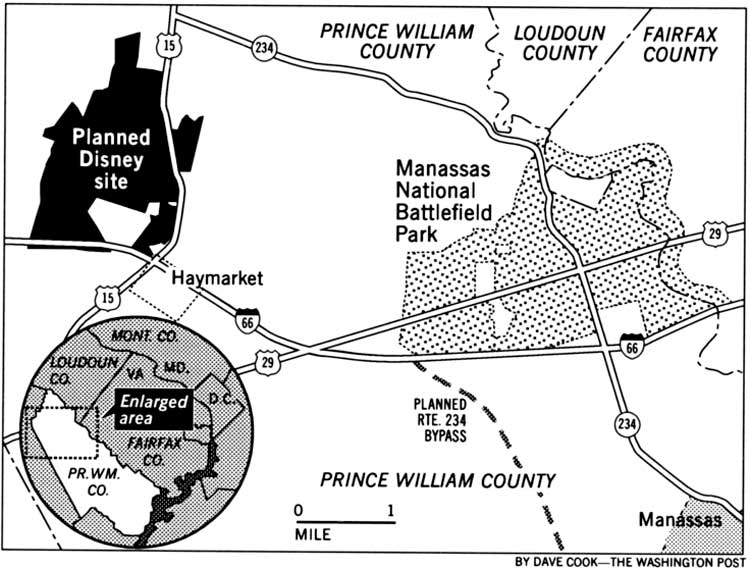
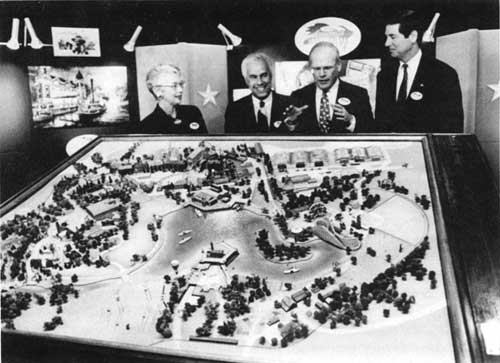
MORE BATTLES The Horse and the Mouse The Virginia piedmont region "has soaked up more of the blood, sweat and tears,...has bred more founding fathers, inspired more soaring hopes and ideals and witnessed more triumphs and failures, victories and lost causes" than any other piece of the nation's landscape, wrote Yale University historian C. Vann Woodward. "If such a past can render a soil 'sacred,' this sliver is the perfect venue." These words, written in response to the Walt Disney Company's 1993 proposal to build a history theme park 3.5 miles from the Manassas National Battlefield Park, helped give a national perspective to a local land-use battle. [1] The proposed site for the Disney theme park lacked historic significance and its lands had never been identified for acquisition in Manassas battlefield park. But Disney's America, as it would have been called, represented a very real threat to places like the battlefield park. Urban sprawl with its encroaching residential developments, office complexes, retail centers, and service facilities have been slowly advancing on rural areas. In most cases, its appearance attracts little notice beyond local preservationists and park officials who want to minimize visual and environmental disruption. The battles are usually fought in local zoning board meetings. The Disney proposal brought the urban sprawl issue to national attention and helped educate Americans about its effects. Horses The Park Service had another issue to resolve before it became embroiled in the Disney controversy: its decision to augment the horse program at the battlefield park. Examination of the history of horse use at the Manassas National Battlefield Park demonstrates how a seemingly innocuous recreational activity evolved into a national debate that questioned the Park Service's commitment to preserve and protect its natural and historical resources. Park neighbors had enjoyed riding their horses throughout the battlefield since the park was established in 1940. Eventually some organized events developed. Francis Wilshin had allowed fox hunts in the park when he was superintendent, a concession to the politically powerful people living nearby. When horseback riding began to overwhelm the historic areas, Wilshin's successor, Russell Berry, put in trails, which controlled but did not eliminate this activity. [2] At some point in the early 1970s regional office representatives decided that horses may serve a worthwhile official function at the park, in addition to recreation for the public. Horses broken in at the George Washington Birthplace National Monument, also located in Virginia, could be trained for Park Service work at Manassas. From Manassas, the horses were assigned to other areas. [3] Over time, Manassas kept three horses for park protection purposes. Carl Hanson, park ranger under Berry and eventual chief of law enforcement, considered the horses a useful tool for patrolling the park. On horseback, park officials could cover short distances quickly and had a visible presence. In addition, horses provided good public relations because most people like horses. The horses stayed at Sutton Farm, located inside the park boundaries, near the Stone Bridge and north of Lee Highway. Outbuildings suitable for keeping horses had been built by the previous owners. [4] The horses attracted little public attention until 1986 when National Capital Regional Director Manus J. (Jack) Fish decided to expand the NPS horse program. Fish chose Manassas because he saw a need to enhance equestrian use in the National Capital Region, and Manassas, as part of the region, provided a suitable setting for the program. Originally, Fish wanted to renovate a dairy barn located on the Wheeler tract, a large parcel in the park's southeast corner acquired by the federal government in 1985, to house horses donated to the United States Park Police and train park rangers and individuals in the Volunteers-in-the-Parks program. Marion C. Wheeler donated $50,000 toward the renovation in memory of her husband, William H. Wheeler. By 1987 the renovation had evolved into the proposal to tear down the aging dairy barn and replace it with a fourteen-stall horse barn with an office, tack room, classroom, and showering facilities. This horse remount facility would cost an estimated $120,000. Fish assigned retired U.S. Park policeman Denis Ayres, a noted horseman, to lead the augmented program at Manassas. [5] John Hennessy, who had served as a temporary park historian at Manassas from 1981 to 1985, led preservationists in an attempt to block construction of the horse remount facility. Hennessy argued that the land identifled for the horse facility was historically significant ground that warranted restoration, not development. Hennessy uncovered this new information while doing research on the Second Manassas troop movement maps for the park. Archaeological excavations completed after Hennessy left the Park Service revealed more evidence at Portici, located adjacent to the proposed remount facility site. The combination of these two finds convinced Hennessy that construction on the Wheeler tract would jeopardize the historical integrity of the area. Bruce Craig and the National Parks and Conservation Association joined Hennessy in trying to stop the project. [6] Hennessy also wondered the effect such a project would have on the Park Service's credibility as an agency dedicated to the protection of historical and natural resources. If it developed historically significant lands within the park boundaries, the Park Service might appear less credible in its objection to intrusive construction outside the park. The William Center complex was only the most recent and most visible indication of continuing pressures to build along the park's borders. In light of the horse remount program, Hennessy believed that "no one will listen" when the Park Service voiced opposition to this and future outside developments. [7] In late January 1988 Til Hazel announced plans to add a regional shopping mall to the William Center tract. As the Park Service expressed its concerns over the effects of the mall on the battlefield park, Ed Bearss, NPS chief historian, and Jerry Rogers, cultural resources director, among others, recognized that the NPS held a precarious position. Historical information brought to light by Hennessy made clear that construction of the horse remount facility would constitute an impact on the park. By pursuing construction on the battlefield while opposing development outside, the Park Service opened itself up to a potential public relations disaster. Interior officials, including Assistant Secretary for Fish and Wildlife and Parks Brian Horn and Deputy Assistant Susan Reece, a horse enthusiast, disagreed with this assessment and tried to pressure NPS Director Mott into continuing the remount program. They argued that the horse program and the William Center project were separate issues requiring separate analysis and action. Mott took Bearss's position and in March 1988 decided to delay construction of the stable pending further review of the historical evidence. The mounting cost of the new horse facility, which grew to as much as four times the Wheeler donation, helped Mott make his decision. The financially strapped National Park Service would have had to use money from interpretation and other programs to build the horse stable, leaving the agency open to further criticism. Ending the discussion of a horse remount facility on the Wheeler tract, the Service returned Mrs. Wheeler's $50,000 donation. [8] Ayres, who had been reassigned to the Manassas battlefield, stayed to manage the existing horse program at the Sutton tract, which had increased to about sixteen horses. Considered one of the best horsemen in the country, Ayres attracted attention within the Washington horse community. Many people used the park's volunteer patrol program to receive expert advice from him. The volunteer program allowed citizens to ride government horses or their own mounts through the park as they patrolled the trails. [9] One family ostensibly in the volunteer program attracted considerable attention beginning in the spring of 1989. Vice President Dan Quayle, wife Marilyn, and their children began making regular visits to the Manassas battlefield park to ride the government horses. This visible presence at the park soon prompted the Secret Service to request that Park Service Director James M. Ridenour, Mott's successor, consent to the construction of six to nine additional stalls at the Sutton Farm to house Secret Service mounts used for the Quayle visits. The mounts would not be used specifically to strengthen the park's law enforcement needs. Opposition to this plan grew after the 1990 Columbus Day weekend when the federal government closed the battlefield park and all other nonessential federal government sites for lack of an approved budget. During this lockout, the Quayle family went riding in the Manassas battlefield, accompanied by three park employees. Newspapers did not mince words over the implications of this ride, calling the national battlefield a "private playground" for the Second Family. Repeated questions surfaced over the apparent use of limited park funds for the singular recreational activities of an already unpopular vice president and other influential individuals. It was becoming clear to observers that the original horse program, which had aided in park law enforcement and protection, had been overwhelmed by recreational use. [10] After a year's debate in the media, Sen. Dale Bumpers, chairman of the Senate subcommittee on national parks, led Congress in defeating the Sutton Farm stable expansion proposal. Congress amended the National Park Service budget to prohibit funding for the stables for fiscal year 1992. Just before the change of administration from George Bush to Bill Clinton in 1993 and after a new fiscal year had started, outgoing Interior Secretary Lujan, who rode at Manassas, ordered the immediate construction of the stables. This work continued until February 1993 when the newly appointed Secretary of the Interior, Bruce Babbitt, called for its immediate halt. The Park Service then conducted a review of the battlefield park's horse program, including the number of horses, volunteer program, and stable addition. In the meantime, the number of horses was reduced to three, and Ayres stayed at the park to manage them. On 1 March 1995, NPS Director Roger G. Kennedy informed Senator Bumpers that the Service had decided to continue the present level of operation, having a three-horse equestrian program devoted to park protection and law enforcement uses. Recreational riding of park-owned horses would be eliminated, and requests from agencies for assistance in equestrian training would be referred to the U.S. Park Police. This controversy demonstrated that uses acceptable to the public, such as horseback riding in the parks, had narrow limits, which would be challenged. The crisis also made clear that development projects within national park sites, though seen by some federal officials as consistent with the park's preservation mission, would meet with scrutiny from outside observers. Preservation and use was a dynamic duo. [11] Disney's America Questions about acceptable uses of park resources, as the horse program highlighted, continued to deserve attention, but concerns over outside development became more pressing: the issue of historic preservation and use extended beyond the park's borders. In the case of the William Center controversy, the belief in the historical significance of the land, the site of General Lee's headquarters, was enough to halt construction. The federal government purchased the land and placed it under the protection of the National Park Service. Future threats would involve development away from the battlefield's historic lands but close enough to cause traffic and other problems for the national park. In these cases, the federal government had no historical reason to acquire more land. Instead, negotiation and education must promote the best interests of the park. In November 1993 the Walt Disney Company surprised northern Virginians with the announcement of its intention to build a historic theme park called Disney's America in Haymarket, Virginia, 3.5 miles from the Manassas battlefield. Disney executives had been working in extreme secrecy for a few years searching for a new theme park location with a regional market that would not "cannibalize" visitation at either California's Disneyland or Florida's Walt Disney World. The Washington, D.C., area, with its estimated 19 million tourists annually proved attractive. Disney officials narrowed their search to Virginia, which they considered more probusiness than the neighboring state of Maryland, and the Route 66 corridor, which was an important transportation link to the rest of the metropolitan area. When a 2,300-acre site in rural western Prince William County became available, Disney was able to place an option on a single sizable piece of land. This tract became the centerpiece of what would eventually become a 3,000-acre proposed development. [12]
After they had identified the location for the theme park venture, Disney representatives explored the full ramifications of settling near the nation's capital. Peter Rummell had extensive experience in resort development in Hilton Head Island, South Carolina, and in other areas of the Southeast before he joined the Walt Disney Company in 1985 and turned its seven person Disney Development Company into the multifaceted Disney Design and Development, which included Walt Disney Imagineering. As president of this new subsidiary, Rummell oversaw the creative and development aspects of the new theme park. As he later recounted, the lure of the Washington market had brought Disney to northern Virginia, but once there, "the creative juices started to flow and all of a sudden we realized that there was, we thought, a really interesting opportunity to deal with the story of America." Vignettes of American history became the brush with which to paint, the common thread that would organize the visitor's experience at the proposed theme park. [13] Disney emphasized the nation's Civil War heritage for its latest venture. As Disney's America was initially conceived, visitors would enter through a re-created Civil War-era village and then ride steam trains to explore nine areas inspired by events in American history, including a Civil War fort portraying the daily experiences of soldiers. Battle reenactments on land would be accompanied at night by a restaging of the naval showdown between the ironclads the Monitor and the Merrimac on a manmade lake called Freedom Bay. In an effort to combine education and entertainment, Disney officials hoped to include "painful, disturbing and agonizing" exhibits on slavery and re-create a piece of the underground railroad through which park visitors would escape. The goal, as Rummell later clarified, was to be "entertaining in the sense that it would leave you with something that you could mull over." [14] The rest of the park was designed around other themes from America's past. Native American life would be highlighted through the presentation of re-created Indian villages and authentic works of art. A Lewis and Clark raft trip would give park goers an opportunity to experience western exploration. "President's Square" would focus on the War for Independence and the ideas of the Founding Fathers. In "We the People," a reproduction of the port of Ellis Island and an offering of a variety of ethnic foods and music would remind visitors of America's immigrant heritage. A tribute to American ingenuity would include examples of inventions and a high-speed roller coaster ride through a turn-of-the-century mill, simulating an escape from a fiery vat of molten steel. The "Family Farm" area would pay tribute to the nation's farms with barn dances and cow milkings, and the "State Fair" section would look at the Depression era and have a sixty-foot Ferris wheel, a wooden roller coaster, and an exhibit paying homage to baseball. The military theme of the Civil War entrance would be continued with "Victory Field," which would use virtual reality technology to give park visitors the opportunity to experience both flying in and parachuting from a World War II-era plane. [15] The history theme park would be only part of the development Disney officials envisioned at the Haymarket location. Having such a large tract of land encouraged Rummell and his coworkers to explore further developments to complement the theme park. They considered adding resort hotels with 1,340 guest rooms, an RV park with 300 campsites, a twenty-seven-hole public golf course, and a commercial complex consisting of 1.3 million square feet of retail and 630,000 square feet of office/business space. Rummell expected to sell part of the land—enough for up to 2,300 houses—to a residential developer. Disney planned to donate land for schools and a library, while up to 40 percent of the site would remain green space, acting as a buffer between the recreational core area and outside developments. [16] Virginia state and county representatives welcomed the Disney proposal, heedful of the attractive fiscal benefits it promised. Governor-elect George Allen unabashedly proclaimed his administration would "kick down any hurdles" Disney encountered on its way toward getting full legal authority to build the theme park and its supporting facilities. Allen believed that the projected $1.18 billion of revenues the state would receive over the next thirty years was well worth the initial investment of taxpayer monies into expanding roadways, building an interstate interchange, and providing adequate sewage and water hookups. Prince William County Executive James Mullen agreed with Allen, stating that there were "no obstacles that cannot be overcome." The anticipated $680 million in tax revenues for the county over the next thirty years and the projected 2,700 new jobs were enough to gain many allies in the county legislature. [17] Landing just this sort of economic windfall had been a driving force in Prince William County long-range planning for years. The 1980s had taken a financial toll on the county, leaving it with a 50 percent increase in population but without an equivalent growth in business to offset steadily rising property taxes. The loss of the William Center land to the federal government added to the problem. To address the need for more and better schools and county administrative services, the legislature adopted in 1990 an ambitious goal of luring 14,000 new jobs and $1 billion in nonresidential growth to Prince William County by 1997. The county advertised its pro-business stance nationwide, and the electorate backed up this marketing effort by approving bonds to finance major infrastructure improvements. The way Prince William officials courted business, including the Danish firm Lego, which considered building a theme park in the county, drew the attention of Disney representatives and played a role in their decision to choose Prince William County for Disney's America. As Kathleen Seefeldt, chairman of the board of county supervisors, stated when learning of the Disney proposal, "economic development, is the number one goal" for the county, and the Disney project promises to "exceed all reasonable expectations for economic development" in the near future. [18]
This seemingly single-focused economic-mindedness worried many individuals living in the rural areas surrounding the proposed Disney site. A curious mix of middle-class families and wealthy landowners, whose ranks included such powerful voices as the owners of the Washington Post and Hollywood actor Robert Duvall, they were attracted to the quiet and privacy of this horse country in western Prince William and adjacent Fauquier and Loudoun counties and relished the quaint two-lane roads and abundance of open space. "Lousy commutes" into Washington every workday on the heavily traveled but sorely inadequate I-66 highway were tolerable because these people valued a home in the country. Over the years, the wealthier residents had been active in preserving "the traditional character and visual order" of the horse country by organizing as the Piedmont Environmental Council and buying permanent easements over 77,000 acres of open space to bar development. Disney's announcement threatened this peace and seclusion. Visions of clogged roadways and a snarled interstate appeared in their minds as they heard Disney predict an estimated 30,000 visitors daily (6.3 million annually) to the theme park. Along with the traffic, opponents believed the region's already polluted air would get worse with the increased tourist traffic. And, once Disney settled into Haymarket, accompanying developments on the surrounding lands seemed a sure bet, especially given the board of county supervisors' probusiness attitude. The speedy urbanization of this rural outpost appeared a certainty, much to the disliking of many of its inhabitants. [19] Others opposed Disney's decision to combine proud and painful moments in American history with entertainment. At the initial press conference, Senior Vice President Bob Weis made the mistake of saying that, to show the Civil War "with all its racial conflict," attractions would "make you a Civil War soldier . . . [and] make you feel what it was like to be a slave." Weis meant to refer to Disney's use of the new technology of virtual reality, in which visitors could physically enter an environment and explore it. For instance, Disney had created a ride on Aladdin's carpet in which guests would literally feel as if they were flying through a room. Weis did not intend to suggest for Disney's America the sociological impacts associated with slavery, but many listeners immediately made the connection. Washington Post columnist Courtland Milloy did not mince words when he reminded readers that "authentic history," as Weis promised, must include such atrocities as slave whippings and rape. Unamused, Milloy urged Disney to stick with fun and keep history, especially slave history, out of the park. [20] With the lines of battle already drawn, National Park Service officials entered into negotiations with Disney. The talks centered around potential impacts of the theme park development on the Manassas battlefields; from the federal government's perspective, the lands identified for the theme park were not of sufficient historical significance to warrant acquisition. The Park Service found Disney a ready listener. For example, Disney agreed to limit the height of its structures to 140 feet, which the government determined would probably not be visible from the battlefield. Disney did not want people looking down from high rises into the theme park, and it did not want theme park guests looking up at tall structures. Disney also had an interest in addressing traffic concerns. The company proposed limiting vehicle trips to its theme park and introduced the idea of transporting 20 percent of guests and 10 percent of employees by special transit buses. Although opponents argued that such measures as capping the number of vehicles to the theme park would be unenforceable, Disney's proffers to ward reducing the expected rise in traffic were seen by some in the Park Service as at least promising. [21] What most concerned Park Service and Interior Department officials were traffic and building heights from ancillary development. Already congested roads seemed vulnerable to what Park Service Director Roger Kennedy called "shortsighted quick fixes" by the county. In particular, Kennedy and Interior Assistant Secretary George T. Frampton Jr. worried about Prince William County's apparent decision to widen Lee Highway through the Manassas National Battlefield Park. Long opposed by park officials, this proposed widening would, in their estimation, "violate all accepted criteria for maintaining the dignity and integrity" of the national park. The Park Service wanted assurances that road improvements on I-66 would be completed in time for the theme park's opening, and it wanted "enforceable commitments" to reroute and close the roads bisecting the battlefield park. The NPS had proposed closing Lee Highway and Route 234 in 1988, but this idea evaporated as soon as the furor over the mall subsided. To address concerns about building heights, the Interior Department promoted the idea of establishing a historic overlay district for a distance of two miles from the Manassas park, limiting the height of buildings within that area to sixty feet. Although the existing county land-use plan designated the areas north and west of the national park as semirural residential, the potential existed for tall structures to be introduced, thereby disrupting the historic viewshed. The historic overlay could also act as a tool to guide development, making the county a national example in land-use planning. [22] Although troubled by the potential for development further encroaching on the battlefield park, some Park Service officials and other preservationists saw positive benefits from Disney's America. As Rummell remembered, former superintendent Ken Apschnikat, who left the park in fall 1994, was "tickled to death" with Disney because it promised higher visitation rates. Apschnikat also hoped that having Disney as a neighbor would divert existing recreational traffic to the theme park. Apschnikat and his staff could then direct their attention to interpretation, instead of trying to balance recreation and history. Others believed Disney's focus on history would help the Park Service and other historic preservation interests. Perhaps most influential, Disney's creative genius might spark an excitement about history in many of its visitors that the federal government and schools could never match. Disney had also promised to donate a significant amount of its charitable giving to historic preservation, a pledge it quickly fulfilled by giving money to the Association for the Preservation of Civil War Sites. The company agreed to design and sell special items with a historic preservation theme in the theme park. Finally, Disney expected to create a separate venue in the history theme park devoted to educating its visitors in historic preservation issues and about Manassas National Battlefield Park. These actions, for some people, showed the opportunities that Disney's theme park promised. [23] The Disney theme park expected six million visitors annually, and Park Service officials knew they would have to upgrade the battlefield park to handle the many people who would come there as well. Park officials began revising the 1983 general management plan, which laid out the overall interpretive and administrative plans for the park. The existing facilities could not accommodate the expected increase in visitation. The visitor center on Henry Hill needed a larger parking area, more restrooms, and more space for educational exhibits. These deficiencies prompted discussion on whether the visitor center should remain at Henry Hill. Before the Disney announcement, the Park Service had considered developing a full-fledged interpretive program for Second Manassas, including building another visitor center near the newly acquired Stuart's Hill. Park Service representatives renewed their discussions of this second visitor center in response to Disney's plans. All these ideas required extensive planning, increased funding, and speedy implementation to meet the expected opening of Disney's America in spring 1998. [24] As the Park Service began preparing its response to the Disney proposal, debate over the theme park grew in tenor. The Piedmont Environmental Council (PEC) launched an aggressive lobbying effort against the Disney proposal, sending two full-time representatives, twenty-six-year-old news reporter Hilary Gerhardt and twenty-nine-year-old environmental lawyer Chris Miller, to Richmond, the state capital. Although bankrolled by generous gifts from such prominent families as the Mellons, du Ponts, and Mars (of candy bar fame), the council's efforts failed. Disney's America promised too many financial benefits to the state to be easily dismissed. And, the wealthy connections of the Piedmont Environmental Council fed into pro-Disney media hype, which characterized Disney opponents as being rich and powerful elitists. The fact that Disney was a multibillion-dollar company whose chairman earned $203 million the previous year failed to garner attention. Governor Allen went to bat for Disney, seeing an "economic renaissance" for Virginia from the project, and convinced the state legislature to hand Disney a $163-million package of subsidies, including widening I-66 and expanding or building interchanges to handle the theme park's traffic. Disney seemed unstoppable—until Richard Moe put pen to paper and made Disney's America a national issue. [25] Moe, president of the National Trust for Historic Preservation for less than a year when Disney made its big announcement, brought the weight of his national organization to the table. Under his stewardship, the National Trust had begun to broaden its focus from saving individual historic properties to fighting what it considered was the devastating effects of urban sprawl, which often ate up the last remaining bits of open land while leaving historic downtowns as ghost towns, unable to compete against megastores like Wal-Mart and Home Depot. Disney's proposed theme park and residential-office-retail complex was exactly the type of development that Moe and the Trust feared: it leapfrogged past the current line of development and settled on a countryside resonant with historical associations. Once in place, Disney's America would, they believed, spawn further development, filling in the remaining green space between Washington and Haymarket. As Moe later stated, "Even though this [Disney's America] wasn't on historic land, it would've had the effect indirectly of destroying historic areas, Civil War battlefields, districts, the whole landscape, because of the sprawl." The example in Orlando, Florida, which was transformed by Walt Disney World and accompanying developments, painfully indicated how extensive this type of low-density, land-consumptive, automobile-oriented development could be. [26] Moe and others did not want the region where Founding Fathers had trod and Civil War soldiers had fought to suffer the same fate. Believing that review of the theme park proposal belonged in a national—as opposed to a state or county—forum, Moe tapped into the elite circle of Disney opponents living in the northern Virginia horse country. He prepared an article outlining his views and shared it with Julian Scheer, a former newspaperman who had lived for the past thirty years in Fauquier County. Scheer's daughter was Hilary Gerhardt, one of the PEC's Richmond lobbyists. Moe submitted the revised column to the Washington Post, where it was published in December 1993. He argued that urban sprawl emanating from Disney's America would "devastate some of the most beautiful and historic countryside in America." With a graceful turn of the pen, Moe transformed the debate from a local land-use issue to one of national historical significance. The country's national heritage was at stake, in Moe's estimation, and action was needed now. [27] Many prominent historians, led by Pulitzer Prize-winner David McCullough, answered Moe's call. In spring 1994, after talking with an old friend who was active in the Piedmont Environmental Council, McCullough visited the Disney site and met with local residents opposed to the project. Appalled by what he saw and heard, McCullough soon began volunteering hours of his time toward the anti-Disney effort. McCullough's national reputation, gained from his appearance as narrator on the Ken Burns series on the Civil War and his many connections within the historical community, brought increased visibility to the issue. Other historians soon joined the movement and organized in May 1994 as Protect Historic America. The luminaries in Protect Historic America included Princeton University Professor James M. McPherson, whose Pulitzer Prize-winning book Battle Cry of Freedom is considered one of the best single-volume histories of the Civil War. McPherson had previously contributed his talents to the fight against the Manassas mall. Yale University Professor Emeritus C. Vann Woodward and Duke University Professor John Hope Franklin served as spokespersons for the organization. The PEC handled much of the organizational work for the historians in Washington, including financial support. On May 2, the National Trust published an open letter to Disney Chairman Michael Eisner in the Washington Post, asking him to consider an alternative site for the theme park. Nine days later, Protect Historic America sponsored a news conference at the National Press Building, with Woodward leading the call by characterizing Disney's America as "an appalling commercialization and vulgarization of the scene of our most tragic history." Newspapers across the country covered the story, and people began writing their congressional representatives demanding action. [28]
Moe and his fellow preservationists obtained their desired result. National attention, similar to that generated by Annie Snyder and the Save the Battlefield Coalition in 1988, focused on Disney and its plans to build a theme park on what was now seen as historically significant land. Snyder, not surprisingly, joined Protect Historic America and participated in a June rally in Washington, D.C., at the opening of Disney's animated movie The Lion King Snyder and about 100 protesters chanted to Eisner "Take a hike, Mike" in front of television cameras. Also in June, Sen. Dale Bumpers asked McCullough, McPherson, and Moe, along with Governor Allen and Disney executives, to testify on the potential impact of Disney's America on the scores of historic sites scattered throughout the farms and hillsides of the Virginia Piedmont." Rep. Michael Andrews, the Texas Democrat who had spurred the House into action against the mall, introduced on June 16 a House resolution asking Disney to relocate its theme park. Newspapers throughout the country publicized the debate (producing more than 10,000 items on the subject), with many editors and syndicated columnists coming down on the side of the historians. George Will labeled Eisner a "Hollywood vulgarian" who should follow the example of Gem. Robert E. Lee and surrender. Cartoonists delighted in picturing Honest Abe with mouse ears. These cuts at Disney were not lost on Disney's chief executive officer, Michael Eisner. [29] Location was the most significant factor driving opposition to Disney's America. The Piedmont Environmental Council adopted a classic not-in-my-backyard (NIMBY) stance, opposing Disney because it believed that the region's traditional character, its peace and seclusion, would be lost to fast-food restaurants and endless traffic snarls. When the council's efforts to thwart Disney at the state level failed, its members sought alternative means for defeating Disney's America. The National Trust offered the promising avenue of gaining a national audience, and the PEC embraced this opportunity. Once Protect Historic America joined the opposition, the council provided significant financial and organizational resources to ensure its continued success. However, the membership within Protect Historic America had joined in opposition to Disney's America for differing reasons. Officially, Protect Historic America followed the lead of the Piedmont council and the National Trust and opposed Disney's America on the basis of its location. The historians believed that building the theme park in Haymarket would destroy historically rich lands and trigger later development that would encroach on the Manassas National Battlefield Park. Prince William County officials tried to address this concern, pointing out that the type of project Disney proposed would generate less traffic than the existing mixed-use development zoning allowed. Beyond the site of the proposed development, the zoning remained low-residential density, and the county did not expect this designation to change. The county's proactive stance toward attracting business, however, left many people questioning whether such zoning would withstand future development proposals. [30] Some historians supported Protect Historic America because they were skeptical about how Disney would interpret and present the past. Disney's record at Disneyland had shown that fantasy often crept into its interpretation of historic events. As custodians of the nation's history, American historians were especially sensitive to its presentation because of recent attacks on the profession. When the Smithsonian's National Air and Space Museum began developing a fiftieth-anniversary exhibit on the atomic bombing of Japan, using the B-29 aircraft Enola Gay as a central feature, veterans' groups opposed the preliminary exhibit plan, arguing that the text was offensively anti-American and overly apologetic to Japan. Lengthy negotiations ensued, involving the Smithsonian, the American Legion, and members of Congress. Historians wondered, who owned history? Did the curators have the right to plan exhibits without interference from the public? Did public institutions like the Smithsonian have a responsibility to give voice to organized groups having special stakes or expertise in the nation's past? Smithsonian Secretary I. Michael Heyman resolved the debate by removing all text and displaying the airplane alone, with only a brief statement as to its significance. [31] This action was a politically astute move, but the question of how history should be presented to the public remained a hot issue. As multiculturalism flourished in the university, inviting scholars to explore the nation's diverse cultural heritage, right-wing critics questioned the advisability of teaching the writings and history of underrepresented groups. Former National Endowment for the Humanities Chair Lynne Cheney blasted the newly released National Standards for United States History in October 1994, arguing that it produced an unbalanced focus on victims and oppressors without affirming the greatness of the nation. Such attacks, widely reported in the media, forced historians to confront how their work was adopted by others. Disney's America unleashed questions about how to make accurate history fun and entertaining. McPherson worried that Disney's version of the past might be "an artificial and probably sanitized version" of reality. Civil War historian Shelby Foote agreed, stating that Disney would do to history what it had already done to the animal kingdom—take out the complexity and leave visitors with a rose-colored glasses' view, this time of the past. [32] On the other side of the debate, some historians questioned whether location should be an issue at all. James Oliver Horton, professor of history and American studies at George Washington University and director of the Afro-American Communities Project at the Smithsonian's National Museum of American History, pointed out that historical significance depended on what stories you focused on: "Do we commemorate Ellis Island as the gateway for immigration or as an ancient site sacred to Native Americans?" Why were no voices raised against the obliteration of slave pens near the White House? Why did no one fight the replacement of historically significant sites to southern and African-American peoples by luxury resorts in the Sea Islands of South Carolina and Georgia? A particular location has many potential stories to tell, requiring historians, archaeologists, preservationists, community leaders, and the public to explore fully together. [33] For Horton, the promise of Disney using its command of technology to do good history in an entertaining way was enough to gain his critical support. Horton decided to work with Disney as a historical adviser, saying later that historians have a responsibility to convince the public and corporations like Disney that "really good history sells as much, maybe even better than fantasy." Admitting that most people will learn their history in national parks, museums, and historical theme parks, Horton urged historians to be "in those places to the extent [they] can and [to] encourage people who are doing history in those places to do good solid history based on the latest most sound research." To address concerns that such history is ultimately boring, Horton argued that "good education is really entertaining." As an example, he thought Disney's America might explore the historical themes of urbanization and race by recreating New York's Savoy Ballroom. While playing variants of jazz as performed in Chicago and New York, the setting could teach theme park guests about the Great Migration of African Americans from the South to northern cities and how different African-American communities interacted. What historians should remember, Horton later stated, was: "all of this would call for a great deal of imagination, but the point is that that ought to be part of our business. If we want to educate people . . . then we have to use a little imagination to make [history] engaging." At stake, in Horton's mind, was nothing less than the survival and flourishing of democracy. History has shown that monarchy lasts—it has lasted for thousands of years. Democracy has survived a test of only a couple hundred years. To maximize the success of democracy, Horton believed that "we need to educate our people and we need to do that in a variety of places. We can't count on the schools or the universities or even formal mainstream traditional museums to do the education . . . alone." Horton saw promise with Disney's America, but many others saw standstill traffic and urban sprawl lapping at Manassas National Battlefield Park. [34] The growing national opposition to the historical theme park caught Disney by surprise. The company had sailed through the Virginia statehouse, developed public-private partnerships, conducted environmental and archaeological studies, and argued that the theme park would not degrade the environment or the traditional character of the region. Yet, these studies and partnerships mattered little. For Peter Rummell, "the problem was that the people that owned those farms just didn't want us there. And there's nothing you could do or prove that would ever change that." What most impressed Rummell about the Piedmont Environmental Council was its sophistication, its ability to turn an essentially NIMBY argument into a national discussion about Disney's right to present history. The council's membership used its extensive contacts to educate others about the Disney's America proposal and provided initial organizational and financial support to the historians when they joined to form Protect Historic America. Although location of the theme park remained a concern for both groups, the council sought to protect a rural twentieth-century lifestyle while the historians wanted to preserve a historically poignant landscape. Once Disney's America attained national significance, its fate was sealed by public opinion and action. Previous development confrontations related to Manassas battlefield park had ended either with compromise, as in the routing of the interstate south of the national park instead of through it, or with preservation triumphant, as in the case of the legislative taking. Unlike the determined Til Hazel who refused to give up until forced by the taking, Disney chose another route. [35] Mounting public opinion against Disney, bad press, and challenges within the company prompted action. Still amazed by the strength and intensity of opposition to Disney's America, company officials were reluctant to defend their theme park proposal. As Rummell later stated, "We didn't feel comfortable as a company having to go out and defend ourselves against something that we really didn't think needed a defense." In addition, in 1994 Euro Disney reported a $900 million loss, the Walt Disney Company's first major financial trouble since Eisner's arrival in 1984. The corporation suffered further when Frank Wells, its president and CEO, died in a helicopter crash and Eisner himself underwent emergency quadruple bypass heart surgery. Eisner returned to shake up the corporate leadership by firing one of the rising stars in the film and animation divisions. The combination of internal turmoils and public outcry convinced Eisner that it was time to cut his losses. He asked Disney Channel President John F. Cooke to open discussions with Moe, McCullough, and McPherson in an attempt to forge a compromise. When these talks failed to produce an agreement, Eisner recommended to the Disney board that the Haymarket location be abandoned. Leaks to the press forced Eisner to announce his decision earlier than planned. [36] On 28 September 1994, less than one year after its initial announcement, Disney concluded that the theme park hurt the company's treasured public image too much to warrant continued fighting for the Haymarket location. Although it had obtained incentives from the state of Virginia and approval from the county's zoning board, Disney killed the project. Rummell later remarked: "It was just not worth it. We're a big company, we've got a lot of things going on, and at some point the abuse, combined with the time it was going to take, just weren't worth it...I'm convinced in the end we could've won but it just takes time, it takes management, it's a distraction, and frankly in the end it wasn't worth it. The potential rewards were just not worth either the time or the continued abuse." [37] For the Manassas National Battlefield Park, Disney's withdrawal meant that the spring 1998 deadline for upgrading visitor services could be extended. But the same problems existed—overloaded roads, inadequate visitor facilities. Without the money and cooperation that Disney promised, these problems would likely continue well into the future. The Disney tract in Haymarket would eventually bring in other development, as allowed under the county comprehensive plan, though the developers might not be as willing as Disney to deal on a friendly basis with the Park Service. As had happened when the mall controversy was resolved, constructive talks about improving roads and even shutting down the two bisecting the national park halted without promise of renewal. A county task force report, commissioned in 1993 in response to the Disney proposal, met with underwhelming interest when it was released more than a month after Disney's retreat from Haymarket. The report's suggestions for channeling growth around the battlefield park and building multilane highways into Loudoun and Fairfax counties appeared "slated for obscurity," although the underlying issues remained. [38] What lessons do we take with us from the story of the horse and the mouse? We know that preservation of our national treasures requires vigilance and commitment in the face of a range of challenges. Yet, preservation becomes a slippery term when applied to real circumstances and changing ideals. Three horses in the Manassas National Battlefield Park were acceptable for law enforcement purposes, but sixteen for the same reason were found to be inappropriate. Any developments on parkland today, whether for horse remount centers or for visitor centers, must meet exacting but changing criteria to ensure that the land where they are sited has less national significance than other areas within the park. Having too much development inside a park raises questions about then Park Service's commitment to preservation. But how much is too much? Finally, what right does the Park Service and the public have to question development outside a park's boundaries? At what point does this outside development reach the point of unacceptability and require action? With the Disney controversy, fears of ancillary development surrounding the battlefield park and forever altering its character prompted action by citizens nationally. Disney retreated and so the historians and their followers disbanded, but the slow advance of development continues. More than likely, there will be no national outcry if a filling station is put here or a small residential subdivision there, but the end effect for the national park will be the same: the replacement of the last bits of open fields with modern life; the steady stream of more and more cars on the fragile two-lane roads. With Disney as one of the players, debate and negotiation seemed promising. Without such a nationally known player, the opportunity for open and extended conversation seems uncertain. What park managers and the public must remember is that participation and discussion at all times are needed to achieve necessary objectives. |
|
| ||
| <<< PREVIOUS | CONTENTS | NEXT >>> |
|
Battling for Manassas ©1998, Pennsylvania State University Press adhi/chap11.htm — 01-Apr-2001 | ||