

|
Popular Study Series History No. 15: The Oldest Legislative Assembly in America & Its First Statehouse |
 |
THE ASSEMBLY, 1620-39
It is not known that the General Assembly actually convened the following March. Evidence that it did is lacking, yet there is good likelihood that a meeting did take place. An assembly did meet after the arrival of Governor Sir Frances Wyatt in October 1621. The session continued for several days, although little is known of what actually took place. It seems improbable that there was an assembly during the period of the Indian massacre of 1622. For some months after this destructive blow the problems of sickness, protection, lack of food, and security from further attack were the paramount questions of the day. It seems reasonable to suppose that the Governor, acting with his council, made the necessary rules and regulations to take the colony through this period.
The last assembly under the Company met in February and in March of 1624. This meeting was given over for the most part to answering statements relative to the state of the colony. At this time the future of the Virginia Company, which had been directing the affairs of the colony since 1607, was the leading question of the day. The assembly, anxious to preserve the liberties granted in 1619, went on record in a petition to King James I and the Privy Council denouncing the autocratic government that existed in the colony prior to 1619 and asking that this type of government be abandoned for all time. Among other things, the burgesses at this meeting were called on to assist the commissioners who had been sent to Virginia to inquire into the state of the colony. In its relations with these commissioners, one of whom (Sir John Harvey) was later Governor, the assembly refused to associate its name with an attack on the company. It is significant, perhaps, that the burgesses refused to send their papers to England by the commissioners. They chose instead a personal representative of their selection, one John Pountis. In all of its transactions, it seems that the assembly was conscious that the end of the Virginia Company was at hand.
In 1624 the company was dissolved and the guiding hand in Virginia affairs, since the founding of the colony, was removed. Virginia came directly under the control of King James I. A crisis had developed in the affairs of Virginia and many feared that an attack upon popular government would result. The Privy Council appointed a commission—the so-called Mandeville Commission—to administer the colony and to report on the advisability of issuing a new charter for the government of Virginia. On August 24, 1624, a commission was granted to Sir Francis Wyatt, who was to continue as Governor. In this commission there was no mention of a general assembly. Control in the colony now rested with the Governor and council, it would seem. At the same time John Harvey continued in Virginia to collect data for use by the Mandeville Board. It was early in 1625 that Harvey returned to England to present his report.
While these events were taking place Governor Wyatt, in the colony, continued his work of administration and government. Lacking royal orders, or even an expression of royal will, he called an assembly to meet in May 1625, although he did not call it such, as had been the case heretofore. Wyatt preferred to speak of this meeting as the "Govr Councell and Collony of Virginia assembled together." He wanted to get an expression of popular feeling regarding the fall of the company. In assembly the Governor, council, and representatives of the colony made copies of its former petitions and declarations, issued statements regarding new plans of government, and expressed the hope that men placed in charge of Virginia affairs would be men in whom the colony had confidence. The documents prepared in the "Convention" were sent to England by former Governor Yeardley, who was authorized to present at court the case of the colony.
From this brief statement it is apparent that the future of the Virginia Assembly was for some time in doubt. Modern research has revealed, however, that there was little basis for the strong fear of the colonists that the King intended a direct move against their free institution. It is true that there was a drive to set up a more closely knit and a more responsible form of government in London. It is even possible that the assembly could have been rejected on the theory that it would interfere with such a system. It is difficult, however, to support the thesis that there was a crusade afoot against free and representative institutions in America. The assembly received no formal recognition for a time, yet there is no recorded attempt to prevent its continuance.
The death of James I, in March 1625, brought the deliberations of the Mandeville Board to an end. Charles I became King of England with direct control of Virginia affairs. Not as bitter against the company as had been his father, he consented to reopen the case of the company, yet in May he, like his predecessor, rejected all the company pleas. It was not until later in 1625 that Yeardley arrived in England with the instructions of the assembly. Evidently he gained admission to the Privy Council and presented the case of the colony. Obviously he presented a strong case that was favorably received, since the council approved many of the things that he sought. On one point, however, the continuation and the confirmation of the "liberty of the General Assembly," the Privy Council was evasive, although it implied that there would be later favorable action. Despite this, Charles I did not hasten to give his approval for the assembly.
For the period 1624 to 1629, it would seem that government in Virginia fell directly to the Governor and council. They exercised judicial, executive, and legislative powers. In some of the proclamations there is reference to existing laws—those in the great charter or those passed by the assembly from 1619 to 1624, perhaps—yet other regulations seem to have emanated directly from the Governor and council. Governor Wyatt secured permission to leave his post and return to England, and Yeardley became Governor, for a second time, in May 1626. His instructions and commission, however, said nothing regarding the assembly.
It should be mentioned at this point that Wyatt, in a letter to the Privy Council before he left Virginia, suggested that the assembly be allowed to meet "in spetial cases when it was desirable to get the expression of the planters." To this the King and his council did not reply. Despite this, the suggestion must have been given consideration for when a "spetial case" arose in the form of the tobacco contract, a monopoly for the importation and sale of this commodity from Virginia, it was thought necessary to instruct the new Governor for Virginia, Capt. Francis West, in November 1627, to call an assembly to discuss the tobacco issue. This assembly met in March 1628, discussed the tobacco question, and adjourned. This meeting of representatives of the colony does not seem to have constituted a real legislative body, for it appears to have exercised few, if any, real legislative functions. As in 1625, it had been called for a specific purpose and did not go much beyond this. It differed from the Convention of 1625, as this meeting came to be called, in that it had royal sanction. It did go so far as to levy a tax to pay its expenses.
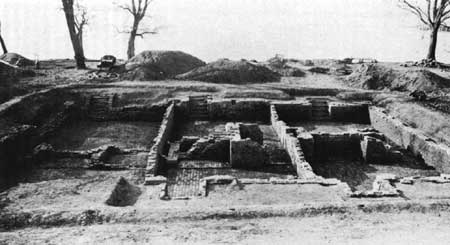 General view of the foundation of the first statehouse at Jamestown. |
In the instructions to Governor Harvey, August 6, 1928, there is reference to a "Grand Assembly" to discuss and provide for a palisade from Martin's Hundred to York—across the Virginia Peninsula—for protection against the Indians. Perhaps the royal authorities thought that this would encourage wholehearted cooperation in a defense measure against the Indians. An assembly did convene in October 1629, and its chief work was the adoption of various measures of protection against the Indians, followed by a tax law affecting all freemen in the colony for the support of the measure. The assembly went beyond a discussion of defensive measures, passing legislation regarding the planting of tobacco and reenacting the law of 1623 regarding compulsory church attendance.
In 1629 propositions touching Virginia, endorsed by Sir John Harvey, asked the King for the confirmation of former privileges and for the approval of a general assembly to meet on "necessary occasions, wherein to propound laws & orders for the good government of ye people." In answer to this last proposition it was stated that:
. . . the governor may be authorized shortly after his first coming into Virginia to call a grand assembly, and there to set downe an establishmt of the Government, and ordaine lawes & orders for the good thereof, and those to send hither to receive allowance, and such as shall be soe allowed to be returned thither under the great seale and put in execucon, the same to be temporary & changeable at his maties pleasure, signified under the like great seale. [4]
In March 1629/30 another assembly was called to meet at Jamestown. It assembled and business began after "The oathes of alleidgeance and supremacy were administered to the Governor and Council, and afterwards to all the Burgesses then assembled"—46 in number. This meeting, much more than that of October 1629, exhibited the characteristics of a regular legislative body. At this March session various topics came before the burgesses, and legislation followed on religious questions, on fortifications and defense against the Indians, on the engrossing and forestalling of commodities, on staple commodities, and on tobacco.
It may be that the conventions of 1628 and 1629 were sufficient precedent for the reassumption of law-making powers by the assembly, or it may be the colonists assumed, on the faith of repeated promises, that they could resume the old privilege. In any case various meetings of one kind or another had been authorized by the Crown in instructions to the Governors without, it seems, stating that the assembly was renewed in its old sense of regular or periodic meetings. It is a fact that from 1629 regular yearly meetings took place in the colony. These meetings passed legislation, and there seems to be little doubt that the burgesses assumed all the rights and privileges of regular representative bodies following the current variety of parliamentary practice. When Governor Harvey returned to Virginia in 1637 he brought instructions to call an assembly, yet these did not specify a regular-meeting legislative body. It was in the instructions to Governor Sir Francis Wyatt, returning to Virginia for his second administration in 1639, that there was the first clear and unmistakable renewal and guarantee of the assembly.
The state of Virginia's assembly from the dissolution of the company in 1624 until 1639 is difficult to trace. It appears that until 1637 the King governed Virginia through committees in the Privy Council. During this period there were various efforts to derive a system of administration for the colony. It would appear that the royal commission set up to make recommendations concerning Virginia in 1631 assumed that an assembly was functioning in the colony. Even though assemblies convened after 1628, the planters, it would appear, were none too sure of their rights in this matter.
Charles M. Andrews, in his study of the evolution of the assembly in The Colonial Period in American History, has concluded that the Virginia planters themselves were largely responsible for the establishment of self-government in the royal colony of Virginia. Charles I did not purposely intend to deprive Virginia of its assembly, yet he seemed reluctant to give it his seal of approval. The colonists, acting without direct or explicit consent, yet with something of an implied sanction, proceeded to keep the assembly alive through regular meetings—through action and then explanation. Over a 15-year period a precedent was established, and the King came slowly to a decision. The case was settled in Wyatt's instructions of January 1638/39 when he was instructed "Once a year to call a General Assembly and the Governor therein to have a negative voice." A similar instruction was issued to the next Governor, Sir William Berkeley, in 1641. A year later the colony expressed its satisfaction at its "freedom of yearly assemblies" under the Crown. Summing up this development, Professor Andrews has stated:
Not only was the Virginia settlement assured of its future, but what was even of greater importance for the later history of the royal colonies in America, a precedent was set according to which the people of any royal colony was assured of their right to share in the making of laws, the levying of taxes, and the taking into consideration those many other things, chiefly of a local and prudential nature, that meant most to men two and three hundred years ago. As the result of fifteen years indecision on the part of the crown and of action on the part of the colony, the principle was finally laid down that a royal colony should be, in part at least, a self-administering community, with a governor and council appointed in England and a representative assembly chosen by the free men or freeholders in the colony. Though self-government was in no sense of the word democratic government and though popular interest in lawmaking was never very keen during colonial times, nevertheless the very presence of such a gathering in a royal British colony in America was a factor of vast consequence in the development of American political practices. [5]
For 20 years before 1639 the General Assembly had been functioning in Virginia, but there was as yet no especially designated building to house this body. The colony was still without a capitol building—still without a statehouse. The explanation for this fact may lie, in part, in the early insecurity and uncertainty of the assembly itself, for it should be remembered that at an early date provisions had been made only for accommodating the permanent features of the colony, such as church and governor.
It was natural that the first meeting of the burgesses should take place in the church at Jamestown. Here was ample space, and it was the most convenient place. Without doubt, the church was considered a fitting place for the beginning of popular control in the colony. The church then standing was not that erected in 1607, rather it was a later building. Fire and frail construction meant short life for most of the early buildings at Jamestown.
For some years after 1619 the burgesses evidently continued to hold their sessions in the church. At the first meeting a precedent had been set for later meetings here. Besides, it seems that the church continued to be the best and most convenient place of meeting. In the winter of 1631-32 divine service and the meeting of the assembly were both identified with the same room. This is apparent from a quaint order that reflects the spirit of the time:
It is ordered, That all the counsell and burgisses of the assembly shall, in the morninge, be present at devine service, in the roome where they sitt, at the third beatinge of the drum, an hower after sun rise, uppon the penaltie of one shillinge to the benefitt of the marshall at James Citty; and yf any shall absent himselfe from the assembly, to pay 2s. 6d. to the same use; and yf any shall after neglect, to be fined by the whole bodie of the assembly. [6]
After this date there is strong indication that some of the sessions of the burgesses convened in the Governor's house at Jamestown. As early as the time of Sir Thomas Gates (1611-14) there was a house at Jamestown set aside as the Governor's residence, commonly called the "country house." Before 1618 this building had been repaired and enlarged. It was to his house that the Governor called his council for periodic meetings to act on affairs of the colony. The "Counsell Chamber" mentioned in the minutes of the General Court of the colony (the Governor and his councilors) in 1625 must have been in reference to some designated place in the Governor's house. The council records of this period form good proof that separate meetings for the transaction of its several kinds of business had not become necessary. Executive and judicial items were passed on in a single session. In matters of legislation the council convened with the burgesses as a part of the assembly. When, in the early years after 1619, there was no assembly the Governor and council acted alone in these matters.
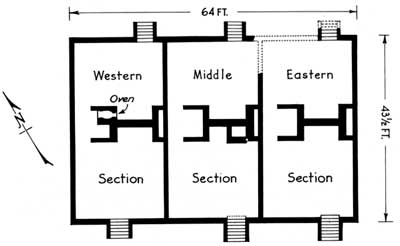 A plan of the foundation of the first statehouse at Jamestown. |
Council meetings, it would seem, continued to be held in the Governor's house, whether he was residing in his official or his private home. It was not until the arrival of Sir William Berkeley in 1641 that the home authorities felt it necessary to order that provisions be made for a place for council meetings, especially when the council was sitting as the General Court for "dispatching of public affairs and hearing of causes." It can readily be understood that the Governor was at considerable expense, since his house was the center of colonial government with its council meetings, court meetings, and even, on occasion, assembly meetings. Aside from all of this he was the host to all important visitors of state to Jamestown. In May of 1632 it caused Sir John Harvey, then Governor of the colony, to protest in pleading terms to the Lords Commissioners in England:
. . . I conclude with my humble prayers unto your honours to take into your compationate cares my nowe almost three years service uppon the place, without any meanes or annual entertainment to support me great expence, who may be as well called the hoste as gouvernor of Virginia, all the country affayres being prosecuted at my house in James Island where is no other hospitalitie for all commers, and if some speedie remedie and reliefe be not found for me, not onlie my creditt but hart will breake, . . . [7]
In the winter of 1636-37 the subject of a separate statehouse appears to have been approached for the first time with practical definiteness. The English Government in instructions to John Harvey directed him to see that the assembly take steps to build a capitol. In a letter written by Richard Kemp, secretary of the colony, in April 1638, it is stated that a tobacco levy had been fixed for building a statehouse at James City and that George Menifie, a prominent colonist, had been sent to England with the funds to secure workmen to accomplish the project. Again in January 1640 the assembly laid a 2-pound levy for the statehouse. As events moved, however, the colony did not build a statehouse, rather it secured one already constructed.
Governor Sir John Harvey, financially speaking, came upon evil days after he was replaced as Governor in 1639. In April 1640 the court in Virginia took action to provide for Harvey's creditors, promising sale of his property. The next month Harvey arranged to have his estate in York County and in Jamestown sold. It was on April 7, 1641, that the Governor, council, and burgesses for 15,700 pounds of tobacco purchased from him for the colony:
all that capital messuage or tenement now used for a court house late in the tenure of said Sir John Harvey, Knt., situate and being within James City island in Virginia with the old house and granary, garden and orchard, as also one piece or plot of ground lying and being on the west side of the said capital and messuage as the same is now enclosed [8]
In this manner the colony acquired what must have been a rather pretentious structure in Sir John Harvey's residence, with another building adjoining. This place, enclosed by palings, as were many other homes in Jamestown, had a garden and orchard and on the west side some undeveloped land as well. In all, it must have been one of the better homes in town, in full conformity with the many regulations about fences, fruit trees, vines, and gardens.
Harvey's house, apparently a brick structure, was already old in associations, being locally known as the "capital messuage or tenement" and now in use as the courthouse. This indicates that the house was not new, but had seen some years of service. If this were not the case, there seems little reason for the description "old" in the order of transfer. Sir John Harvey came to Virginia in 1624 as one of the commissioners appointed by the King to report conditions in the colony. He became a councilor and soon acquired property at Jamestown in the New Town section where he had a residence. He left Virginia in 1625. Just what disposition he made of his property at that time is not clear. When he returned to Virginia in 1630, as Governor, he seemingly settled himself in another section of town.
In May 1630, Harvey was settled at "James cittie, the seate of the Governor." Some months later Harvey wrote to the home authorities emphasizing the needs of the colony and stressing the lack of carpenters, brickmakers, and bricklayers, especially since now "wee intend our houses for decencye and Comoditie." This indicates a determination to build good houses; and Harvey himself may have taken the lead. At least, in 1632 he had a fairly commodious and established place of abode. He spoke of it as the point where all the affairs of the colony were conducted, and as the sole point of hospitality "for all commers." The substance of this claim, with even greater emphasis, was repeated by Capt. Thomas Yong who visited Jamestown in 1634.
The charge of this gentleman [Governor Harvey] is extraordinary in regard that this seate of James Town hath in it no other place of receipt, but only the Governors owne house, wherein he is continually at excessive charges in his housekeeping, as well as entertayning the whole councell and their retinewes, which are not small, at all times, whensoever any occasions either of the King's or Countrye's service requires. Their attendance, and that sometimes for a weeke or fortnight, nay, sometimes for a month together, which meetings grow dayly more and more frequent, as the Colony increases in number and so consequently in buisnesse both for the State & Country; this house also is the randevouz of all sorts of strangers, who have any occasion of resort thither upon any buisnesse. , . . . [9]
Thus his house was the focal point of government and the center of social life at Jamestown.
Sir John Harvey, whether because of his personal nature, his own view or interpretation of government, or because of the severe opposition that confronted him, managed to become thoroughly disliked throughout the colony. His high handed and autocratic methods arrayed even his council against him. Eventually, in April 1635, a protest meeting was held in York County. This enraged Harvey, and he moved to take counter measures. It was to his house at Jamestown that he called a council meeting, only to find that his council would not approve the measures of reprisal that he recommended. During one of these council sessions Harvey was forced to realize that the wrath of the people had been aroused against him. He was a virtual prisoner in his own house, and his council no longer stood with him. This became clear when, while making a threat of arrest against some of the councilors, Dr. John Pott, one of the council, moved near to the door of the room and at a signal had about 50 armed musketeers appear from concealed positions back of the fence surrounding the house. Obviously, there was little that the Governor could do. Harvey himself reported this incident:
. . . That upon the 28 day of Aprill last which was the time when they were to meet for his Majesties said service, the said Mathewes, Utye, Farrer, Pearce, Minefie, and John Pott, came all armed and brought with them about 50 Musketeers, and besett mee in my owne house, which was the place which I appointed for our meeting . . . [Heated discussion followed] . . . upon this Uproare John Pott, (who by the said company was pleased at the doore of said house) with his hand gave a signe and immediately the Musketeers which before that time lay hid, came presently running with their pieces presented towards my house; and when one of my servants saw them coming so hastily towards my house, he asked the said Pott what the said Shott meant; he said unto him; Stirr not for your life; and when they were come neare to him, he said to the Musketeers: Stay there untill there be use of you; and there upon they retired again . . . nor had I meanes or power to raise any force to suppress this meeting they having restrayned me, and sett a guard upon me. [10]
In the end the council moved to depose the Governor, naming John West to take over the post until the King's pleasure was known. A meeting of the assembly, in May, approved the work of the council, and Harvey was sent to England to answer charges placed against him there. In this he must have been successful, or perhaps the King wanted to vindicate his choice, for in 1637 Harvey returned to Virginia as Royal Governor. From this incident it is evident that Virginia's burgesses and council, when sufficiently aroused, stood ready to uphold the right of the people to order their own government.
Harvey returned early in 1637 and resumed his duties as Governor, taking up residence in his own house. This presaged an attempt to inaugurate a period of development for Jamestown. The Governor reported in January 1638 that as a result of an act passed by the assembly in 1637 the secretary of the colony, Richard Kemp, had constructed a brick house, the "fairest" yet known in the colony; others had built framed houses and stores, and much land had been patented. Evidently, Harvey continued to live in his own residence even after he was replaced as Governor in 1639. He was still living there in April 1640 when the court, arranging for the sale of his property, guaranteed to him the enjoyment of the premises of his house and grounds at Jamestown during his life. Just where he was on April 7, 1641, when the colony purchased this place, is not clear.
3The Records of the Virginia Company of London, edited by Susan Myra Kingsbury. Washington, 1933. Volume III, page 177.
4"Virginia in 1629 and 1630," published in the Virginia Magazine of History and Biography (April 1900). Volume VII, page 371.
5Charles M. Andrews, The Colonial Period of American History. New Haven, 1935. The Settlements, part I, pages 204—205.
6Statutes at Large: Being a Collection of All the Laws of Virginia, edited by William Waller Hening. Richmond, 1809. Volume I, page 162.
7A letter from John Harvey to the Virginia Commissioners, May 27, 1632, published in the Virginia Magazine of History and Biography (October 1900). Volume VIII, page 150.
8Minutes of the Council and General Court of Virginia, 1622-1632, 1670-1676, edited by H. R. McIlwaine. Richmond, 1924. Pages 497—498.
9"Captain Thomas Yong's Voyage to Virginia, and Delaware Bay and River in 1634," published in the Collections of the Massachusetts Historical Society, Fourth Series (Boston, 1871). Volume IX, pages 112—113.
10"Declaration of Sir John Harvey," published in the Virginia Magazine of History and Biography (April 1894). Volume 1, pages. 426—427.

|

|

|
|
|
Last Modified: Sat, Oct 20 2001 10:00:00 am PDT |