

|
Popular Study Series History No. 15: The Oldest Legislative Assembly in America & Its First Statehouse |
 |
THE FIRST ASSEMBLY, 1619
Apparently, the election of burgesses took place soon after June 19, with the inhabitants of the various localities registering their choice. It appears that the term "inhabitants" was interpreted literally and the whole populace, excepting women, children, and apprentices under age, assembled and made their selections viva voce, or "by show of hands." On July 30 newly chosen burgesses from eleven centers of settlement scattered along the James River met at Jamestown, as did the Governor and his councilors. The Governor and the burgesses are known by name, and of the councilors the names of six have been preserved. Many of the men were already considered old planters in Virginia; some were already quite prominent in colonial affairs; and others were to become better known later in Virginia history. John Pory, secretary of the colony and a councilor, was appointed speaker of the assembly and from his pen has come "A Reporte of the Manner of proceeding in the general assembly convented at James City" in 1619. Pory, because of his knowledge of parliamentary rules and procedure, undoubtedly contributed a great deal to the success of the first assembly. He was a man of considerable experience having been a member of the English Parliament for several years before he came to Virginia.
The meeting convened in the "Quire of the Churche" at Jamestown, "The most convenient place . . . [they] could finde to sitt in." Governor Yeardley took his seat in his accustomed place in the church and the councilors sat beside him, some on the right, some on the left, excepting John Pory, who was named speaker and sat in front of the Governor. John Twine, clerk of the assembly, sat beside the speaker. The sergeant, Thomas Pierce, stood at the bar ready to carry out the orders of the body. All assembled in the "quire," and Rev. Richard Buck, "A verie good preacher" and officiating minister, opened the meeting with prayer. The burgesses then withdrew into the church and on receiving the "oathe of Supremacy," administered individually, entered the assembly. With this formality completed, the assembly began its deliberations.
Before the burgesses moved to take up their legislative work, they first considered the eligibility of the members to their seats in the House. Here the burgesses evidently assumed a power that the House of Commons in England had, after a struggle, wrested from the King. In any case, the first burgesses exercised this power when they challenged the seating of four representatives, ultimately denying the seating of two over a question of special privileges enjoyed by the plantation from which the burgesses came. "Special privilege" was a theme that was to echo through many decades of American politics.
The order of business apparently had been arranged before the assembly convened. Possibly it was arranged by the speaker, the Governor, or both acting together. The first matter was a consideration of the "greate Charter" brought over by Governor Yeardley. This important document dealt largely with the settlement of land tenure and internal organization in the colony, with only general attention to government and political rights. It is best described as a veritable code of privileges, orders, and laws, dealing with the affairs of the colony in all their bearings and designed to be binding upon the members of the colony and their heirs forever. The speaker read the charter before the assembly and then two committees were set up to consider it in detail. On July 31 the committees made their reports on the charter and the assembly approved the document acting through petitions, however, to ask for certain minor changes and assurances in the application of the charter. The major concern shown in the petitions seems to have been the right to, and the confirmation of, land titles. One writer has asserted that the approved charter became the first written constitution of government promulgated or put into practice in America.
Proceeding to the next step in the legislative agenda, the assembly began a consideration of the instructions that had been issued by the Company in England to the various governors that had been appointed for Virginia. The assembly moved to enact into law the passages from these instructions that would make toward better government and security in the colony. On Monday, August 2, the committees reported on this subject and the assembly adopted measures against idleness, gambling, drunkenness, and excess in apparel. Other measures touched on protection against the Indians; christianizing the Indians; the planting of corn, mulberry trees, hemp, and vines; the application of tradesmen to their trades; the carrying out of contracts; and the regulation of the magazine. One bit of legislation attempted the control of tobacco prices by law.
On August 3. the assembly for a time took over an element of judicial power when it tried a servant of one Capt. William Powell for irregular living and for giving false information to the Governor regarding Captain Powell. There were two trials of this sort conducted by the assembly of 1619.
Also on the 3rd of August the assembly considered still another type of law—"A thirde sorte of laws suche as may issue out of every man's private conceipte." As these descriptive words imply this would mean laws proposed by the individual members of the body itself. Here is the immediate assumption of the power of initiating legislation, as well as of acting on laws proposed from above. The legislators acted to control relations with the natives and the personal affairs of the colonists where they were detrimental to the welfare of the colony. The burgesses went further, requiring compulsory church attendance, insisting that ministers in Virginia perform their duties, including the keeping of accurate records of births, marriages, and deaths. Other laws touched on trade, marriage, protection of livestock, contracts of indentures, and related subjects.
On the last day of the assembly, August 4, the assembly passed its first tax law. This was in the form of a poll tax on every man and manservant in the colony above the age of 16 and was to pay the officers of the assembly for their services during the session. With this out of the way and after several additional petitions, the assembly was prorogued by the Governor due to "the intemperature of the weather and falling sick of the Burgesses."
The first assembly, lasting 6 days and meeting in mid-summer when conditions at Jamestown were most unfavorable to work of this sort, accomplished a great deal before it was prorogued, apparently with its own consent. Within 6 days it debated and passed three principal bodies of law. Aside from this, its chief work, it tried two cases, passed on the qualifications of its members, and gave attention to various other details. Although it accomplished a great deal and in fact even began to reach out for additional power, its status as an element in the government of the colony was not secure. Even its nature and limits were still undefined.
The first assembly later proved to be the real beginning of representative government in America; yet, in 1619, it is doubtful if any of the burgesses was conscious of the real significance of the meeting. Whatever the interpretation of the event, the assembly disbanded on August 4. The members were probably glad to return home, for the heat was intense and sickness was rife—one burgess died during the session. In any case, they were scheduled to convene again in March, at which time they would be able to complete any unfinished business that remained.
At this point it is interesting to note that in this first assembly there was evidence that its members by diverse means hoped to increase the power of the body and thereby exercise greater power in the affairs of the colony. This is best seen, perhaps, in the last petition that passed the burgesses on August 4:
Their last humble suite is, that the said Counsell and Company would be pleased, so soon as they shall finde it convenient, to make good their promise sett downe at the conclusion of their commission for establishing the Counsel of Estate and the General Assembly, namely, that they will give us power to allowe or disallowe of their orders of Courte, as his Majesty hath given them power to allowe or to reject our lawes. [3]
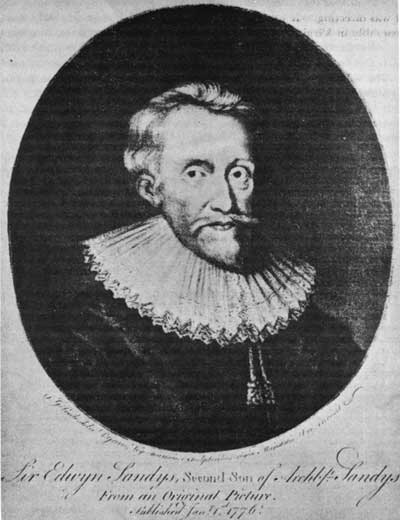 SIR EDWIN SANDYS A leader in the movement for popular government in Virginia. He was an uncle of Margaret Sandys, wife of Governor Sir Francis Wyatt, of Virginia, who favored the practice of representative government in the Virginia Colony. (Portrait from Alexender Brown, The First Republic in America. Courtesy, Houghton, Mifflin and Company.) |
2Journals of the House of Burgesses of Virginia, 1619-1658/59, edited by H. R. McIlwaine. Richmond, 1915. Page 36.

|

|

|
|
|
Last Modified: Sat, Oct 20 2001 10:00:00 am PDT |