

|
Popular Study Series History No. 15: The Oldest Legislative Assembly in America & Its First Statehouse |
 |
DISCOVERY OF FOUNDATIONS OF BUILDING
There was thus much precise factual material available regarding the statehouse before its ruins were found. It attracted considerable attention when at various intervals from 1932 to 1935, in piecemeal fashion, the foundations of a building were uncovered at Jamestown having three separate sections (an east, a west, and a middle section) located by the river side and in the general area where it was thought the first statehouse was erected. Naturally, the supposition was that the ruins of this building had been found. When the architectural pattern of the building, as well as the relics and artifacts found in association with it, proved to be seventeenth century; and especially when dimensions checked very closely with known dimensions, the case was strengthened further.
It has been reported that as early as 1901, when Mr. and Mrs. Edward E. Barney, then owners of much of Jamestown Island, were conducting random explorations in the town site on the hunt for any relic or landmark to be found, they encountered the foundations of a building. This building proved to be that now identified as the first statehouse, although they were unaware of this identification at the time. The report is that they dug into the eastern section of the building, encountering a fireplace where there were fine feathery ashes still in place. In the center of the fireplace was a three-legged pot containing bones, as if a meal had been stopped in the course of preparation.
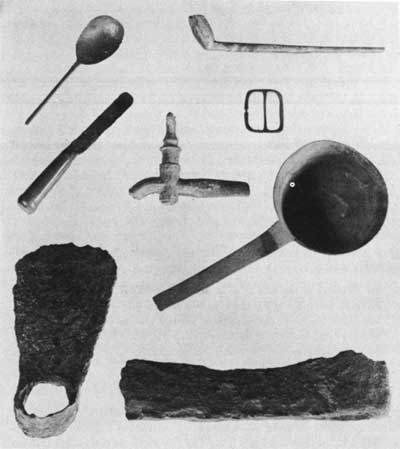 These objects were among the many taken from the location of the first statehouse. |
In 1932 George C. Gregory conducted much more careful research at Jamestown. After studying the town site, using what historical data he could collect, he tentatively concluded on the location of the statehouse. It was while exploring on the ground that he encountered the actual foundations of a building which he identified as that which he was seeking. His work was extended until he had exposed the general outline of the foundations and carried out limited excavations.

|

|

|
|
|
Last Modified: Sat, Oct 20 2001 10:00:00 am PDT |