

|
Popular Study Series History No. 13: Rifle Making in the Great Smoky Mountains |
 |
Rifle Making in the Great Smoky
Mountains (continued)
Making the Bullets
Individual bullet moulds were made for the rifles. First the blanks for the two halves were beaten out of a piece of iron (Figure 15). They were hinged at the proper place with a rivet and then the spherical cavity was cut by means of a "cherry." A cherry consists essentially of a sphere of steel the size of the bore of the rifle mounted through a rather slender shank to a bar of iron with which to hold it. The temper was drawn from such a steel sphere and the cutting edges, exactly like those of a dentist drill, were laboriously filed out. Then the cherry was heated and dropped into tepid water (case hardened), which gave it an intensely hard surface. The cherry was used as follows: The halves of the bullet mould were opened and the cherry was rotated between the faces either by hand or by a bit brace. The cherry was turned, pressure being applied to keep the halves of the mould together and gradually a spherical cavity was ground out. As the cavity neared completion the narrow neck of the cherry would cut out a channel from the central spherical cavity to the outside and this was the channel or sprue through which melted lead was poured to make the bullet.
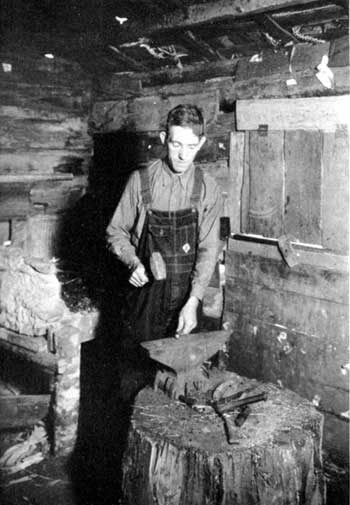 Figure 15. Forging the blank for a bullet mould. |
When a rifle was dressed out after a period of use, the bore became a trifle larger and it was, therefore, necessary to enlarge somewhat the bullet mould to fit the new condition. Usually a new cherry was required for this purpose. Time was a very secondary factor with the gunsmiths of the Great Smoky Mountains; to make a new cherry, a dressing stick, or, indeed, any of the multitudinous pieces of equipment for a mountain rifle, was all in a long day's work.

|

|

|
|
|
Last Modified: Sat, Oct 20 2001 10:00:00 am PDT |