

|
AMERICA'S OLDEST LEGISLATIVE ASSEMBLY and Its Jamestown Statehouse |
 |
THE FIRST STATEHOUSE
In a relatively short time this double building, the western section of which became the first statehouse, was officially known as the capitol building. It was referred to in the land records and became a landmark at Jamestown. The fact that this structure had been used for court meetings before acquisition and had in all probability witnessed council meetings, even assembly meetings, over a period of years, may be the reason that it had already become fixed in the minds of the colonists. The acquisition of this statehouse was merely a change in title and not so much one of actual use. It evidently remained the colony's statehouse for the next 14 years.
The colony did not long retain actual title to the statehouse. The assembly in June 1642 presented to the Governor, at that time Sir William Berkeley, as a free and voluntary gift the two houses and orchard belonging to the colony. It seems reasonable that the Governor should have a residence here, and it must have been understood that council and assembly should convene here on regular occasions. This apparently had been the case when Harvey was Governor, before the colony had officially acquired a single structure for use by the colony. As to the actual use of the building, such as distribution of space and rooms regularly designated for particular meetings, little is known. To this two-building structure, at some unknown date, Sir William Berkeley added a third. He added a brick house to the west end of the group, thus forming a brick structure made up of three separate and distinct sections. On March 30, 1655, Berkeley sold this to the then Governor, Richard Bennett, for 27,500 pounds of tobacco.
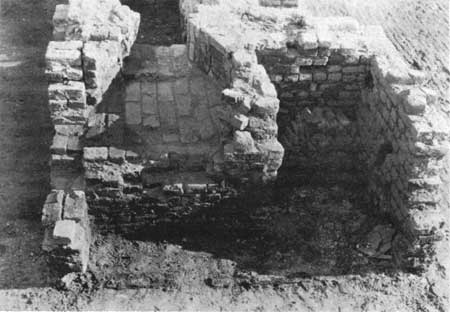
Interior of the first statehouse foundations looking
from east to west. Note Dutch brick floor in lower right corner.
Evidently the first statehouse was burned, partially burned, or otherwise rendered unserviceable sometime in the early part of 1656, for in December of that year the assembly enacted legislation to cover the expense of the court and committees incurred when they met in privately owned buildings. Besides, an additional act set aside 20,000 pounds of tobacco to cover the cost of accommodating the "Governor and Councill att James Cittie during quarter courts and Assemblyes." Even before this legislation, however, there is evidence that another statehouse—the second statehouse—had been or was being provided.
From 1641 until 1656 it can be assumed that the first statehouse functioned as the center of government for the colony—the place where assemblies met, courts were held, and council sessions were called. Although considerable activity must have taken place before 1641, during the interval that followed all important events of the day must have been associated with this brick statehouse. From it must have come the "Remonstrance of the Grand Assembly" against the recharter of the old company in 1642, the repeated legislative acts to encourage western exploration, and heated reverberations of the Virginia-Maryland boundary dispute. Many routine matters must have been discussed here by the representatives of the colony—regulation of religious matters, the organization of the judicial system, the establishment of county boundaries, the authorization of ferries and bridges, regulation of trade (both internal and external), and taxation, to name but a few. Without doubt, the action against non-conformists in regard to church matters, that forced a later Governor and owner of the statehouse, Richard Bennett, to leave the colony, echoed here. It was in 1647 that the assembly passed a law requiring all ministers to read prescribed prayers, thus launching the attack. Perhaps the surrender of Virginia to the Parliament of England in 1652 was one of the most stirring events associated with this structure.
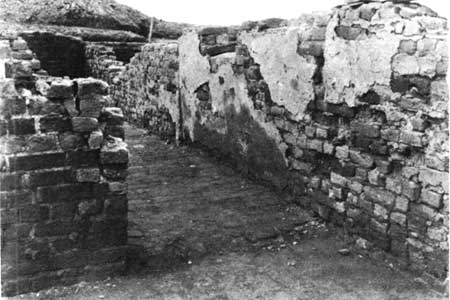
Detail of built-in oven in eastern section of the first statehouse.
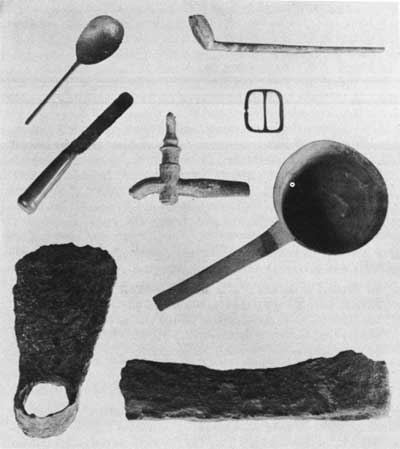
Objects among the many taken from the location of the first statehouse.
Sir William Berkeley was most loyal to the Crown, and the colony went far in supporting his position, yet in the end, when commissioners appointed by Parliament appeared before Jamestown in the ship Guinea, Virginia surrendered to the Commonwealth of England, despite Berkeley's plans for defensive measures. The terms arranged for the surrender were quite liberal. As agreed upon, Virginia was to enjoy all of her old privileges and to be free of taxes and customs, except such as were to be imposed by the assembly. In regard to popular control the colony had more freedom than heretofore. The assembly became the chief organ of the government with full power to name the Governor and his council. The assembly proceeded to name and elect Richard Bennett as Governor, with William Claiborne as Secretary of State, both men being adherents of Cromwell. While these momentous changes were taking place, the statehouse must have been the busiest spot in the colony.
This first Virginia statehouse also served as the official residence, and private home as well, of three well known Virginia Governors—Sir John Harvey, Sir William Berkeley, and Richard Bennett. Sir John Harvey, who served two terms as Governor in Virginia, is better known perhaps for his autocratic and arbitrary methods than for his more constructive accomplishments. Sir William Berkeley, an outstanding figure in the history of the colony, served long in Virginia and for much of the time wisely. He came to the colony, a well traveled Oxford graduate, in 1642. He remained Governor until Virginia submitted to Parliament and then withdrew to his plantation at Green Spring, near Jamestown. In 1660 the assembly called him from retirement, naming him Governor for a second time. After the restoration, Charles II renewed his commission as Royal Governor. He was to remain as Governor until the events of Bacon's Rebellion would lead to his recall.
The third Governor to use and own a part of the statehouse group was Richard Bennett. He had come to Virginia in 1621 to take charge of his uncle's plantation in present Isle of Wight County, Virginia. In the colony he became active in political affairs and emerged as a councilor in 1639. He was a Puritan in sympathy, however, and in 1649 he felt it necessary to leave Virginia because of his religious affiliations. He took up a short residence in the neighboring colony of Maryland and was later named as one of the commissioners for the reduction of Virginia. The assembly named him Governor, a post which he held from 1652 until March 1655. At that time he was sent to England as agent.
Even though the first statehouse ceased to function as the colony's capitol in 1656, the interesting history of the house did not cease. The place was renovated and again used as a residence until fire wrecked it in 1670. Linking the former owners with the later owners of this group of buildings, it reads like a register of old James River families: Harvey, Berkeley, Bennett, Woodhouse, Talbot, Bland, Marable, Randolph, Swan, Ludwell, Stegg, Bacon, and Sherwood.
It is from later transfers that it is possible to glean many of the known facts about the structure, such as its size, its use, how it was eventually destroyed, and the identification of the men who owned it. A short quotation from a deed of conveyance for the "westermost" house of the group from Henry Randolph to Thomas Ludwell on April 7, 1671, will make this clear:
one messuage or tenement of brick building of 40 feet long and 20 feet wide being the messuage of Pt. [part] of that fabrick pile of building which contains three tenements, the middlemost whereof was the old State house which messuage was formerly in the occupation of Richard Bennett Esqr situate, lying and being on the river side in James city. . . .

|

|
|
|
Last Modified: Thurs, Sep 11 2003 10:00:00 pm PST |