

|
Field Division of Education The Geology of Devils Tower National Monument |
 |
THEORIES OF ORIGIN
There is a good deal of uncertainty concerning the mode of origin of Devils Tower and the type of igneous body it represents. Newton and Jenney noted the extreme difference in the appearance of Devils Tower with its steep-sided shaft in contrast to the rather uniformly conical shape of most of the other igneous masses of the region. They further state, concerning the igneous bodies of the Black Hills, that the peaks appear to be merely pointed or conical waves of igneous rock forced upward through the sedimentary strata which are found disrupted and turned up around them only in their immediate vicinity. The metamorphism of the upturned strata is limited in extent, reaching only a few feet from their contact with the igneous rocks. There seems to be no evidence of any overflow of the igneous matter, but it is confined exclusively to the peaks. The view that they are the cores to extinct volcanoes or centers of igneous overflow is scarcely warranted by the observed facts. It would appear that the igneous peaks, instead of being the product of violent volcanic action, are situated at a great distance from the central and maximum region of igneous action, and that instead of the material being ejected with great violence and at such a temperature as to cause it to overflow readily, it was forced through the sedimentary strata under great pressure and at such a temperature as to make it plastic rather than fluid. The occurrence of these trachytic peaks appears like a great postular outbreak on the surface of the northern end of the Black Hills, whereby the deep-seated igneous forces were relieved, or like the appearance of bubbles on the surface of a kettle of boiling tar.
Carpenter (1888) interpreted Devils Tower to represent a volcanic plug, being the duct through which the subterranean magmas passed to higher level in the earth's crust. Russell (1896) proposed the name plutonic plug for the intrusive bodies of the Black Hills, stating that they differ from the laccoliths described by G. K. Gilbert (1877) in the fact that the molten rock did not spread out horizontally among the stratified beds so as to form "stone cisterns", although some of the hills not thoroughly examined by him might reveal this structure with further study. "As they are composed of igneous matter forced into sedimentary strata and have a plug-like form, it will be convenient to call them plutonic plugs." Devils Tower is believed by him to represent an extreme type of plug, the part now remaining being an erosional remnant, where the arch of stratified rock which once surmounted the summit of the mass has been completely removed and the surrounding strata eroded away.
Pirsson, (1898, p. 582) in commenting upon Russell's view, states, "It is impossible to conceive that the tall shaft-like mass of Mato Teepee, with a vertical columnar structure whose columns are several hundred feet long, can be a volcanic plug in a condition anywhere near approaching its original horizontal diameter. The mechanics of the jointing of igneous rocks forbids such a supposition, and we must believe that it represents only a still uneroded fragment whose vertical walls are produced by the columnar structure of a mass which formerly was of much greater lateral extension and possibly of laccolithic form".
Jaggar (1901) adheres to the theory of a laccolithic origin for Devils Tower, believing it to have been at one time an eastward extension of the Little Missouri Buttes laccolith and that erosion has removed the connecting mass. He states it is probable that the agglomerates were the first and most fluid injections of a magma which rose rapidly and with some violence through fractures from Algonkian to Cretaceous rocks. The conduits were dikes now nearly concealed under the Little Missouri Buttes. The laccolith spread southeastward in Benton shale, met an opposing northwest dip of the Warren Peak flanks, broke downward through the lower Cretaceous sandstone, and formed a subordinate Mato Teepee laccolith in soft Jurassic strata. The present upper surface of Devils Tower is smooth and possibly represents nearly the actual upper contact, from which the shales have been weathered away. The following geologic section shows an ideal reconstruction of the original laccolithic mass as postulated by Jaggar.
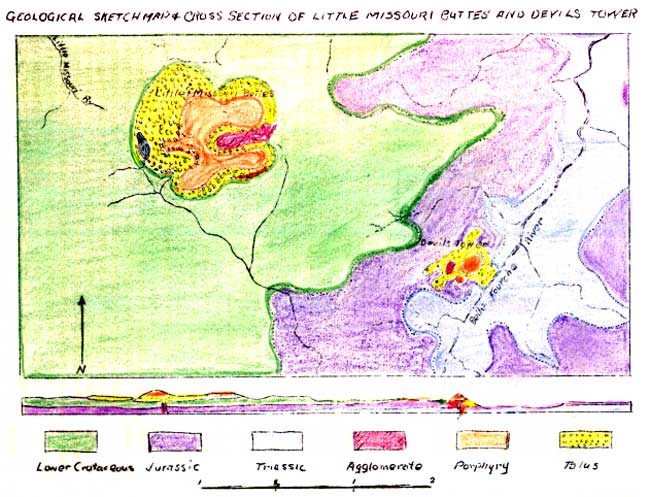

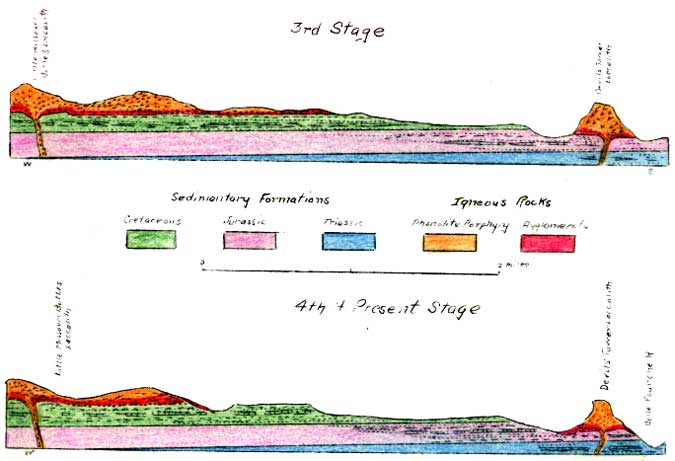
(click on images for an enlargement)
Jaggar further states that "the proofs that Little Missouri Buttes were the main laccolith of which Mato Teepee was a subordinate offshoot, may be summarized as follows: The Little Missouri Buttes form the larger mass today, encircled by the larger streams, and show evidence of conduits beneath in the shape of dike ridges, a large mass of breccia at the base, irregular and horizontal columns, and inclusions of granite in porphyry. Mato Teepee shows evidence of smaller size and lenticular form in the arrangement of the smaller encircling streams, and shows only a little of the breccia at the base, and that on the side of the Little Missouri Buttes; the breccia contains fragments of black shale from Little Missouri Buttes horizon; the vertical columns give evidence of an extended horizontal upper cooling surface, and the Jurassic beds below give evidence of a horizontal basement; flat porphyry outcrops on the Jurassic platform gives evidence of former greater horizontal extension of the Mato Teepee porphyry; entire absence of dikes or deformed sediments indicates that the porphyry came into its present position through lateral conduits from the greater mass."
Darton (1909, p. 69.) briefly comments upon the origin of Devils Tower and states that: "There is no conclusive evidence as to the location of the vent of the Devils Tower rock. The vertical columns have been supposed to indicate that the tower is not the stock of flow or intrusion at higher levels, but recent observations by Johnson in the Mt. Taylor region of New Mexico and by C. A. Fisher in Central Montana show that vertical columns may exist in stocks. Doubtless the mass was much larger originally, for evidently much of the laccolith has been eroded, but the original form and extent can only be conjectured. It is believed that the vent is under the tower or the talus, for the agglomerate is of local origin and no dikes appear in the surrounding area." The suggestion that Devils Tower is a remnant of the southeast end of a laccolith extending from the Missouri Buttes, involves an improbable amount of erosion and numberous other difficulties.
From a consideration of the evidence presented it would seem most reasonable to believe that Devils Tower represents a remnant of a laccolith, probably rather small in comparison with others of the Black Hills, and separate from the Laccolith of the Little Missouri Buttes. It would seem probable that the duct through which the igneous material was injected lies beneath the tower or the talus. The stages in the formation of Devils Tower according to this hypothesis might be represented diagramatically as is shown in the succeeding charts.

|

|

|
|
|
Last Modified: Sat, Feb 9 2002 10:00:00 am PDT |