

|
Field Division of Education The Geology of Devils Tower National Monument |
 |
STRATIGRAPHY
Devils Tower is underlain by Jurassic beds stratigraphically and topographically lower than those on which the Little Missouri Buttes rest. A hundred yards northwest of the tower, following the narrow divide between the encircling streams, a white, fine-grained quartzite outcrops in the characteristic greenish soil of belemnite shale. A hundred yards farther west along the divide a shell bed (Tancredia) occurs, carrying concretions and dipping due south about 48 degrees. Above and below are green shales, and the strike of the outcrop seems to curve. A little farther west oyster beds appear, dipping 34 degrees north, 35 degrees west, but these beds followed west along the strike, become more nearly horizontal under the Little Missouri bench of horizontal strata. At the foot of this bench are green and purple clays capped by buff sandstone.
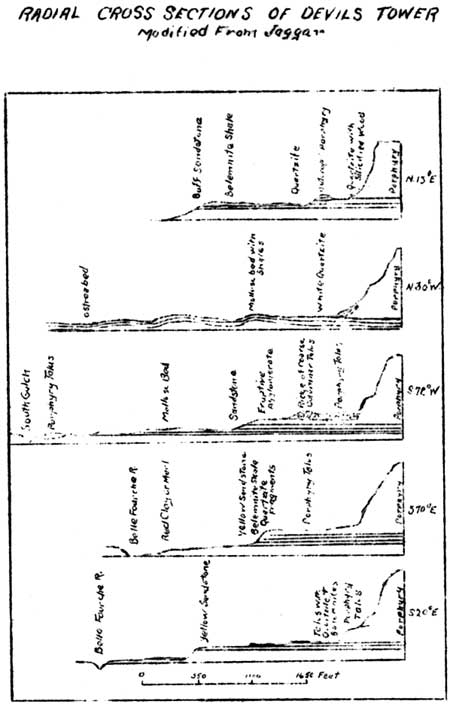
The accompanying sections show the structure of the platform beneath Devils Tower, which in general consists of level bedded Jurassic sandstone, marls, shale, and quartzite; any variations from horizontality being rather of the nature of dip toward the tower than away from it. North 25 degrees west from the tower about 1000 yards occur two quartzite ridges showing scattered fragments of quartzite on the side toward the tower, but without sufficient outcrop to give clear evidence of dip. About the same distance north 55 degrees west in the gulch the buff sandstone appears, dipping two degrees due north. Two hundred yards due north of the tower there is an outcrop of quartzite, very fine in texture, so as to appear almost like flint, of gray color, with a vertical lamination trending east and west, and 25 yards nearer the tower, adjacent to the quartzite, occurs a large mass of porphyry that appears to be an outcrop. On a small knoll north 75 degrees east of the tower, only thirty yards from the porphyry talus, directly at the foot of the great basal bench, there is an outcrop of quartzite carrying fossil fragments of silicified wood, and this quartzite is abundant here in the roots of fallen trees, indicating that this bed is the uppermost member of the Jurassic strata that underlies the eruptive mass. This quartzite undoubtedly occurs higher than the belemnite shales that cover the ridge on the southern side of the tower. The quartzite varies, in places consisting of distinct clastic grains, and elsewhere being of fine-grained aphanitic texture. The platform bench northeast of the tower is not so long as on the southwest side. It extends northwest for some 2000 yards, and the greenish belemnite shales here crop out below the quartzite. The best point of view for observing the synclinal sag under the tower is the road near Ryan's Ranch on the eastern side of the Belle Fourche Valley. From this point the talus of porphyry fragments from the tower to the very border of the stream may be best observed, and on either side the sandstone is seen to dip inward gently, forming a V-shaped sag of wide angle in which the apex is immediately below the great columns.
The Jurassic section is approximately as follows from the base of the tower down: (Jaggar 1901, p. 260).
Quartzite
Tancredia limestone
Smoky, fine-grained limestone
Belemnite shales
Oyster bed
Bluff of tender buff sandstone, sometimes pink
Green shales
Thick shell bed, forming a hard band
Buff marl
Gypsiferous red beds (marl)
GEOLOGICAL AGE OF THE
INTRUSIVES
The geological age during which the intrusive bodies of the Black Hills were formed may be stated only in the most general terms. The Bear Butte and Little Missouri Buttes laccoliths were intruded into Benton Cretaceous and were unquestionably covered by Niobrara limestone. Jenney found pebbles of Black Hills porphyries in the conglomerate at the base of the White River beds (Oligocene) to the southeast. This would limit the time of intrusion to that span of time between the Upper Cretaceous and the Lower Oligocene. Darton (1909, p. 76) states that the igneous intrusions probably occurred during early Tertiary time - or possibly in latest Cretaceous time - contemporaneously with the general uplift of the Black Hills.

|

|

|
|
|
Last Modified: Sat, Feb 9 2002 10:00:00 am PDT |