.gif)

Cover Page
MENU
|
The National Park Story in Pictures
|
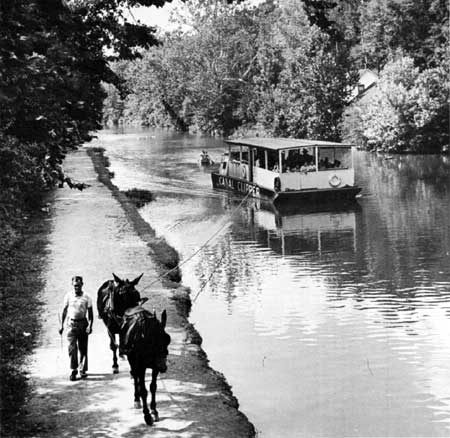
ALONG THE C & O CANAL, National Capital Parks. The Chesapeake and Ohio Canal, extending from Washington to Cumberland, Md., is one of the least altered of the old canals that once were an important part of the network of waterways over which flowed most of the transportation of the young United Stares. Its route, the Potomac River Valley, has played an important role in the westward expansion of the Nation. Through it passed, in turn, the Indian trail, colonial wagon road, canal, railroad, telegraph and telephone, and even some highways. Along the canal, in its heyday and until 1924, mule-drawn boats carried coal, flour, grains, and lumber. Now during the summer, mules or horses draw a barge carrying visitors along restored sections. Thought of more in the light of possibilities of water recreation in the National Capital Parks System when first acquired by the Federal Government, increasingly attention has centered on the historic aspects of the old waterway. Now plans are under way to seek congressional legislation making it a national historical park. Also under consideration is the construction of a parkway, away from the canal, for some 25 miles or so between Pawpaw in West Virginia and Woodmont in Maryland. This will make the park more readily accessible. In 1938 an allotment of $2,000,000 of Public Works funds made possible acquisition of the historic canal, which was first envisioned by George Washington in 1754. Another $500,000 of Public Works money made possible surveys, research, and some development. Early clearing of canal banks and other work was done with Civilian Conservation Corps labor and PWA equipment. (Photograph by Abbie Rowe.) |
| <<< Previous | >>> Contents <<< | Next >>> |
 Top
Top
|
|
Last Modified: Sat, Oct 5 2002 10:00:00 pm PDT
story/story35.htm