|
National Park Service
A Survey of the Recreational Resources of the Colorado River Basin |

|
Chapter III:
PLANT AND ANIMAL LIFE
RECREATIONAL VALUE OF PLANTS AND ANIMALS
Plants.—Regions devoid of plant life are among the most uninhabitable wastelands in the world. The rains or melting snows, unchecked by an absorbent mantle of forest or grassland, sweep over the bare slopes in torrents, carving out gullies that grow with the years until they become great barren valleys. Then, with the passing of each unchecked flood, the watercourses shrink to a trickle or vanish entirely.
Without plants there can be no cool, clear trout streams; no shady camping spots; no fertile, humus-bearing soil; no food for other forms of life. Even in desert lands there is usually a thin mantle of plant cover which, though sparse, helps hold the soil in place and permits a foothold for higher forms of life.
Recreational enjoyment of plants ranges from subconscious appreciation of their beauty and shade to active interest and wonderment at the marvelous diversity of plant forms which results from their adaptation to the earth's extremes of climate and environment.
Unity of plants and animals.—Plants and animals are dependent upon one another in a manner so complex and far reaching that they cannot be fully enjoyed, or protected, separately.
|
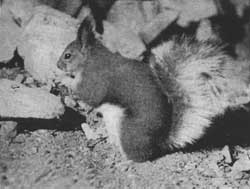
As an example of this interdependence, in mountain regions acorns roll downhill when they fall from the trees. Therefore, in the course of centuries the forests would travel downward from the high country and eventually would disappear if their reproduction were not assisted by other members of the plant-animal community. However, jays, woodpeckers, squirrels and other small animals that eat acorns assist the forest through their habit of carrying off and storing the surplus crop of nuts.
Often these creatures fly or run up hill with the seeds, and not infrequently they fail to find them or are caught by some natural enemy before the storehouse can be used. Seeds which sprout from these abandoned supplies become the trees which maintain the forest in the high places. [1]
In a like manner, many species of desert yucca are wholly dependent for their pollination upon a single kind of moth. This insect thrusts its eggs into the plant tissues surrounding the future seed, where the larvae will be safe from most enemies, and at the same time collects and applies the yucca pollen by means of mouth parts that are specially shaped for this work. [2]
|
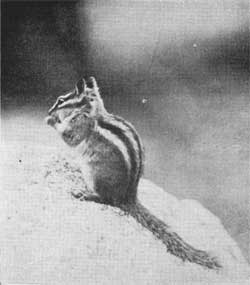
A commonplace, though very important and often forgotten, example of plant-animal dependence is the plowing and cultivation of the soil by billions of insects, earthworms, field mice, pocket gophers, moles, and other small burrowing animals. The vegetable matter that they drag underground to line their nests, or to eat, is transformed into humus that is essential to plant growth. In addition, the loosening and turning over of the earth through burrow excavations permits air to enter, which is required by the humus-forming bacteria. It also allows water to penetrate the soil, which otherwise would settle and pack year by year until it became as impervious as sandstone. When water penetrates the earth instead of quickly running off the surface, there is far greater plant growth; the soil washes away but little or not at all; floods are fewer; the soil is more fertile; and the land is a better place for living—and for recreation.
Animals.—If plants are essential not only to other forms of life, but to most recreation, animals are hardly less so.
During the decade ending in 1930, hunters and fishermen increased 400 percent and totaled 13 million. It was estimated that the recreational attraction of wildlife accounted for 254 million dollars of tourist expenditures annually, and that 158 million dollars was spent by hunters. [3]
By 1945, in spite of wartime restrictions, 20 million anglers and hunters spent 2 billion dollars per year in pursuit of their sport. [4]
The postwar trend toward shorter working hours and increased leisure no doubt will result in still more hunting and fishing. Some estimates place the future annual expenditures for this purpose at 3 billion dollars. [5]
At the beginning of the war only about 2 percent of the millions who went into the armed forces had previous experience with firearms. Their new skill and acquired habits of wide travel surely will further stimulate hunting, and no doubt fishing as well.
|
The trend may be still further accelerated if there should be a revolutionary increase in civilian aviation, permitting the average sportman to reach even the remote and choicest fishing and big game areas in a few hours.
Fishing and hunting are only two of many recreational values of wildlife. Rivaling the sportsmen in enthusiasm is a rapidly increasing group of amateur and semiprofessional wildlife photographers. Though the hunter may have a lifetime of unforgettable experiences, the wildlife photographer can claim an even richer field of opportunity and golden memories. For him there is no closed season, and no animal, however rare, is on his forbidden list. With luck and patience he may "catch and hold," to enjoy forever, yet unharmed, many beautiful and vanishing creatures denied to the hunter, such as the trumpeter swan of the northern lakes or the stately bighorn of the crags and canyon walls.
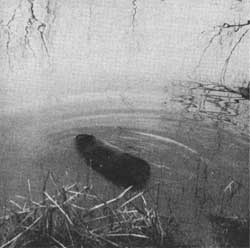
Probably even more important, though less vocal than these special groups of enthusiasts, are the millions of persons who derive lasting enjoyment from just watching and being near wildlife. For them the splash and spreading ripple of a beaver on a twilit pond or the fairy-like chimes of a thrush in the cathedral stillness of a forest, are a source of inspiration complete in itself. Their enjoyment is not to be measured in dollars, any more than sunshine or freedom can be so measured.
STATUS OF PLANT AND ANIMAL LIFE
Original conditions.—The stories that early explorers brought back from the western wilderness of the incredible lushness and wealth of vegetation and wildlife read like fairy tales to us now, who will never see birds in flocks of millions that darken the earth for hours as they pass, or grass as tall as a man's shoulder, thronged with endless herds of buffalo, extending to the horizon. Civilization has left for present generations so little trace of the overwhelming primeval abundance of the "wild west" that the imagination, even when aided by the early records, now finds it almost impossible to reconstruct the original picture.
Because of the arid climate, the lowlands of the Colorado River Basin had a much less luxuriant vegetation than that of other regions in the West, such as the prairies and great plains on the east side of the Rockies. Nevertheless, by contrast with conditions in much of the basin today, the forage and the wildlife that it sustained were almost unbelievably abundant.
The vast sage plains of the Upper Green River Valley and the Red Desert in Wyoming were comparatively poorly stocked with game even in the early days [6] because of the scanty rainfall and the absence of water over large areas. Nevertheless, prior to 1850 there appears to have been considerable grass among the sage. Bands of antelope and buffalo roamed those regions where there was water [7] and sage hens came to the waterholes at evening by the thousands. [8] Elk in vast numbers wintered in the Red Desert. Now hundreds of thousands of domestic sheep use the region as winter pasture. [9] The buffalo have vanished, as has most of the grass, and the antelope and sage hens are but a small percent of their former numbers.
In the somewhat better-watered though still relatively barren sagebrush valleys of the Duchesne, White, and Yampa Rivers in northeastern Utah and adjacent Colorado there was good grass in 1844, [10] especially at the higher levels, and this condition lasted until about 1879. Buffalo were present, together with antelope [11] which sometimes were sold by the wagonload for meat. There were sage hens [12] and mountain plover in uncounted thousands, but, as elsewhere, these vanished at an early date. The upland plover, the existence of which now is threatened almost everywhere, [13] was "rather common" in 1877. [14] By 1892 the sharp-tailed grouse, once abundant, was rapidly disappearing as a result of overgrazing and burning. [15]
Even some parts of the Canyon Lands of Utah, now notable for the barrenness of their immense sandstone wastes, once were surprisingly fertile. Although cattle were abundant in the area by 1872, the Henry Mountains still stood in a valley of grass. [16] Antelope were seen frequently on the near by San Rafael Swell [17] as late as 1895 by the few persons who penetrated this wild region, although these animals disappeared not long thereafter. Antelope Valley, which is southwest of the San Rafael Swell, undoubtedly got its name from the former presence of this species.
The great valley of the Little Colorado River now is covered with a sparse, scrubby vegetation composed principally of semidesert shrubs with bare soil and desert pavement between the scattered plants. Although some areas may always have been barren, in 1857 grama grass on great areas of mesa land grew tall and rank between these shrubs. [18] Elk, deer, and beaver were common in the valley near Window and one the adjacent grassy plateaus and there were great herds of antelope. [19] Since 1852, herds of cattle and sheep have replaced the antelope bands, and the grass is abundant only at higher elevations in the basin where lack of water has prevented grazing by domestic stock. [20]
Even the vast, unpopulated southern desert lands which are commonly imagined as eternally unchanging would in many places hardly be recognizable to those who first discovered them. Many desert watercourses that present generations are accustomed to think of as dry washes, or as intermittent streams at most, once flowed the year round. The more luxuriant desert vegetation of those early days checked the run-off from the storms more efficiently than at present, thereby reducing the volume of flash floods and distributing the stream flow more uniformly throughout the year.
Those who are familiar with the bare, dry, sandy bed of the present intermittent Santa Cruz River at Tucson, in the heart of the Arizona Desert, will find it difficult to believe that prior to 1776 water there was so abundant that travelers sometimes had to wait for 6 weeks before it was possible to get horses across its swampy expanse. During the latter part of the eighteenth century the Spanish inhabitants of southern Arizona could ford the San Pedro and other rivers only at certain places. [21] Tucson was established at the site of the swamp on the Santa Cruz River because of the abundance of wood, water, and meadowland at that time. Where now there is only powder-dry desert, the grass once reached as high as the head of a man on horse back. [22] The river bottom then was densely forested with giant mesquites that formed a wide green belt extending down the valley for many miles. The region teemed with immense numbers of quail and doves. Peccaries and other wildlife of Mexican origin were abundant and beaver were plentiful.
After 1800, the valley was denuded of its mesquite forests, and the ironwood was stripped from the hills to feed the nearby lime kilns and provide fence posts. The beaver were trapped out and their dams destroyed. With the disappearance of the vegetation, the wildlife that depended on it also vanished. This history has been repeated in various degrees in the San Simon (once lush with grassy meadows), the San Pedro, and nearly every other mesquite valley of the Southwest.
Changes in the desert away from the river bottoms have been equally profound. Today we are accustomed to desert lands in which there is little or nothing between the widely spaced cacti and woody desert shrubs except rocks, gravel, or bare sand. However, before 1870, the spaces between the desert shrubs were quite generally filled with grama grasses, [23] and it was these highly nutritious grasses that maintained the herds of antelope that were common in those days.
After 1870, cattle increased greatly in the desert regions and the grama grasses thinned and disappeared. The trampling hoofs stripped the thin protecting layer of decaying plant materials from the surface of the soil, which then dried up, and gradually blew away, or was washed away by unchecked flood waters, leaving the bare gravel and sand that we know as "desert pavement." When the cattle removed most of the grass, the cacti and tough, unpalatable shrubs were able to multiply and predominate as they had not before.
Not only were the antelope starved out, but in some regions the character of the desert vegetation itself slowly changed. Seedlings of the giant saguaro of southern Arizona require moisture-holding duff and the protecting shade of dense, low-growing brush in order to establish themselves. Over great areas of the desert these necessary conditions were removed many years ago by the grazing of cattle and have never been restored. [24] The old saguaros that lend to the Arizona Desert much of its spectacular charm now stand on practically bare soil. They are commencing to die of old age, and with their disappearance will come a great change in the landscape and far-reaching reverberations among the desert birds and lesser wild creatures that depend upon the saguaros for their existence.
The new generation to replace the dying saguaro forests is sparse or lacking. Restoration of soil, decaying plant materials, and humus would require many years even if commenced at once. A saguaro seedling requires 10 to 15 years to grow to a noticeable size and 20 to 30 years to reach above the surrounding shrubbery. Thus the desert could hardly reverse its present trend within the next 50 years even if actually encouraged.
The fading picture of primeval beauty and abundance has not been confined to the valleys and deserts. The vegetation of the mountains originally was much more luxuriant and its resistance to grazing was greater, because the more abundant rainfall gave it greater vigor. However, the process of deterioration has been the same, although it has taken a little longer. In 1847, grass in some canyons of the Wasatch Mountains in Utah was from 6 to 12 feet high, and in some places the first explorers found themselves unable to penetrate the thickets which it formed. Today, the grass in these places often is less than 6 to 12 inches high, offering no obstacle to travel in any direction. Great numbers of unpalatable weeds and shrubs have replaced the original forage, of which many of the best kinds are on the verge of extinction. [25]
In 1844, Mountain Meadows, on the summit of the Colorado River—Great Basin divide in southwestern Utah, was a beautiful valley of green grass that extended for miles, bounded by piñon- and juniper-covered hills. By 1877, the grass had been mostly replaced by desert shrubs as a result of sheep grazing, and the appearance of the landscape was so greatly altered that landmarks of 20 years before could no longer be identified. Today the "meadow" is dry, and gray with sage. Great gullies have drained away the water, so that even if ungrazed, the grass could not come back. Junipers have been steadily invading the site of the vanished meadow from the surrounding hills since 1862. [26] These conditions are fairly typical of changes which have occurred throughout the mountains of the Colorado River Basin.
Animal life in the mountains has undergone a corresponding decrease, as a result of direct persecution, as well as from forage and habitat depletion. In primitive times, elk were abundant in nearly all the mountains and foothill valleys of Wyoming, Colorado, northeast Utah, central New Mexico, and northern Arizona as far west as the Hualpai Indian Reservation.
A very trustworthy observer who has lived in the Ashfork region since 1896, says there was one old Merriam bull elk that watered with the cattle north of Ashfork as late as 1914. I could never question his record as he is a most conservative and careful reporter. He gave me a pair of Merriam horns a few years ago, one of two pair which he picked up in this same general area several years ago. [27]
By 1910, they were nearly exterminated in the Colorado River Basin, but subsequently, determined efforts, particularly in Colorado, have restored them to part of their former range.
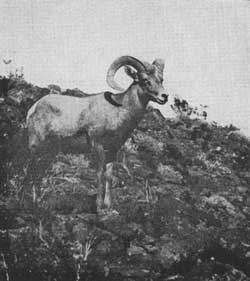
When the first white settlers came, bighorn in great numbers seem to have occupied nearly every canyon, cliff, and mountain range of the Colorado River Basin, but they began to decline about 1840. [28] By 1900, hunting, competition with domestic stock for the diminishing forage and water, changes in the type of forage plants, and diseases introduced by the domestic herds had reduced the bighorn to a dwindling fraction of their original numbers.
|
Beaver, which had molded American history for a century in the well-watered lands to the east and north, were remarkably abundant even in the Colorado River Basin in primitive times. In 1825, James O. Pattie caught 250 beaver in 2 weeks on the San Francisco River of Arizona and New Mexico. [29] The San Francisco is a tributary of the Gila River, which has but a meager stream flow today. Other trappers, including the famous Bill Williams, also found beaver abundant along the Gila and Salt Rivers.
Although beaver trappers had little success in the desolate gorges of the Colorado River in southern Utah, they found thousands of the animals in the more hospitable headwaters of the Green and Colorado Rivers. Individual trappers in the Rocky Mountains sometimes took as many as 500 beaver per year. However, the beaver's fate was like that of the buffalo, antelope, elk, bighorn, sage hen, turkey, grouse, and waterfowl. Though their original numbers had been immense, and though for untold thousands of years they had flourished in the presence of their natural enemies, the so-called predators, yet against the attacks of civilized man they held out less than 25 years before being brought to virtual or complete extinction. By 1840, the beaver market went into a decline from which it never recovered. Recent conservation measures have brought about good recovery in some areas, but the profound changes in the land brought about by human settlement and development make it impossible for the animals ever to regain their primitive numbers.
Almost as much a symbol of the wilderness of long ago as the buffalo is the wild turkey. In 1824, there were thousands of them in practically all the forested mountains and foothills of Arizona, New Mexico, [30] and southern Colorado (as well as in similar areas adjacent to the Colorado River Basin). In Arizona, they even came down from the mountains to the banks of the San Pedro River, which was thickly overgrown with giant mesquites at that time, and ventured into the desert far enough to feed on the fruits of the saguaro. [31] Wild turkeys now seldom wander from the ponderosa pine forests of the Transition Zone, and even in that zone they have been reduced to a fraction of their original numbers. In Texas, it has been shown that overgrazing eliminates many food plants required by wild turkeys. [32]
The chronicle of disappearance and deterioration throughout the Colorado River Basin since 1825 would be long if given in full, although the region has lost less of its primitive resources than have many other parts of the United States. To gloss over these great losses of the past would be futile, for the forces that brought about many of them continue almost unchecked even today. The only hope lies in recognizing them, in learning their causes, and in actively working to stop them now. An account of some of these causes follows, with an indication of remedial measures.
Changes caused by man.—1. Farming. A fertile environment produces large numbers of plants and animals, but an infertile one can support few or none. This fundamental biological rule governs practically all living creatures, including man. It goes far toward explaining the widespread disappearance of wildlife following human occupation of the country.
The plains, foothills, and lower valleys—not the cold mountains or the rainless deserts—have a virtual monopoly on the moisture, warmth, and deep, fertile soils that are necessary to produce abundant vegetation and other raw materials required by the higher forms of life. An abundant vegetation is required to feed the billions of insects, worms, and other invertebrate creatures that support the hordes of small birds and rodents. These, in turn, make possible the existence of such valuable fur bearers as the raccoon, marten, and the rare fisher, and the picturesque hawks and eagles which act as a "governor" to prevent the overproduction of the herbivorous animals.
|
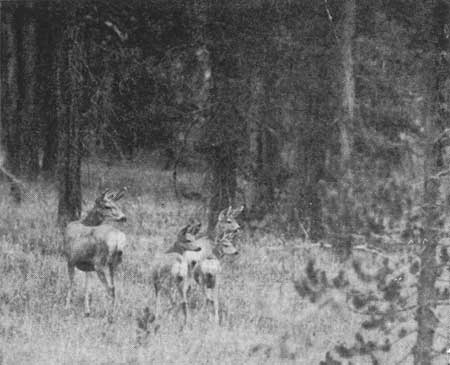
| Figure 32.—Mule deer. |
An abundant vegetation is required also to sustain the deer, elk and antelope, beaver, wild turkey, grouse, and waterfowl that once swarmed over the plains and foothills in such numbers that they were thought to be inexhaustible. The same biological relationship between warmth, abundant food, and large numbers of animals enables the more fertile waters of the lowlands to support many more fish than can the waters of the mountains, and permits the individual fish to grow larger.
Although excessive fishing and the slaughter of game on a commercial scale were among the principal causes of wildlife depletion at the time that the country was settled, several more deep-seated causes soon commenced to operate and have continued to hasten disappearance of the original conditions long after the wholesale slaughter of the early days was halted by law. One of these causes of depletion has been the occupancy of most of the choice, fertile regions of the country by cities and farms.
Elk, deer, beaver, turkeys, and many other wild creatures, that in the West are considered today to be almost exclusively mountain dwellers, had their centers of abundance, particularly during the winter, in the lower hills and adjacent valleys. When these lowlands were cleared for farming or for the establishment of cities, the original plant-cover was destroyed and the animal life was forced to move, if it could. The elk and deer which previously had used the mountains primarily for summer range now were forced to live there the year round. Other less adaptable kinds of animals dwindled away or died out completely.
Retreat into the mountains, however, brought new problems of existence for those animals that were able to change their life habits in this manner. Fur-bearing animals found fewer rabbits, mice, and birds because the growing season for vegetation required by the latter was shorter at the higher altitudes. The deep, long-lasting snows often buried more than half of what browse there was beyond reach of elk and deer. Many mountain lakes used by waterfowl in summer froze solid in the winter months. The biological relations between numbers of animals and fertility of the environment immediately operated to maintain the migrants from the lowlands at a permanently low population. Competition between different kinds of animals for what little food there was became unnaturally severe during the winter months. Elk crowded into what was formerly a sheltered range of bighorn in the ponderosa pine belt, thereby forcing the bighorn to remain all winter on the higher, windswept areas above the timber line. [33] Today, the cold mountains and the rainless deserts are the principal remaining strongholds for many kinds of wildlife, not because they are the most suitable or productive areas, but because they are all that man has left in a relatively undisturbed condition.
However, wildlife has dwindled away in the desert, too, for settlements have been built around some of the best watering places. Water from many of the remaining scattered springs has been piped away to mines and ranches, and, as mentioned later, even the rivers have dried up. Where water still remains, it is often used so heavily by livestock that all vegetation in the immediate vicinity is destroyed, leaving no cover for game birds or other animals. Under such conditions the water is as unavailable as though it had been fenced or piped away.
2. Grazing. In the days of early settlement, grazing was carried on with the same reckless, competitive abandon as was the first cutting of timber and the commercial slaughter of wildlife for the meat market. No natural resource, however abundant in the beginning, has long withstood such wasteful use.
At the termination of the Civil War in 1865, the cattle business of the West entered a boom period comparable to the Gold Rush. In the scramble to get rich from the vast, new, unfenced lands, great syndicates were formed in the East and in England, and men and money poured in even from such far away places as Australia.
North and west from the Great Plains through the Uinta Basin in Utah and the Red Desert and the Upper Green River Valley in Wyoming, all the way to Canada, the tide rolled in. So abundant was the grass at first, even in that inhospitable climate, that no winter feeding was done—an inconceivable practice today. With such overstocking the primitive grassland disappeared. The severe winter of 1886 brought about the end of boom times. Cattle perished by the thousands, and unlimited grazing without winter feeding in the Northwest States collapsed. By 1895, "not an acre of grazing land was left unoccupied, and ranges that for permanent and regular use would have been fully stocked with a cow to every 40 acres were loaded until they were carrying 1 to every 10 acres." [34]
In the Southwest the story was repeated a few years later. Grass grew more slowly than in northern regions because of the lighter rainfall. Although often luxuriant, the grass withstood the reckless grazing competition less easily because its moisture requirements were close to the danger line of water availability. Mountains and plains, stripped of their green covering, turned to dust. Freshets tore away the trampled sod of mountain meadows and cut deep gullies into the unprotected soil, thereby draining the meadows and turning them into deserts. In 1893, drought and ruination of the range brought the cattle boom of the Southwest crashing to a finish. [35]
The forage of the early days, like the wildlife, never has regained its primitive abundance. Perhaps it never will, even with the application of conservation measures learned in later years, for when the forage commenced to die from overuse, the soil began to die, too. Just as animals and plants are dependent upon one another for life, so are plants and the soil mutually dependent, both for their daily existence and their perpetual renewal.
Importance of topsoil.—Topsoil, the life substance of grass, is a porous, chemically active medium, sometimes one-third to one-half air and from a tenth to one-fourth water. [36] In the surface layers of good topsoil, the air, the water, and the warmth of the sun combine to form a rich culture medium for a vast unseen world of struggling micro-organisms—billions of them to the square foot. Bacteria, protozoa, and microscopic fungi, during their own life processes, change the free nitrogen of the soil, and the nitrogen of decaying materials, into substances that plant roots can assimilate. By their endless rotting and disintegrating action on rocks and dead roots, on the bodies of other animals and last year's half-buried leaves, they keep the spaces between the soil particles open, whereby air, water, and warmth keep the fermentation process going on endlessly.
The microscopic soil-makers are aided by the millions of tiny worms and burrowing insect larvae that drag living and decayed vegetation, which they use for food, beneath the surface where the bacteria, too, can reach it. This yeasty brew of invisible, silently struggling creatures is a thin web of life draped over the mountains and valleys of the earth wherever there is topsoil. The chemicals which it distills are the life-juices that the roots of the plants must suck from the soil in order to live. Without topsoil, life for most plants is impossible.
However, topsoil seldom is more than 7 to 12 inches deep. [37] The chemical processes that form it, through the gradual decay of underlying rock, and the mixing of this rock with the products of organic decay derived from the surface of the soil above, are very leisurely. Some rich soils may accumulate at the rate of not more than 1 inch per 1,000 years. [38] Therefore, if a 7-inch layer of such a topsoil is removed, the full thickness cannot be replaced from the barren, chemically inert stratum of disintegrating rock beneath it in less than 7,000 years, even if all other conditions should be favorable for the required reaction.
Thus, when all of the topsoil is removed, the land dies, and with it die also the plants and the animals, whose lives are all so inextricably bound up together.
Difference between natural and man-caused erosion.—Removal of the soil layers, by whatever means, is known as soil erosion. We are concerned with it in the Colorado River Basin because much of this soil erosion was caused by ruinous overgrazing in the early days of settlement. But first a frequent and dangerous misconception must be corrected regarding two very different kinds of erosion, and man's responsibility in relation to them.
Natural or geologic soil erosion is a slow process, except in a few special areas. It is so slow that in humid climates, where the soil is held together by a luxuriant protective mantle of forest and grass land, the rate of new topsoil formation balances the rate of erosion. Even in an arid climate like that which prevails in most of the Colorado River Basin away from the mountains, the accumulation of vegetable litter, the formation of new soil, and the healthy growth of a protective covering of grass originally occurred on almost all slopes and flats. It is true that in the Colorado River Basin the lowering of stream beds and canyon bottoms by natural erosion, and the reduction in size of plateaus and buttes by the weathering and collapse of their vertical-walled perimeters, proceeded at a rate that, geologically speaking, was fairly rapid, when compared with that of some other regions. The top surface of the country also was extensively planed down during the lapse of millions of years. Nevertheless, in terms of year-to-year continuity, the topsoil was healthy, and maintained a wealth of plant cover and animal life in startling contrast to what is found today. Natural erosion originally was no insuperable obstacle to fertility and abundance even in the desert. For example, in the great expanse of sandstone soils of the Little Colorado River Basin, "where the cover of grass, sage, and other low growth has not been disturbed by grazing, erosion is of no importance; but under conditions of depleted vegetation, as a result of overgrazing, sheet erosion, gullying, and wind erosion are active over large areas." [39] The soil has sickened and commenced to die only after the balance has been disturbed by the coming of the white man.
Man-caused or "accelerated erosion" results when grazing and other agricultural activities strip away the plant cover and allow the wind and water to wear away the topsoil more rapidly than nature ever did. In many places, this living surface layer, product of hundreds of centuries of microscopic accumulation, has completely disappeared, and the land has died within the space of 20 years. [40] The misconception of those who fail to distinguish between natural and man-caused erosion, imagining that the consequences of the latter are of little importance, is like that of a person who would ignore the fact that his house had caught fire, on the theory that fire always had existed as a purely natural phenomenon.
Franklin Flat, in the San Simon Valley of Arizona, was covered with grassy, flower-spangled meadows in 1882. Grass was stirrup-high along the continuously flowing river, which had practically no banks. In 1895, 50,000 cattle were grazing in the valley. By 1934, as a result of overgrazing, the green meadow cover had been replaced by drifting sand and the river, now an intermittent stream, had cut a chasm through the heart of that once-fertile land. [41]
Oraibi Wash, once a small stream tributary to the Little Colorado River in Arizona, has been cut by silt-laden, runaway waters into a twisting gully 80 miles long and from 20 to 80 feet deep. [42] The adjacent Polacca Wash commenced to deepen after 1868, when immense numbers of livestock were crowded upon the newly created Navajo Reservation. Now the wash is dissected by a continuous 90-mile gully from 10 to 50 feet below the valley floor, with great tributary gullies that continually eat into the slopes of Black Mesa. Today, "overgrazing has altered the plant association on the mesa areas of the Polacca Wash drainage and has so increased the run-off that all rains except those of very low intensity cause soil erosion" [43] Most of the hundred-foot-deep channel in the Jadito Wash has been cut since 1914.
Chaco Canyon had no gully in 1849 and contained a continuous, clear stream. By 1877 an arroyo 16 feet deep and 40 to 60 feet wide had developed. In 1924 this arroyo was 30 feet deep and 200 to 300 feet wide. There is no stream there now except during flash flood. [44]
The Santa Cruz River did not develop a continuous channel until 1890. [45]
Until about 1888, the (San Pedro) valley consisted of a narrow strip of very fertile sub-irrigated fields. Beaver dams retarded the flow and prevented channel cutting. Trapping of the beavers and removal of the grass from the hillsides allowed such an increase in erosion that by 1892 or 1893 a channel 3 to 20 feet deep had been cut almost the whole length of the river. [46]
In 1846, even the Gila River, which, like the Colorado River, receives much sediment from natural erosion, flowed clearer. Its tributaries commenced to erode rapidly only after 1870.
Kanab Creek, in southern Utah, commenced to erode severely in 1883. Three years later a gully 60 feet deep, 70 feet wide, and 15 miles long had been formed. [47] Formerly timbered slopes on the Chuska Mountains of northwestern New Mexico have been eroded down to bedrock in some places as a result of overgrazing. [48]
Wind has added its influence to that of water in scouring away the unprotected topsoil. Winds are strong over the Colorado River Basin, but in the early days of settlement, dust storms and whirlwinds were relatively small in scale and infrequent. Trampling hoofs loosened and broke the protective, all-embracing grip of the virgin grass roots. When the plant cover was depleted, the soil dried out and become pulverized. Now the whirling dust columns march across the desert and semi-arid lands of the basin during the spring, summer, and fall months. Finer soil particles are sucked high into the air and sometimes are carried hundreds miles; coarser particles are rolled and skipped along the bare surface, accumulating in drifts when they encounter an obstacle. Dust storms last for days, particularly in the basin of the Little Colorado River, obscuring the horizon. When the wind blows continuously, "blow holes," where the soil lighter or the vegetation scantier, send up such stream of dust from a given spot that from a distance it resembles the billowing smoke of a factory.
The great dust storm of May 12, 1934, stimulated national interest in the problem of erosion. This spectacular dust cloud was the first one in history big enough to retain its identity as it swept across the country from the Great Plains to beyond the Atlantic Coast. It blotted out the sun over a large part of the nation and sifted through the windows of New York skyscrapers. When that happened it began to dawn on the public that something had gone wrong with the land resources of the nation. [49]
Meaning of soil erosion to human welfare.—The seriousness of soil erosion to the future of the entire nation has been emphasized over and over again experts, who have ably presented the picture of slow destruction. The dying of the soil is all the more insidious because the first stages often have been slow enough to escape notice from one generation to another. By the time they have speeded up and become conspicuous, complete restoration is usually hopeless. The Soil Conservation Service estimates there are in the entire country some 200 million erosion gullies. These, and the still more widespread sheet-erosion, already have ruined 14 percent of the United States or an area nearly eight times as large as Wisconsin. An additional 35 percent of the land is now threatened.
These facts regarding soil erosion in the country at large help to give some perspective regarding conditions in the Colorado River Basin, where aridity accentuates the problem. In that region,
. . . crops often are poor and pastures thin, not because of insufficient rainfall but because too much of the available rain is permitted to run to waste. In other words, although the actual climate is unchanged, the effective agricultural climate or effective rainfall in terms of water at the plant roots has been tending in many areas, under this artificial acceleration of run off, toward the equivalent of a very dry climate. When this tendency is combined, as it generally is, with a continuing loss of fertility through erosion, the farmer faces a serious prospect of steadily declining yields and steadily dropping income. [50]
Obviously this prospect of decline applies also to other soil crops of the region, such as native plants and wildlife.
The Forest Service estimates that it takes one-fifth more range of the tall-grass type to feed a cow now than when the range was first used. On short-grass range, nearly twice as much acreage is needed now; on sagebrush-grass range, more than three times the original acreage; and on salt-desert shrub, three and one-half times the former amount. Continuous overgrazing has changed the whole character of the range, reducing the quantity and quality of the forage and deteriorating the soil itself. [51] The importance to human welfare in the Colorado River Basin of this reduction in the production capacity of range land may be judged from the fact that grazing outranks all other agricultural interests there manyfold.
Soil washed downstream from the uplands is deposited in lower-lying areas whenever the velocity of the water is decreased by a lessening of the stream gradient. In the Colorado River Basin, material that has been removed from other areas seldom benefits the land on which it is deposited, and usually does great damage. If erosion in the uplands has been going on very long, the sand, gravel, and inferior subsoil that is washed downstream covers the good bottom lands with a layer of inert materials.
Reservoirs become choked with this sand and gravel, and with a fine slimy mud that kills fish and spoils recreation. Often the deposited materials interfere so seriously with water storage as to threaten the principal purpose for which the reservoirs were constructed. In extreme cases, such as the removal of all watershed vegetation by fire, reservoirs have been almost completely filled with soil during a single month of heavy rain.
In the Southwest high rates of silting are largely the result of overgrazing, which induces extraordinary sheet and gully erosion. At the Elephant Butte and Zuni Reservoirs in New Mexico and Coolidge and Roosevelt Reservoirs in Arizona, the watersheds are subject to both sheet and wind erosion and to arroyo and gully development and the badlands type of dissection. In the watershed areas of the Zuni and Roosevelt Reservoirs, sheep grazing under arid conditions which has reduced the vegetal covering is responsible for much of the accelerated erosion. [52]
When the retarding influences of vegetation and soil porosity are lost, floods increase in violence. There have always been floods, even under strictly natural conditions, but the nature and the enormous extent of recent deposits along thousands of streams are proof to geologists and soil surveyors that the floods of today have become increasingly violent and dangerous following the destruction of vegetation. [53]
Some stockmen, and a few others, while admitting that these profound land changes have indeed commenced since the advent of heavy grazing, maintain that there is no true connection between the two, and that the real cause of the range deterioration is to be found in a recent change of climate. This claim is not supported by recent careful investigations. [54]
Examination of evidence in tree-rings, lake levels, cutting and filling of valleys, and in the development of pueblo peoples fails to reveal proof of any climatic change in the Southwest in the last 2,000 years. Climatic fluctuations of the magnitude experienced today have occurred, and intense storms and groups of intense storms have had their effect on the landscape, but if there has been any progressive change toward either a more humid or a more arid climate that trend is so slight as to be completely overshadowed by the shorter period fluctuations. [55]
Hunting, fishing, and trapping.—The pioneer days, marked by the careless, mass slaughter of wildlife when millions of waterfowl glutted the meat markets, when antelope were hauled to town by the wagonload, and buffalo were shot by the thousands for their tongues alone, or for fun are gone. Before the killing was stopped by belated conservation laws, some of the most incredibly abundant wildlife species had been nearly exterminated and several had vanished forever.
Nevertheless, as far as hunting and fishing are concerned, the picture today is no longer black. Conservation organizations have sprung up in great numbers, many of them organized by hunters and fishermen. Conservation of natural resources is taught in the schools, and many universities now offer comprehensive training in the field of wildlife management, which has become a recognized profession. State and Federal protective legislation has become more and more responsive to the demands of national conservation groups, and, in recent years, has begun to take into account the investigations and recommendations of trained biologists. Some threatened species already have been partially restored, or at least rescued from extinction.
Much progress in conservation education remains to be made, particularly in bringing about public and legislative recognition of the great value of many so-called "predators," the importance of which has been conclusively demonstrated by the comprehensive investigations of innumerable field biologists. Even here, however, the trend is hopeful. Hunting, fishing, and trapping no longer are the principal obstacles to the restoration of wildlife. Land use, or abuse, in relation to the remaining soil and plant cover, will determine the destiny of our native plants and animal life.
Stream pollution.—Because of the sparse human population in the Colorado River Basin and the relative scarcity of large industrial establishments, stream pollution is not nearly as serious as in the East. However, mine and mill waste has destroyed large numbers of fish at times, [56] and still is responsible for the poor quality of fishing in many Rocky Mountain streams.
The recent introduction by man-caused erosion of great quantities of sediment into streams that formerly were clear is a form of pollution. Fish food is destroyed during floods when the moving sand and gravel tear aquatic plants and animals loose from stream beds and grind them to pieces. Silt deposited in stream and lake beds smothers aquatic growth in a manner comparable to the burying and killing of topsoil on land by the deposition of inert layers of flood-borne sediment. Fish may be killed directly when spawning beds are covered by the silt deposits and the eggs smothered. In severe floods the fish often are suffocated by the suspended mud or crushed by the moving masses of rock and gravel. [57]
Even in the absence of scouring floods, any fine silt or mine sediments that may be suspended in the water are extremely harmful because they shut out the sunlight that is required for the growth of bottom-dwelling aquatic plants. These plants, particularly the microscopic forms, are the starting link in the aquatic food chain in the same general way that topsoil organisms have been shown to be the starting link in the terrestrial food chain.
REMEDIAL MEASURES SO FAR TAKEN
The decline of wildlife reached an all-time low in the late 1920's. Since then, vigorous conservation efforts have partially restored some, but by no means all, species.
Regulations.—Gradual enactment of fish and game laws finally checked the old-time slaughter of wildlife, rescuing some species from the verge of extinction and permitting others to recover to a considerable extent. Such regulations were absolutely essential and always will be part of any conservation program, but they cannot solve the fundamental problem of wildlife production. They can be used to curtail the taking of wildlife to a safe proportion of the remaining numbers, but they cannot restore the worn-out land, de-silt the streams, or bring back the grass. If and when such a restoration is accomplished, present hunting and fishing regulations no doubt can be extensively liberalized.
Artificial propagation.—In recent years, large sums have been spent annually by State and Federal departments on artificial fish propagation. Similar expenditures are made by State and private agencies on the propagation of game birds, and by private industry on the production of fur bearers.
No doubt, artificial fish propagation always will be necessary to satisfy the requirements of the vast and growing number of fishermen. However, the addition of new fish, no matter how great the numbers, cannot restore the productivity of lakes and streams. If the former productivity and stability of the waters can be restored, artificial propagation either can be reduced or, if maintained at the present volume, can furnish vastly more recreation to still greater numbers of people.
The artificial propagation of game birds is becoming recognized as an expensive substitute for the process which nature formerly accomplished on an incomparably greater scale. A few introduced game species have been able to hold their own in an impoverished man-made environment, just as certain plant species have been able to take over after the native grasses were killed out. However, it has been learned that permanent results usually are dependent upon restoration of the land to something like its former productivity. When this is accomplished, nature needs only moderate help from man in restocking.
Fur farming is replacing wild trapping to an increasing degree because of the declining productivity of the wild lands. One of the benefits of restoring some types of lands, and using them on a sustained yield basis, will be the revenue from furs. However, if the current demand prevails, commercial fur farming hardly will lose its present importance.
Refuges.—The establishment of wildlife refuges has on the whole brought excellent results. Their necessity is indisputable, and the only questions that might be raised relate to whether present distribution is adequate in all parts of the country, and whether existing and potential refuges might be made more productive.
There seems little question that the present number of waterfowl winter refuges, in the United States as a whole, is insufficient to feed the number of birds now being produced during the summer months in Canada and Alaska. [58] In the Colorado River Basin, as elsewhere, former natural feeding grounds for waterfowl have been converted to agricultural use, thereby further aggravating the problem. Reservoir construction offers a potential solution to the waterfowl feeding problem, but such a solution remains strictly theoretical unless operating water levels in the reservoirs are kept within such bounds as to permit the actual production of food for waterfowl.
The States of the Colorado River Basin operate many important refuges for waterfowl and game animals, but within the actual limits of the basin the distribution of refuges is irregular. An increase in the number of refuges within the basin would be beneficial provided the productivity of the land also was restored. "Most wildlife refuges provide feed. Most refuges for mammals only protect them from shooting and do not exclude domestic stock. This difference is fundamental." [59] The present restricted status of antelope in northern Arizona, where the creation of antelope refuges would be inadvisable at present because of the lack of grass, is a good illustration of this point. [60]
The vast amount of Federal land in the Colorado River Basin would, if other circumstances were favorable, make possible the creation of a system of refuges of far-reaching importance. The Fish and Wildlife Service maintains a number of waterfowl refuges on various large reservoirs, and several important desert game refuges. Production of food for waterfowl on these reservoirs is small, and consequently their potential value is largely unrealized. As in the case of State refuges, extension of a Federal system of game refuges would be beneficial only if the productivity of the land were restored.
The National Park Service, by reason of its policy of maintaining absolute sanctuary for wildlife, maintains in effect an irregularly distributed system of refuges along various parts of the Colorado River. However, a fundamental defect of some national park and monument areas as wildlife refuges has been their relative lack of fertility. Rainless deserts and barren canyon walls often make spectacularly beautiful recreation areas, but as a rule they can produce only inconsequential numbers of wildlife.
The U. S. Forest Service administers some of the largest and most outstandingly productive natural habitats remaining in the Colorado River Basin. In contrast with the general situation throughout the remainder of the basin, most wildlife has held its own there in recent years, and some species have increased. One reason for the better status of wildlife in the national forests is that the latter are located principally in the foothill and mountain areas, which are the regions least subject to transformation by urbanization, heavy industry, and intensive farming. Another reason is that wildlife has received increasing consideration in forest management following recognition of its recreational value. The result is that forest lands function as one of the most important refuge systems in the basin, even though hunting is permitted. However, aside from the hunting, which is a legitimate form of recreation and is carefully regulated, national forests are by no means absolute wildlife sanctuaries. This is because under the existing principle of "multiple-use," other economic activities that interfere in varying degrees with maximum wildlife production are allowed to dominate. Heavy grazing, and the intensive trapping of rare fur bearers, probably are the most serious of these competing economic activities at present. In theory, the great body of knowledge that has been accumulated on game and range management shows the way to a profitable reconciliation that will also restore land productivity, but in practice, local pressure groups in many areas so far have prevented the actual application of the needed reforms to the land.
Soil conservation.—The Soil Conservation Service, of the U. S. Department of Agriculture, has been engaged since 1933 in large-scale demonstrations of how to prevent man-caused erosion and restore the soil to its original productivity. These demonstrations are given at the request of soil conservation districts, which are voluntary local organizations of farmers and ranchers who wish to save their lands from further erosion by adopting agricultural practices that will restore and preserve the soil. As of October 1944, there were 1,169 such local soil conservation districts covering approximately 650 million acres in 45 States.
The Soil Conservation Service has shown that of its 59 time-tested soil-conservation practices, all assist indirectly in bringing back wildlife, while several methods, where applicable, bring a direct increase almost at once, often with cash benefits in the form of fur or food fish. These methods include marsh development and management, beaver management, stock pond development, stream bank protection, and range reseeding. "Even in the Southwest, farm ponds of Arizona and New Mexico show promise of becoming highly productive," [61] thus affording both food and recreation.
Development and protection of vegetation on odd corners, or on wastelands and gullies that can no longer be used for any regular agricultural purpose, has not only prevented further loss of soil, but has produced large quantities of wildlife, particularly game birds, having a high recreational value. Often this wildlife could not otherwise have found any suitable habitat in the region. The Service has stated that in the United States as a whole, 5,641,300 acres of otherwise unusable land can be reclaimed for this purpose.
Range management.—Soil erosion and range surveys have been carried on by the Soil Conservation Service throughout the country, but actual restoration projects so far have been concentrated to a considerable extent upon farm lands, particularly in eastern States. In western regions, including the Colorado River Basin, vast grazing areas lie in the public domain. This range land is administered by Federal agencies, and is not adapted to voluntary organization by small agriculturists into soil conservation districts. In 1938, an interdepartmental board was created to facilitate cooperation in soil conservation between the Soil Conservation Service and other Federal agencies, including the Forest Service, National Park Service, and the Bureau of Indian Affairs. One of the most important projects of the Soil Conservation Service in the Colorado River Basin has been its joint demonstration with the Bureau of Indian Affairs of range management on the severely overgrazed Navajo Indian Reservation.
Much of the land in the Colorado River Basin is administered by the Bureau of Land Management of the Department of the Interior. The Taylor Grazing Act, establishing the Grazing Service, now incorporated in the Bureau of Land Management, was passed by Congress in 1934 to protect the public domain from the unregulated and destructive grazing that had existed since the first days of settlement, and to provide for the orderly development and restoration of the range.
Considering the enormous loss of forage and topsoil that had taken place before the creation of the Grazing Service by this act, subsequent progress in restoration of the land, though slow, gives room for hope. Livestock has been better distributed by the extensive development of springs and stock reservoirs. Wildlife has benefited not only from the water development but from the more equalized distribution of the livestock, with its attendant lessening of overgrazing.
Grazing regulations provide that "a sufficient grazing capacity of Federal range will be reserved for the maintenance of a reasonable number of wild game animals to use the range in common with domestic livestock." Although the feeling is by no means universal, many stockmen definitely favor game conservation, and are willing to support any measures for its restoration that do not seriously interfere with the numbers and welfare of their livestock.
Although the Bureau of Land Management receives no funds for wildlife conservation, and any progress in that direction is voluntary or incidental, a noticeable increase in various game species appears to have resulted from such range improvements as have been accomplished to date. Many Bureau of Land Management field men serve as volunteer deputy game wardens, and there is considerable cooperation on specific wildlife problems with local sportsmen, State conservation agencies, and Federal departments.
Proper regulation of the numbers of livestock and of the duration of the grazing season on the grazing allotments is one of the most important conservation functions of the Bureau of Land Management, because the only hope of restoring soil and plant cover lies in that direction. Control of the number of livestock grazed on the public domain is achieved in part by allotting grazing areas and permits only to soundly established local operators who have a personal stake in the future of the land, thereby eliminating the reckless competition between owners of transient livestock that characterized the early days of unregulated exploitation.
Decisions as to numbers of livestock to be granted under each permit are made by the local Bureau of Land Management representatives, and are passed on by the local advisory boards. The latter are composed of cattlemen and sheepmen elected by the users of the range, and one wildlife representative who is appointed by the Secretary of the Interior on the recommendation of the State fish and game department of the area. Although the local advisory boards are without executive authority, their general attitude is naturally an influential factor in local range policy, including any proposed program of curtailing the present numbers of livestock in order to improve the ultimate carrying capacity of the range. Obviously, effective range restoration requires that the technical knowledge of the local Bureau of Land Management representatives be supported by an enlightened outlook regarding modern principles of range management on the part of these boards.
Public education in conservation.—The awakening of the public, and of the law-making representatives of the public, to an understanding of the basic importance of soils and waters, and the magnitude of the Nation's losses in terms of them, has hardly commenced.
Scattered, uncoordinated efforts are made in this direction by many public-spirited agencies and individuals, but the total effort lacks focus, and for the most part reaches only those who already are converts, while millions of the general public remain almost totally unaware that a problem which may be soberly assessed as a national catastrophe even exists.
There is a demand by conservation organizations and schools for information on the work of the State fish and game departments. The latter try to fill this need, often with less than adequate funds to develop their educational programs. Beautiful pictures of wild animals often are shown, and heartening progress told of restocking activities, but seldom is there mention of the basic importance to the country of soil and water, their present plight, and the possible methods of restoration. Educational activities of most of the Federal conservation agencies, too, tend to stress the pleasant facts of accomplishment, omitting reference to problems that might arouse public inquiry and concern.
The Forest Service wages a vital educational campaign against forest fires. The Bureau of Land Management is conducting a long-range campaign of practical education to demonstrate to stockmen that conservative grazing yields more pounds of beef and mutton, and more money in the long run than overgrazing, but appropriations received for this phase of the work are hardly on a scale with the need, and meanwhile soil erosion caused by overgrazing continues to drain away the life-substance of millions of acres.
The National Park Service endeavors to maintain the areas under its jurisdiction as complete wildlife sanctuaries. It also stresses the importance of watershed protection in many of its educational programs. Nevertheless, for the most part, it has not been possible to present a clear-cut picture that will enable the general public to understand the basic reason why an ungrazed area with fertile topsoil, held in place by healthy vegetation within the parks, produces more abundant wildlife, clearer and better stocked trout streams, finer forests, and many more flower-covered mountain meadows than a comparable but overgrazed area. Such education in the fundamentals of soils and waters undoubtedly would enlist more active public support for the Service in its efforts to eliminate overgrazing from places like Saguaro National Monument, where the natural conditions which led to the establishment of the area have been practically destroyed.
The schools, for the most part, have missed their conservation opportunity just as completely. As a former director of the Fish and Wildlife Service has pointed out, [62] the history books of the West tell of the great wealth derived from the early fur trade and the enormous fortunes established by the cattle kings, but fail to mention that sheer wastefulness brought an end to that era; and, more importantly, that even today good conservation practices eventually could restore that wealth to many of the lands and waters of the West.
At the education level of the universities seldom is the enormous wastage of water pollution, soil loss, and general land mismanagement really driven home. At present relatively few university graduates are aware of the existence of a national soil erosion problem. Yet it is from this class of educated persons that many of the principal ideas for future development of our country will come.
In the field of fundamental conservation education, the work of the Soil Conservation Service has been exceptional, in part no doubt because this agency was especially created for the purpose, whereas the education program of the Fish and Wildlife Service [63] and other agencies have had to be incidental to other primary responsibilities. Probably this circumstance points to the major defect in our entire conservation-education set-up. Though it is basic to the future prosperity of the Nation, now that frontiers are dwindling and population-saturation is approaching, conservation education, for the most part, has been merely an unorganized labor of love, and not the primary responsibility of any definite agency. To quote from the Secretary of the U. S. Senate Special Committee on Conservation of Wildlife Resources:
I believe, therefore, that the greatest conservation problem that confronts us today is that of conserving our soil. And this can only be accomplished by fundamental understanding brought about by education, both in the school and the political arena. [64]
Wildlife research.—Comprehensive research on habitat requirements and methods of increasing wildlife was commenced on a small scale more than 30 years ago. In 1911, the Committee of Inquiry on Grouse Disease, in England, published results of an exhaustive study of the red grouse that was a remarkable forerunner of modern wildlife management investigations. Studies of the food habits of many birds as they affected agriculture, including methods of encouraging beneficial species and controlling injurious kinds, was undertaken in the United States by the Bureau of Biological Survey (now the Fish and Wildlife Service) at an even earlier date, and carried on over many years, but the concept of wildlife management had not been developed in America at that time.
The viewpoint that wildlife is a direct product of the land, to be increased by restoring the appropriate environment and growing conditions, and, where desired, to be harvested (hunted) according to a definite plan, with a definite financial return like any other crop, was first emphasized in this country during the early 1930's by the pioneer work of Leopold (1931a, b; 1933) and Stoddard (1932). Such a tangible and "practical" concept had Nation-wide appeal and was used to enlist the active support of sportmen's groups, various commercial interests, and many persons of political importance who had been beyond the reach of most previous conservation efforts.
The new game management idea stimulated the investment of an unprecedented volume of public and private funds in wildlife restoration for recreation purposes. In 1935, the American Wildlife Institute aided in establishing nine Regional Wildlife Research Units centered at State universities that had agreed upon a cooperative research program with the Bureau of Biological Survey (now Fish and Wildlife Service) and the respective fish and game departments. By 1944, publications covering the findings numbered more than 500, with many more expected. [65]
In 1937, Congress passed the Pittman-Robertson Act, which uses some of the Federal excise tax funds derived from the sale of sporting arms and ammunition to aid the States in the improvement of depleted wildlife ranges, and for scientific research on problems of wildlife depletion and restoration. The States are required to meet Federal allocations of funds with contributions in the ratio of 1 to 3. Only a part of the total tax receipts has been utilized for this conservation program but the annual amount allocated to all States rose from $1,000,000 in 1939, to $2,750,000 in 1942, after which war conditions brought a decline.
Direct restoration of wildlife habitat and the acquisition of winter range have been made possible in numerous areas through use of these funds. In the Colorado River Basin, lands have been acquired for the restoration of antelope, prairie chickens, wild turkeys, and deer. Surplus antelope, buffalo, beaver, wild turkeys, and other wildlife have been removed from crowded ranges to other areas where restocking was needed.
The financial support given by the Pittman-Robertson Act has been responsible for a vast quantity of the basic studies that are essential to Nationwide restoration of soils, waters, and wildlife. Some of the projects undertaken in the basin include State-wide wildlife surveys, fur resource surveys and big game counts, inventories of water facilities for desert game, studies of the habitat requirements of beaver, mule deer, sage hens, sharp-tailed grouse, and wild turkeys.
Research on wildlife restoration and its relation to the conservation of soil, moisture, and vegetation now proceeds so rapidly upon so many fronts that the technical worker no longer can be familiar with all developments. He is fortunate if he can find time to keep abreast of new discoveries in his restricted field.
Despite this progress, the biological problems involved in wildlife restoration and recreational use are so complicated, and differ in so many vital details from one species to another, that the field has been relatively untouched. Its state of advancement and flux in this respect might be compared with that of the field of medicine, wherein many old problems still remain unsolved, while at the same time, fresh discoveries continually open up great possibilities of progress in new directions.
Restoration has commenced but lags behind knowledge.—Restoration measures have brought good, if limited, results. Elk and deer have shown better recovery than almost any other game animal. In Colorado, elk have been increased from 1,000 in 1910, to 24,000 in 1945, and most of the original refuges in Colorado now have been opened to shooting. The numbers of animals exceed the range capacity in several areas, with resultant damage to range plants and soil, and to adjacent agricultural areas. [66] Return to primitive numbers, of course, always will be impossible because the best part of the original range, which lies in the valleys, has been converted to agriculture.
In Arizona and New Mexico, the native Merriam elk was completely exterminated in the early 1900's. The Rocky Mountain elk was introduced in 1912, and has multiplied until the total number on national forest lands is now estimated at 4,100 in Arizona and 1,500 in New Mexico. [67] This total is encouraging, even if it is not comparable with the thousands that once roamed the mountains and valleys, and is sufficient to permit considerable hunting.
Utah's elk herds also are drastically restricted in numbers by the extent of the remaining range, but limited hunting recently has been possible each year. [68] In Wyoming, the elk have survived in something like their original numbers. The Jackson Hole region, immediately north and west of the Colorado River Basin, is nationally famous as a big game center; however, the region was not considered particularly good game country by the pioneers as compared to what were then the more hospitable game ranges in parts of the Colorado River Basin to the south.
Deer have been restored beyond all possibility of danger. In fact, the deer problem of the Colorado River Basin and elsewhere in the West today is for the most part one of overabundance that seriously threatens the future of the range. Efforts to reduce the deer herds to the carrying capacity of the range have been complicated in many areas by the near extermination of the mountain lions, which in primitive times usually acted as a vital forest-protection agent by keeping the deer within the carrying capacity of the range.
Man through hunting has attempted to take over the control program formerly carried out by the lions, but with less success. In the early days of settlement, he overcontrolled the deer to the verge of extinction in large areas. Later, when he had removed the lions, he let the deer population increase out of all bounds, so that they crippled forest reproduction for decades, and then starved by thousands. The Kaibab Plateau on the north side of the Grand Canyon is the most often quoted example of this mismanagement. "There a small herd of about one-tenth of the 1928 herd is about all the range can safely carry at the present time." [69]
In still more recent times, game management techniques have furnished a key to reasonable control of deer, but if the hunter is to be effective in replacing the mountain lion in Nature's deer-reproduction program, he may find it more and more necessary to discard certain biologically unsound habits not shared by the lion, such as the selective killing of males only.
Antelope have increased sufficiently in certain parts of New Mexico, Arizona, Colorado, and Wyoming to permit a limited open season, but the numbers and distribution of these animals are but a fraction of that which originally prevailed in the country as a whole.
The preservation of antelope is synonymous with the restoration of grassland which constitutes one of our greatest and most important conservation problems. It does not take keen scientific observation to see that "grazing refuge" rather than "hunting refuge" is the urgent need of the antelope range at present. Provisions should be made in each district for antelope in common with livestock. [70]
The buffalo millions are represented in the Colorado River Basin by a herd of approximately 200 head in House Rock Valley in northern Arizona, a band of about 28 in the vicinity of the Henry Mountains in southern Utah, a small herd on or near Anderson Mesa, and 31 head in Colorado National Monument. Forage in House Rock Valley is poor and the herd has to be reduced periodically. Forage is scanty in the vicinity of the Henry Mountains, although this band is still increasing. Forage conditions in Colorado National Monument are deplorable. A substantial reduction in the number of buffalo there had to be made in 1945, but a still greater reduction is needed.
Bighorn, though protected everywhere, have for the most part continued to dwindle in the Colorado River Basin, although perhaps at a slower rate than during the depression years, when poaching by prospectors was more common. In Arizona, "certain localities will see the last of the Bighorn within the next decade. However, the outlook is better for those remaining in Yuma and Mohave counties." [71] In New Mexico, only three bands of native bighorn appear to remain, none of them being in the Colorado River Basin. [72] In Utah, there were at one time many along the gorges of the Green and Colorado Rivers. They are still fairly common there, but local residents state that their numbers have been greatly reduced in recent years, apparently by the widely observed epidemics of scabies, which seem to have been transmitted by domestic sheep. A few bighorn remain along the high plateau lands from Zion National Park to the Uinta Mountains. In Colorado and Wyoming, the bighorn may have ceased their downward trend in some localities. In Pike National Forest, Colo., which is outside of the Colorado River Basin, good summer and winter forage on the Tarryall Range has permitted the bighorn to increase to about 600, and the surplus is being used to restock other localities.
Beaver, bears, and peccaries are said to have increased since 1943, [73] but such statements are relative and require qualification. Beaver restocking programs have been carried out in Arizona, New Mexico, Utah, and Colorado, but as a rule only the more remote and less productive areas are suitable for beaver today. The animals must be kept out of many agricultural regions which formerly were their most fertile habitat because of the damage that they do to crops, irrigation canals, aqueducts, and highways. Less than 10 percent of the original beaver habitat has been restored. In the Colorado River Basin the once abundant black bear has increased in some places, but the grizzly, which was distributed throughout most of the mountains and foothills, now is extinct, except perhaps at the extreme northern end of the basin near Jackson Hole. The peccary, at one time threatened with extinction, was given total protection in the 1930's and has recovered sufficiently for an open season to be declared in Arizona. In New Mexico, they were reported from the Coronado National Forest in 1943, but from none of the other national forests, [74] although prior to 1912 their range in the State had been considerably greater. [75]
The progress in restoration outlined here is in complete, but it is typical of the brighter side of the picture. A start has been made in the right direction, but we still have a long way to go. Waterfowl, for example, have recovered miraculously in the last few years, due in part to a lessening of hunting pressure as a result of war conditions.
But events of the next few years will show whether the administrators and sportsmen are able to perpetuate this "miracle." The army of hunters is sure to increase with a resultant increase in the pressure that will be exerted against all wildlife. The ability of nature to meet the demand will depend in no small part upon the wisdom and reason that is exhibited by all those who regulate for and participate in sports afield. [76]
In spite of game laws, game refuges, restocking, soil conservation activity on many farms, an increasing knowledge of range management, and a start in the field of public education, nevertheless,
. . . wildlife habitat in fertile regions is being destroyed faster than it is being rebuilt . . . A general disorganization of the wildlife community seems to be taking place (and) private initiative in wildlife management has grown very slowly. [77]
The Forest Service and now the Grazing Service have improved the management of ranges that have been eaten into the ground during the years of free range and destructive competition . . . (but) though the principles of good range management are widely accepted among stock raisers, the application of these principles is still far from universal. . . . Even on national forests and grazing districts the conservation of range resources is often below standards set by administrative officers. [78]
Examples of this difference between theoretical standards and actual practice can be found on the range land of any township picked at random in the Colorado River Basin. Such an example is furnished by Elk Ridge in southeastern Utah. In many places there is no grass left, merely trees, brush, and between them bare earth. When it rains, this bare earth turns to mud and washes down the slopes or is further trampled by the wandering bands of cattle so that seedlings cannot get a start. On some open flats that once were meadows, only thistles and other inedible weeds now can grow, and these flats are becoming gullied by run-off waters formerly held in place by grass sod.
Some of the gullies are still small and could be checked if an effort were made soon to save this once beautiful mountain meadowland. Other gullies, like the one in nearby Dark Canyon, have become canyons large enough to swallow a house as a result of the overgrazing. [79] They have drained the surface waters from adjacent meadow levels so that only weeds and dry-soil shrubs now can exist where once there was lush grass. Another 20 years will see the meadows of Elk Ridge transformed into gullied barren lands unless the grazing is placed upon a sustained yield basis. Erosion of this type on the recreational lands of the country is glaringly obvious to persons trained to observe it, but to the average fisherman and camper, realization of the destruction is more likely to come 50 years too late.
Complacency over progress in plant and animal restoration is unwarranted so long as the wildlife winter range areas are in their present condition. Even though deer and elk have been forced by civilization to move into the mountains, it has been physically impossible for all of them to remain at the higher levels all winter. Although they no longer come so far into the valleys as in the early days, they usually move from the areas of deep snow down into the lower foothills in winter.
In the Colorado River Basin and elsewhere in the West, winter range is almost everywhere the area of limited forage for game. The problem is further aggravated by the fact that the heavily used winter range of wildlife often is the same area that livestock men use most heavily in the spring.
Spring range for livestock often is abused more than any other seasonal range because the stockmen are anxious to take their herds away from the home ranch where winter pasture often is short and hay feeding a large expense. As a result of this haste to leave the winter feed grounds, the livestock all too often are put on the spring range while the soil still is too wet, which causes severe damage to the sod by trampling. The forage itself is far less able to withstand grazing pressure during the early spring growth state than at any other time, because the young plants have not yet been able to store up sufficient food in their roots and stems. Plants that are grazed before they have stored up their vital food supplies never can make normal growth thereafter. Often they fail to produce seed at all, and if this too-early grazing is continued year after year, they are gradually exterminated.
Progress in solving the problem of winter range for wildlife will be slight until the following mistakes are corrected: (1) Too much reliance on artificial feeding of wildlife. Either the numbers should be reduced to the carrying capacity of the range or additional winter range should be acquired. (Acquisition of key areas for winter range has been an important Pittman-Robertson Act contribution in some States of the basin.) (2) Lack of realization that lands available for winter use by game are rapidly being withdrawn for other uses by man. (3) Tendency to give attention to methods of hunting, effects of predators, poaching, and lengths and dates of open and closed seasons, rather than to the real issue, which is lack of adequate winter range. [80]
The species which have shown the best increases are principally forest dwellers. Some wildlife of the open range, like the antelope, has recovered to some extent, but even with this species the limits imposed on the extent of recovery by overgrazing have been pointed out. The sage hen has shown a small recovery but is similarly limited. That the bighorn owes its decline at least in part to the depletion of forage will be brought out later. The sharptailed grouse
represents one of our definitely vanishing game species . . . Studies have shown the limiting factor to be the disappearance of suitable habitat for this species. The cultivation, overgrazing, and burning of their natural range has limited it to small islands at the present time. Here is an example where propagating and planting of additional birds could not benefit the birds unless the habitat conditions are corrected. [81]
The rarer fur bearers, particularly martens, wolverines, and fishers, are showing little or no recovery. Hardly anyone knows what a fisher is and few wildlife men actually have seen one. These species so far have been raised with little or no success in captivity. They represent one of the few cases where habitat destruction is not involved, for millions of areas of suitable forest land still are available. Some regulations have been passed, but the actual enforcement of protection measures in winter wilderness areas has been inadequate. [82] Martens are fairly numerous in the mountain forests of the Colorado River Basin, but a Forest Service census for the entire area includes no fishers, and only five wolverines in the extreme northern end of the basin. [83] Formerly all three species occurred in the higher mountains at least as far south as the north lines of Arizona and New Mexico. In 1938, it was officially conceded that "The trapping of fur bearers on the national forests is without benefit of any system of management or control of trapping efforts." [84] Postwar plans eventually may change this.
Another species that is not far from extinction is the otter. No otters were listed by the Forest Service in 1943 for national forests in the Colorado River Basin. [85] However, in Arizona, "there is a small colony on Clear Creek and two or more colonies on the lower stretches of Rock Ruin River." [86]
Meanwhile millions of tons of soil continue to wash away needlessly. In the Southwest and elsewhere, permissible grazing capacity has long since been exceeded and "vegetation now is far from adequate to protect the surface against the erosive forces." [87] The following statements for Utah summarize the situation for nearly all of the Colorado River Basin and afford no reason for complacency:
Range conditions over our state generally show little improvement over those of the last two decades, excepting in some areas where Federal Agencies have been able to improve them. The Forest Service through restricting of grazing, and through better range management practices, has been able to improve several areas. The Grazing Service and the Soil Conservation Service through their activities have demonstrated very plainly the possibility of restoring badly over-used ranges. Much of our range land is yet in need of immediate attention. The drouth of the past few years, although not the primary cause, has added to the range problem.
Game has been blamed by some for the conditions in over-grazed areas, but investigation shows in the main, the areas hardest hit have no game upon them. We refer to those large areas known as the east and west deserts of Utah, areas where the original plant cover has been greatly changed and many of the valuable species replaced by less desirable ones.
The excessive grazing practiced is resulting in floods sweeping down, cutting our canyons deeper; depositing debris on the more valuable lands in the valleys; and causing a general decadence to come to our agricultural, livestock, and wildlife interests.
Unless we give our soils a more reasonable use and employ better methods of grazing, much of our land is going to pass into a submarginal state and this type of land means a sub-marginal people. [88]
In spite of this growth in the understanding stockmen have of the need for management, and in spite of considerable progress on much of the range area, the grazing problem is by no means solved. The Forest Service, oldest federal agency to conduct a continuous program of managed grazing, in its later canvasses of the condition of ranges and watersheds in the West, found that many of them were still in a deteriorated condition. Some of these ranges can be much improved, and in fact have been. For example, many range lands under private ownership have been built up or maintained in good condition. In far too many cases, however, damage has been done to the plant cover and the soil mantle. Until these conditions are corrected, no one really should feel that we have surmounted the grazing difficulties or stemmed the tide of forces that bring about deterioration. Some important citizens, however, still express the opinion that domestic livestock are not primarily responsible for serious damage to the range. It is maintained that as ranges begin to deteriorate, but before serious damage is done, the economics of the situation cause stockmen to cease or lighten the use of the range so that it is an economic impossibility to damage a range permanently through overgrazing by livestock. [89]
It is certainly contrary to sound economics to so damage a range, but such uneconomic practices continually occur.
This lack of understanding of the basic importance of soil and water on the part of "important citizens" is symptomatic of the entire problem which faces today's restoration program. Research and the gathering of facts have far outstripped public education. The technicians in the agencies devoted to land planning are well aware of the depletion, as are most of the administrators. The difficulty is that the administrators, far from receiving strong public approval and support in any program to restrict range and soil abuse, usually are subject to an intensity of local opposition that is in direct proportion to the extent of their proposed reforms. Thus the problem becomes one of gaining public support to carry out what it is already known should be done.
Public realization of the present destruction lags behind our technical knowledge of what needs to be done. In the last analysis, the future of the land and water, of plants and wildlife, of recreation, and of man himself lies in the outcome of a race now under way between the forces of land destruction and the slow growth of public education.
GRAZING A BASIN INDUSTRY THAT NEEDS
STABILIZATION
More square miles in the Colorado River Basin are devoted to grazing than to any other industry. The land is ideally suited to this purpose, but was ruinously depleted in the early days by improper grazing methods and can be restored now only by adjusting the number of animals to the present carrying capacity of the land. The various administrative agencies now in charge of grazing in the basin know what has happened to the soil, water, and forage. They have worked out methods for putting grazing on a sound economic basis that could restore the range and at the same time bring prosperity and permanency to the grazing industry. But because use of the western range is governed by democratic processes and is dependent upon the will of the people, the administrative agencies can only go as far in the direction of restoration as public opinion will support them.
At present the average person is unaware of the existence of overgrazing and has even less knowledge of the profound destruction which it brings to the land. Therefore, public information presented by an interesting and effective program rather than as a dose of unpalatable medicine is fundamentally the solution of grazing problems.
PUBLIC INFORMATION AND MORE SUPPORT FOR
CONSERVATION ARE FUNDAMENTAL NEEDS
The problem of determining the proper uses of the Colorado River Basin is largely one of conserving its basic soil and waters. The present economic-use pattern is a product of various natural conditions, and in general seems well adapted to the land. What is principally needed is the replacement of destructive methods by up-to-date methods with respect to existing land uses. Knowledge of how to do this is readily available, but the program cannot be carried out without public support. Therefore, a more effective program of public information is essential.
The public is uninformed regarding basic conservation issues largely because conservation education has lacked focus. Scattered, uncoordinated efforts are made in this direction by innumerable State and Federal agencies, and by private individuals, but never on a scale that has been adequate for a Nation of more than 140 million persons. The Fish and Wildlife Service has outlined the failure of past conservation efforts to meet the vital need of public understanding. It has indicated three major steps that are essential to an improvement of this situation, together with its own well-thought-out postwar plans for meeting its share of the education responsibility. Yet this agency is forced to admit, as would practically all others throughout the land, "that such efforts as the Fish and Wildlife Service has been able to make in this field are largely sporadic in character and occur as the result of the overwhelming interest in the program, or some part of it, on the part of the individuals in the Service." [90] Conservation education funds and enabling legislation never have been adequate for this or any other agency.
It is true that some progress in conservation has been made, but as previously emphasized, the deterioration of soils and waters and the destruction of recreation values continues. If these destructive processes had not been going on for more than 70 years there might still be time to let public education catch up without assistance—except for the fact that public realization of this kind of destruction seldom dawns until the emergency stage has been passed.
Adequate staffs and funds are needed for conservation education, now. Enough of the basic research in range management, soil conservation, and wildlife production has been accomplished to furnish a clear-cut initial restoration program. The basic knowledge already is in the hands of the technicians and administrators, and only needs to be made available to the general public to gain support. But acquainting the public with the facts will be a full-time job.
Re-education of land users away from some of the old-time destructive soil practices will require not only the special techniques and full-time energies of all conservation organizations, but considerable tact and some salesmanship, as well as the fervor that comes from a genuine conviction as to the urgency of the work. That good results really can come from an educational program based on such a point of view has been well demonstrated by the education-demonstration results achieved by the Soil Conservation Service and the Bureau of Indian Affairs.
The educational programs of the conservation agencies would include the introduction of a really fundamental conservation program into the schools.
In the past many of these efforts have been too limited in scope of material included, and too narrow in their appeal to take the next step and present the basic philosophy. In other words, children have been taught to appreciate birds or trees or flowers or something else without being given a basic understanding of the total interrelationships of each to the other and of all forms of life to the manner in which we manage the soil and waters of America. [91]
It would also be a function of the conservation agencies to stress existing conservation information and entertainment materials. At present, beautiful pictures of scenery or wildlife are too often shown in educational programs without any attempt to follow through with the basic information showing the fundamental reasons why a famous cactus forest is disappearing or why a certain wildlife species needs a particular feeding area if it is to survive. Experience in public education has shown that far from being tedious, this additional information, that gives point to the story, is eagerly accepted by the general public. However, the preparation of material containing this additional interest and critical focus is a full-time job for professional staffs.
There is no doubt that if such a conservation-education agency were established on an adequate basis, a very few years would bring a great increase in public support for the additional refuges, enlarged research staffs, new equipment, and the increased appropriations that are now so urgently, though for the most part fruitlessly, requested by the various conservation agencies.
To any suggestion that Federal agencies embark upon an accelerated program of "education," there usually arises an objection to "regimented thinking" or the dissemination of "propaganda." The cooperative public demonstration methods so successfully used by the Soil Conservation Service might indicate the general answer to this objection. In any event, the education or information program should be conceived not as an attempt to force public thought along certain lines, but rather as a duty on the part of the Government to acquaint all the people with the facts covering basic interrelations of soil, water, plants, animals, and recreation, and their importance to national prosperity and contentment. If a really adequate presentation of the facts is given, the public can be relied upon to support the necessary program of conservation.
ENDNOTES
3 Bureau of Biological Survey, 1935, p. 1.
4 Carhart, 1945; cf. Presnall, 1945a, p. 18.
11 Cary, 1911, p. 58; Powell, 1875, p. 40.
15 Bendire, 1892, p. 101; Utah State Fish and Game Commission, 1940; p. 24.
18 Thornthwaite, et al, 1942, p. 65.
19 Nichol, 1937, p. 197; Knipe, 1944, p. 22.
23 Dodge, 1945, p. 6; Darrow, 1944, p. 360.
25 Cottam and Evans, 1945, p. 178.
26 Cottam and Stewart, 1940, p. 624.
27 A. A. Nichol, letter, Dec. 29, 1945.
30 Bailey, 1928, p. 231; Bendire, 1892, p. 116.
33 Ratcliff and Sumner, 1945, p. 246.
41 Lord, 1938, p. 112; Soil Conservation Service, 1935, p. 5.
43 Thornthwaite et al, 1942, p. 122.
44 Thornthwaite et al, 1942, p. 103.
46 Thornthwaite et al, 1942, p. 103.
47 Thornthwaite et al, 1942, p. 103.
52 Soil Conservation Service, 1935, p. 16.
53 Lord, 1938, p. 13; Thornthwaite et al, 1942, p. 91.
54 Stewart, Cottam, and Hutchings, 1940, pp. 289-292.
55 Thornthwaite et al, 1942, p. 125; cf. also pp. 43-46, 123-216.
59 Bond, R. M., 1945, in letter.
60 Knipe, 1944, pp. 10, 22, 38.
68 Utah State Fish and Game Commission, 1944, p. 11.
71 Arizona Game and Fish Commission, 1942, p. 16.
76 Fish and wildlife Service, 1945, p. 1.
81 Utah Fish and Game Commission, 1940, p. 6.
86 A. A. Nichol, letter, Dec. 29, 1945.
87 Thornthwaite et al, 1942, p. 127.
88 Utah Fish and Game Commission, 1940, p. 12.
| <<< Previous | <<< Contents>>> | Next >>> |
colorado-river-basin/chap3.htm
Last Updated: 06-Sep-2004