|
|
|
NATURE NOTES FROM ACADIA
SPRING PEEPERS With beast and bird the forest rings, In the course of his travels through England, John Burroughs wrote that he did not hear the voice of a frog or toad, "Their marshes were silent," he says, "their summer nights were voiceless. I longed for the multitudinous chorus of my own bog; for the tiny silver bells of our hylas, the long-drawn and soothing tr-r-r-r of our twilight toads, and the rattling drums, kettle and bass, of our pond frogs." Being a New Englander as well as a keen observer of wild life, it is readily understood why he would miss the frog chorus. Nothing can compare with this ancient chatter of the wet-skinned dwellers of the marshes. Those who live and work in the heart of a city seldom hear it - it seems to be a blessing reserved for the country man. But the summer chorus does not compare with that of spring. It is then that the "tiny silver bells of our hylas" ring at their best. The so-called "hylas" are the little tree-frogs which are rarely seen but often heard. Within the limits of Bar Harbor as well as in many places in Acadia National Park these little amphibians begin their singing on the first warm days of spring, but it is in May and early June that the chorus is at its best. By the time summer arrives many of the music-makers have dropped out, and in August only an occasional note is to be heard. 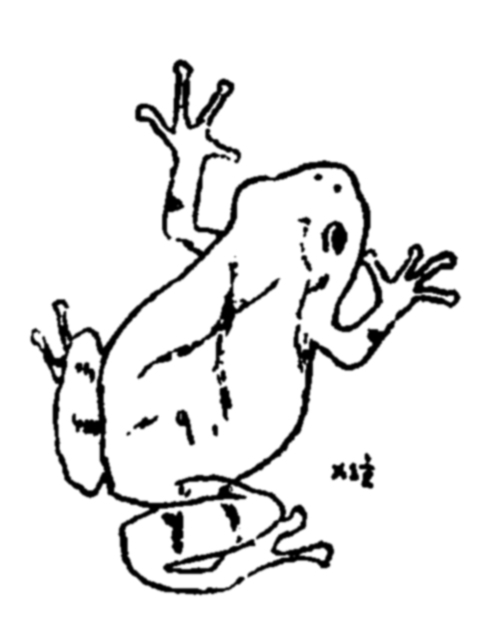
As comparod with other frogs the hylas are considerably smaller and are further characterized by the ends of the fingers and toes being provided with adhesive disks by means of which they climb with greater or less skill. The throat-pouches are large and the little creatures are enabled to utter calls which are all out of proportion to their size. There is little doubt that our spring peeper, an inch or less in length, can be heard fully a quarter of a mile away. Its high-pitched piping, "pee-oep, pee-oep," can hardly be confused with the songs of our larger frogs. And if by chance you should see one of these dwarf performers, the distinct dark cross painted on its brownish back will assure you that it is the common spring peeper whose scientific name is Hyla crucifer. What better proof of the surety of spring is there than the calling of these midget frogs from the lowlands? The willow catkins and the robin may be earlier - too early at times, for the winter may rage for days after their appearance - but the song of the spring frogs is more than a hope, it is a promise. When, upon arriving in Acadia National Park, I heard the song of the peepers in the lowlands, I knew that the spring had preceded me. - Ranger-Naturalist |
| <<< Previous | > Cover < | Next >>> |
nature_notes/acad/vol2-1d.htm
10-Sep-2008