

|
JAMES TOWNE In the Words of Contemporaries |
 |
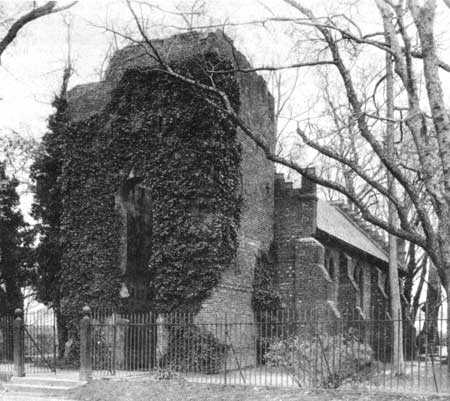
Old Church Tower
29. JAMESTOWN DECLINES
JAMESTOWN, capital and leading town in Virginia since 1607, had now lost its place in the affairs of the colony. Virginia was a growing, prosperous region. The opening of the interior, the seating of better town sites, local conditions at Jamestown, the search for new land, and the development of tobacco plantations with a localized trade system all played a part in the decline. After a century of service the life of Jamestown ebbed out to other areas.
Following the departure of the Government in 1700, decline was swift. Many residents forsook the town and business began to disappear. Hugh Jones, describing the "Present State of Virginia," in the early part of the eighteenth century, presented a picture of Jamestown in decline.
THE first Metropolis, James Town, was built in the most convenient Place for Trade and Security against the Indians, but often received much Damage, being twice burnt down; after which it never recovered its Perfection, consisting at present of nothing but Abundance of Brick Rubbish, and three or four good inhabited Houses, tho' the Parish is of pretty large Extent, but less than others. When the State House and Prison were burnt down, Governor Nicholson removed the Residence of the Governor, with the Meeting of General Courts and General Assemblies to Middle Plantation, seven Miles from James Town, in a healthier and more convenient Place, and freer from the Annoyance of Muskettoes.
Present State of Virginia BY HUGH JONES.
Some fifty years later, at the time of the American Revolution, Jamestown had ceased altogether to function as a town. Even the isthmus that had connected it with the mainland was now fully broken. Lord Cornwallis, en route to Portsmouth and then to Yorktown, in July 1781, forded into the Island. Two months later came French troops en route to join Washington's allied army for its climatic assault on the British at Yorktown. One of these French soldiers, Chevalier D'Ancteville, wrote graphically of the shambles that marked the physical end of the town of Jamestown.
The enemy [the British] a short time before had quitted this post and had left there ineffacable vestiges of his presence. This little town, one of the oldest in America, had been destroyed for the most part. One finds there ruins, the debris of conflagrations, tombs overturned, other fine monuments broken, [and] a church partly thrown down . . .
"Journal of the Chesapeake Campaign"

|

|
|
|
Last Modified: Thurs, Sep 11 2003 10:00:00 pm PST |