

|
THE HISTORY OF CASTILLO DE SAN MARCOS & FORT MATANZAS From Contemporary Narratives and Letters |
 |
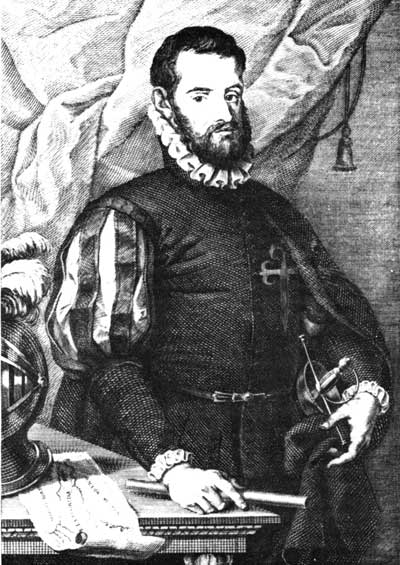
Pedro Menéndez de Avilés, founder of
St. Augustine in 1565, who drove the French from Florida and made it a
Spanish stronghold.
INTRODUCTION
THIS book contains extracts from the vast field of historical records wherein are written the parts played by Fort Matanzas and Castillo de San Marcos in the growth of America. The extracts were chosen be cause, short as they are, they give an accurate picture of the general history of the two areas.
The materials reproduced here are significant not only as recordings of important events in the history of these two sites, but also as expressions of contemporary thought, uncolored by the interpretations of the historian. That is important. Of Spanish civilization in America, our English forbears and their descendants knew little and cared less; on the other hand, the Spaniards saw the enemy colonizers of North America only as interlopers and piratical adventurers.
That Spain did not press further her legitimate claims to the northern continent was due in large part to her concentration of effort in the Central and South American areas, where fabulous riches were to be had for the taking—riches which gave Spain power and upset the balance among European nations. A natural consequence was that the heavily laden galleons became fair prey for the corsairs of the less fortunate states, those nations perforce excluded from the treasures of the Americas. But capable Spanish admirals could cope with the sea wolves reasonably well, and Spain's greatest fear was that a powerful belligerent would establish a strong base at some wayside harbor and, in organized attack, cut the all-important lifeline that bound the colonies to the mother country. To forestall such an attempt, Spain chose the natural but difficult expedient of occupying all territory bordering on the trade route. This was the move which determined Florida's place in the scheme of empire. Then, out of the ensuing dogged fight for the American advantage, was resolved the epic theme of Castillo de San Marcos and Fort Matanzas National Monuments.
In the fall of 1565, at Matanzas Inlet on the coast of Florida, the Spanish destroyed the French Huguenots. This event gave Spain potential control of the entire continent of North America; more immediately, it opened the way to actual domination of the southeast for some two centuries to come.
In Florida, after the French were thwarted, the fight evolved simply into British pressure to break down Spanish barriers and gain control of the Bahama Channel—vital outlet for Caribbean commerce; and by thus pushing Spanish boundaries southward, England would also achieve protection of her own colonial enterprises along the Atlantic seaboard. After the English settlement of Charleston, the die was cast. Frantically the Spanish builders worked at the stone forts in Florida, and while these served their purpose well, Spain's destiny transformed them into gravestones of empire.
The translations of the earlier Spanish documents are rather literal, even to the extent of retaining archaisms, grammatical errors, and ambiguous constructions. It was felt that in no other way could the reader taste the true flavor of the epistles written not by a Cervantes, but by rough men of action, often on the very site of conflict. Neither has any attempt been made to polish the language of the later extracts, since to do so would destroy their historical character.

|

|
|
|
Last Modified: Thurs, Sep 11 2003 10:00:00 pm PST |