

|
ABRAHAM LINCOLN From His Own Words and Contemporary Accounts |
 |
32. THE PRESIDENT TAKES A HAND
There are numerous stories of the times that President Lincoln interfered to ameliorate the harshness of a military judgment or the severity of a court martial sentence. Always he was swayed by what he considered the inherent justice of the case and his deep sense of humanity. Stanton and others in the War Department opposed him in this on the ground that it undermined discipline and military authority. The following letter not only shows Lincoln's abiding sympathy for the common folk, but it also carries a lightly veiled stern rebuke to the Secretary of War for not carrying out a previous instruction.
My dear Sir: A poor widow, by the name of Baird, has a son in the army, that for some offense has been sentenced to serve a long time without pay, or at most with very little pay. I do not like this punishment of withholding pay—it falls so very hard upon poor families. After he had been serving in this way for several months, at the tearful appeal of the poor mother, I made a direction that he be allowed to enlist for a new term, on the same conditions as others. She now comes, and says she cannot get it acted upon. Please do it.
LINCOLN TO SECRETARY STANTON, MARCH 1, 1864.
33. DEDICATION OF A SOLDIERS' NATIONAL CEMETERY
The famous address at Gettysburg contains two hundred and seventy-two words. The Sunday before it was given Noah Brooks accompanied President Lincoln from the White House to Gardner's studio where Lincoln had a long standing engagement to sit for the photographer. Thinking he might have an opportunity to look it over at the studio, Lincoln took with him a long envelope containing an advance copy of Edward Everett's speech, which was scheduled to be the main event at the dedicatory services. Everett's speech was long. It covered both sides of a one page supplement to a Boston newspaper. In response to a remark by Brooks, Lincoln observed that what he had to say would be "short, short, short." There was no danger that it would cover the same ground as Everett's oration. Lincoln told Brooks that his speech was written, but not finished. It is now known that he took considerable pains in formulating "the few appropriate remarks" he had been invited to make.
There are five manuscript copies of Lincoln's Gettysburg Address in his handwriting. The first was written in Washington. Apparently certain revisions in the wording were made by Lincoln at Gettysburg on the evening of his arrival there. These were incorporated in a second copy which was written out by him the following morning. This copy contains the draft of what he spoke later in the day. The other copies were made by him from the second in compliance with requests. In the spoken version, which seemingly was delivered from memory, Lincoln added the words "under God," and they were incorporated by him in subsequent manuscript copies of the speech.
Few of those present at Gettysburg sensed that imperishable words had been spoken. John Hay, one of Lincoln's private secretaries who was in the group that accompanied the President from Washington, noted in his diary the next day that "the President, in a fine free way, with more grace than is his wont, said his half dozen words of consecration." The world has long since accepted the Gettysburg Address as one of the supreme masterpieces of English eloquence.
Fourscore and seven years ago our fathers brought forth upon this continent, a new nation, conceived in Liberty, and dedicated to the proposition that all men are created equal.
Now, we are engaged in a great civil war, testing whether that nation, or any nation so conceived, and so dedicated, can long endure. We are met on a great battlefield of that war. We have come to dedicate a portion of it as a final resting place for those who-here gave their lives that that nation might live. It is altogether fitting and proper that we should do this.
But in a larger sense we can not dedicate—we can not consecrate—we can not hallow—this ground. The brave men, living and dead, who struggled here have consecrated it far above our poor power to add or detract. The world will little note, nor long remember what we say here, but it can never forget what they did here. It is for us the living, rather, to be dedicated here to the unfinished work which they have, thus far, so nobly carried on. It is rather for us to be here dedicated to the great task remaining before us—that from these honored dead we take increased devotion to that cause for which they gave the last full measure of devotion—that we here highly resolve that these dead shall not have died in vain—that this nation, under God, shall have a new birth of freedom—and that this government of the people, by the people, for the people, shall not perish from the earth.
LINCOLN, ADDRESS AT DEDICATION OF SOLDIERS' NATIONAL CEMETERY AT GETTYSBURG, NOVEMBER 19, 1863.
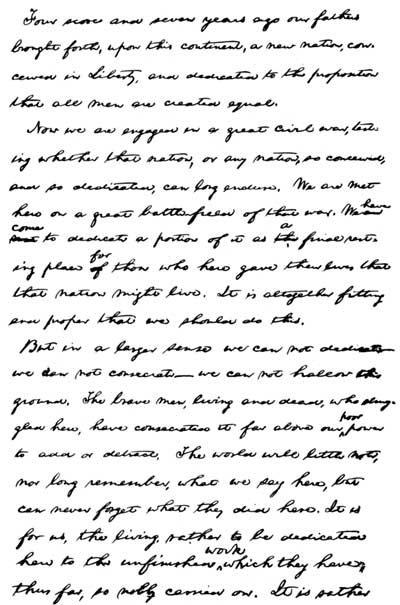
First page of the second draft of the Gettysburg Address, copied
out by Mr. Lincoln on the morning of November 19, 1863, in Gettysburg
and used by him later that day in making his "few appropriate remarks."
Reproduced from the original in the Library of Congress.

|

|
|
|
Last Modified: Thurs, Sep 11 2003 10:00:00 pm PST |