

|
YORKTOWN Climax of the Revolution |
 |
13. THE SURRENDER
The terms settled, the victorious allies prepared to receive the surrender of the British Army, while Cornwallis's men made ready for the humiliating ordeal with which they were faced.
19th.—This is to us a most glorious day, but to the English, one of bitter chagrin and disappointment. Preparations are now making to receive as captives, that vindictive, haughty commander, and that victorious army, who by their robberies and murders have so long been a scourge to our brethren of the southern states. Being on horseback, I anticipate a full share of satisfaction in viewing the various movements in the interesting scene.
The stipulated terms of capitulation are similar to those granted to General Lincoln at Charleston the last year. The captive troops are to march out with shouldered arms, colors cased, and drums beating a British or German march, and to ground their arms at a place assigned for the purpose. The officers are allowed their side arms and private property, and the generals and such officers as desire it, are to go on parole to England or New York. The marines and sea men of the king's ships are prisoners of war to the navy of France, and the land forces to the United States. All military and artillery stores to be delivered up unimpaired. The royal prisoners to be sent into the interior of Virginia, Maryland and Pennsylvania, in regiments, to have rations allowed them equal to the American soldiers, and to have their officers near them. Lord Cornwallis to man and despatch the Bonetta sloop of war with despatches to Sir Henry Clinton at New York without being searched, the vessel to be returned and the hands accounted for.
At about twelve o'clock, the combined army was arranged and drawn up in two lines extending more than a mile in length. The Americans were drawn up in a line on the right side of the road, and the French occupied the left. At the head of the former the great American commander, mounted on his noble courser, took his station, attended by his aids. At the head of the latter was posted the excellent Count Rochambeau and his suite. The French troops, in complete uniform, displayed a martial and noble appearance, their band of music, of which the timbrel formed a part, is a delightful novelty, and produced while marching to the ground, a most enchanting effect. The Americans though not all in uniform nor their dress so neat, yet exhibited an erect soldierly air, and every countenance beamed with satisfaction and joy. The concourse of spectators from the country was prodigious, in point of numbers probably equal to the military, but universal silence and order prevailed.
It was about two o'clock when the captive army advanced through the line formed for their reception. Every eye was prepared to gaze on Lord Cornwallis, the object of peculiar interest and solicitude; but he disappointed our anxious expectations; pretending indisposition, he made General O'Harra his substitute as the leader of his army. This officer was followed by the conquered troops in a slow and solemn step, with shouldered arms, colors cased and drums beating a British march. Having arrived at the head of the line, General O'Harra, elegantly mounted, advanced to his Excellency the Commander in Chief, taking off his hat, and apologized for the non-appearance of Earl Cornwallis. With his usual dignity and politeness his Excellency pointed to Major General Lincoln for directions, by whom the British army was conducted into a spacious field, where it was intended they should ground their arms.
The royal troops, while marching through the line formed by the allied army, exhibited a decent and neat appearance, as respects arms and clothing, for their commander opened his store and directed every soldier to be furnished with a new suit complete, prior to the capitulation. But in their line of march we remarked a disorderly and unsoldierly conduct, their step was irregular, and their ranks frequently broken. But it was in the field when they came to the last act of the drama, that the spirit and pride of the British soldier was put to the severest test, here their mortification could not be concealed. Some of the platoon officers appeared to be exceedingly chagrined when giving the word "ground arms," and I am a witness that they performed this duty in a very unofficerlike manner, and that many of the soldiers manifested a sullen temper, throwing their arms on the pile with violence, as if determined to render them useless. This irregularity, however, was checked by the authority of General Lincoln. After having grounded their arms and divested themselves of their accoutrements, the captive troops were conducted back to Yorktown and guarded by our troops till they could be removed to the place of their destination. The British troops that were stationed at Gloucester surrendered at the same time, and in the same manner to the command of the French general de Choise.
JAMES THACHER
A Military Journal during the American Revolutionary War.
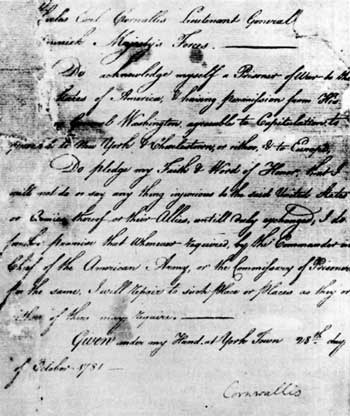
CORNWALLIS'S PAROLE
FOLLOWING THE SURRENDER, Cornwallis, as a prisoner of war, gave his
parole not to engage in further hostilities against the United States,
or its allies, until exchanged and was permitted to go to New York. The
original document is in the Virginia State Library.

|

|
|
|
Last Modified: Fri, Sep 26 2003 10:00:00 pm PDT |