

|
Popular Study Series History No. 2: Weapons and Equipment of Early American Soldiers |
 |
Sticks and Swords*
SINCE the faint light of dawning fell across the first page of history, man often has found an advantage in carrying a stick in his hand. In the beginning he discovered, after due deliberation, that by grasping a staff he could increase his reach and lend force to a blow for the better protection of his cave, or for the procurement of food. Thereafter he seldom ventured forth without one, Throughout the ages youth played at manhood with stick in hand; man shook it as a weapon or as a symbol of authority; old age leaned upon it for support.
During the seventeenth and eighteenth centuries in all civilized countries, the walking stick was not only useful but likewise fashionable, and those persons who were entitled to wear swords, by virtue of rank or position, carried a cane also. Half again as long as the canes now used, they lent dignity and poise in the walk and served as probes to possible pitfalls and to puddles in the ill-paved streets of the time. Although walking stick and cane now are synonymous, the latter name applied originally only to staffs of bamboo or other tropical, treelike grasses brought back by travelers to far countries.
The fashion of wearing small swords passed, on the part of civilians, at the turning of the nineteenth century; but the walking stick, although losing its aristocratic slimness and lightness due to the influence of the French Revolution, remained in vogue. The sword-knot, made usually of gold or silver lace with pendant tassel, remained on the walking stick in the form of a leather thong with tassel. Those little tasseled cords found today on most umbrellas are in memorial to the vanished sword-knot.
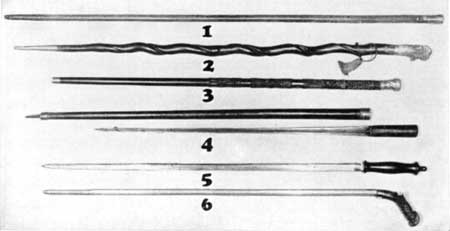
The walking sticks possessed by the museum of Morristown National Historical Park were originally gifts from individuals to the Washington Association of New Jersey, which in 1933 presented them to the Federal Government. The long, slender cane at the top in the illustration (see below) is of Malacca wood, gold-capped, and engraved with the initials of the owner, and has a gold-bushed opening for cord and tassel. It once belonged to Joseph Barrel, who attended a reception given in honor of General Washington in Boston in 1789. It is likely that he carried the cane on that occasion. No. 2 in the photograph is a walking stick with silver-mounted buckhorn handle, presented by Gen. Nathanael Greene, in 1784, to his friend and companion-in-arms Capt. Jonathan Nicholas. No. 3 is a carved and silver-mounted stick made of wood taken from the famous Charter Oak in which, upon a memorable occasion, the liberal charter of Connecticut was hidden.
|
With the passing of the sword from civilian dress, there came into use the sword cane—a blade, often of fine temper and handsome decoration, concealed within a cane, the handle formed by the upper portion. Men who had served in the Army, or who were skilled in the use of the sword, considered such weapons excellent for defense. In the early years of the nineteenth century the lighting of city streets was far from adequate and robbers frequently lurked in shadows to waylay belated pedestrians. Many a miscreant was surprised at finding himself transfixed by a keen blade in the hand of some skilled swordsman. No 4 is a cane of this type, the triangular blade engraved with floral designs and a trophy of arms in French technique. When the blade is in the cane, the joint of handle with sheath is concealed by a band of decorative brass. Although it has an American flag incorporated in its engraved decoration, it is probably of French manufacture. It was found concealed in the walls of the old Norton Claggett homestead at Wardenville, W. Va.
The owner of the cane at the bottom of the photograph did not rely upon cold steel for self-defense. With buckhorn handle and brass-covered ferrule, the shaft is an octagonal steel barrel, bored to take one buckshot or more and having at the breech, near the handle, a nipple upon which to place a percussion cap which could be struck by a small cock or hammer concealed in the handle and released when the trigger was pulled. To load the piece, the ferrule was unscrewed from the muzzle and powder and ball rammed into the barrel by means of a steel ramrod. A copper detonating cap was placed on the nipple and the weapon was ready to fire. Such arms were made about the middle of the nineteenth century, and apart from being a possible means of self-protection, were used often in bagging small game.
*Reprinted from The Regional Review (National Park Service, Region One, Richmond, Va.), Vol. II, No. 4, April 1939, pp. 10-11.

|
|

|
|
|
Last Modified: Sat, Oct 20 2001 10:00:00 am PDT |