

|
Popular Study Series History No. 11: Robert E. Lee and Fort Pulaski |
 |
Robert E. Lee and Fort Pulaski (continued)
Lee's Farewell to Fort Pulaski
Thirty full years were to elapse after that warm spring day in 1831, when young Lieutenant Lee joyously turned his face toward Virginia, before the seasoned and distinguished soldier was again to set foot upon the marshy soil of Cockspur Island. The passing of the years had brought many changes at the scene of his youthful apprenticeship. Major constructional work at Fort Pulaski had been completed for 14 years, and the red and gray brick structure reared its ponderous mass over the foundations he had surveyed and the excavations he had commenced so long before. All of the temporary frame structures that he could recall on the island were gone. The construction shops, the laborers' barracks, and the officers' quarters, where he had spent many an isolated and lonely hour, which all had stood once a short distance to the northwest of the fort site, had long since disappeared. Viewed in retrospect by the 54-year-old officer, the appearance of the island could barely have been more familiar than on that cold November day in 1829 when he first saw it. The fort, however, the object of this long deferred return visit, now reassuringly raised its low lying bulk above the faded November marsh. Of it, he soon made a brief but professional inspection.
The deep gravity of the circumstances of Lee's second and final trip to Cockspur Island was in sharp contrast to any youthful forebodings he may have had momentarily upon his first arrival at a strange and isolated post 30 years previously. His hurried visit to Cockspur, in November 1861, was for a far different purpose than had been his sojourn there in 1829-1831. The long feared break between the North and South had finally occurred, and by the fall of 1861 the early movements and campaigns of the War between the States were already past history. Following the secession of South Carolina in December 1860, Georgia had become alarmed for the safety of her own undefended coast and had dispatched a detachment of her State militia to seize Fort Pulaski on January 3, 1861.
Upon Georgia's secession later in that month, her militia in garrison at Fort Pulaski was mustered into the Confederate service, and measures were hurriedly taken to strengthen the armament of the fortification in the face of the impending Federal naval offensive along the southeastern coast. On November 7 this offensive suddenly struck the South Carolina coast not far from Fort Pulaski, and the Federal fleet succeeded in capturing the Confederate forts at the entrance of strategic Port Royal Sound. At this crucial moment, on the day following the unexpected Confederate disaster, Gen. Robert E. Lee, Confederate States Army, assumed command of the defense of the southeastern coast. Within 3 days, in his desperate determination "to push forward the defenses of Charleston and Savannah," he was at Fort Pulaski. His urgent and unexpected visit was for the purpose of giving personal instructions regarding the strengthening of the defenses of a fortification he had commenced over a quarter century before for the United States, but had never seen since its completion.
General Lee, who had just conducted his first major campaign for the Confederacy in western Virginia, had been selected personally by Jefferson Davis as the most capable officer at hand for the command of the endangered southeastern coast.8 During the fall of 1861, President Davis had become increasingly concerned over the weak and unorganized condition of the Confederate land and naval forces along the South Carolina and Georgia coasts. The appearance of the Federal fleet off Port Royal Sound at the beginning of November, forced him to make an immediate military reorganization of the Confederate forces in that now vulnerable region. Accordingly, on November 5, the "coasts of South Carolina, Georgia, and East Florida" were "constituted a military department." On the same day, and to his astonishment, Lee was assigned to this new and difficult command, "in order to . . . concentrate all . . . [the Confederate] forces at any point that might be attacked." Hurrying to South Carolina, he arrived 2 days later, at the height of the overwhelming Federal naval attack against the Southern forts on Port Royal Sound.
By November 8 Lee had established his headquarters at Coosawatchie, near the scene of the Confederate disaster on the coast. From this tiny station, on the line of the Charleston and Savannah Railroad, he next day notified Secretary Benjamin in Richmond, that his immediate plan of defense was "to collect troops to defend the line of the railroad and to push forward the defenses of Charleston and Savannah." This emergency course of action, to organize the scattered Confederate forces and to strengthen the defenses of the two strategic ports, was gradually accepted by Lee as his permanent plan of defense. Its execution quickly brought him to Savannah late on the Sabbath evening of November 10 for an inspection of the city's defenses and Fort Pulaski during the following day.9
Accompanied by Brig. Gen. Alexander R. Lawton, commanding the Confederate forces at Savannah, and his staff, General Lee and his aides were transported by the tiny paddle-wheel river steamer Ida, on the hasty 25-mile round trip over the mud red waters of the broad Savannah. Landing at the North Wharf on Cockspur Island, from the main channel of the river, the party walked the short distance to Fort Pulaski. Here they were welcomed by youthful Maj. Charles H. Olmstead, commanding the detachments of the First Volunteer Georgia Infantry then in garrison at the fort. The formalities of receiving such distinguished visitors were soon concluded. Then the 25-year-old officer conducted General Lee and his party on a careful tour of the fort and the island.
Major Olmstead became colonel of his regiment in December 1861 and was in command of the Confederate garrison at Fort Pulaski when it was bombarded and forced to surrender by Federal forces on April 10-11, 1862. Many years afterwards he wrote an interesting account of the last visit of General Lee to Cockspur Island on that early November day in 1861. Colonel Olmstead recalled that
Prior to the closing of the [Savannah] river [about November 24, when Confederate log obstructions were completed to prevent the passage of Federal gunboats], General Robt. E. Lee, who was then in command of the Military District of South Carolina, Georgia and Florida, visited the Fort and gave instructions for further defensive work to be done—traverses to be built on the ramparts between the guns, ditches dug in the parade to catch shells, the light colonnade in front of the officers quarters to be torn down, blindages of heavy timber to be erected before the casemate doors around the inner circuit of the Fort, and these to be covered by several feet of earth.
It is interesting to quote a remark of Gen'l Lee's at this time. Pointing to the nearest part of Tybee Island, 1700 yards away, he said, "Colonel, they will make it very warm for you with shells from that point but they cannot breach at that distance." From 800 to 900 yards was then laid down in the books as the extreme range at which a wall of good masonry could be attacked with any prospect of success, but up to the Siege of Pulaski, so far as the writer [Olmstead] knows, no fortification had ever been subjected to the fire of rifled guns. Their power against masonry was yet an unknown quantity . . . [Of especial interest is the fact that from the exact point on Tybee Island referred to by Lee in 1861, Federal batteries of rifled cannon successfully breached the walls of Fort Pulaski in 1862].
Immediately after General Lee's return to the city [Savannah] steps were taken in supply the timber required for the work he laid out. Rafts were brought down the South Channel [of the Savannah River] and from thence by a small canal on the South-side of the island into the moat. The whole garrison was put to work and to such good purpose, with such hearty good will, that everything contemplated was practically completed when the bombardment actually began [on April 10, 1862].10
Especially observant of his famous visitor's every action during that last momentous inspection, Colonel Olmstead also has left an unusual anecdote concerning an occurrence of the day, which vividly illustrates Lee's gracious humanity even while preoccupied with pressing military problems. The exciting news of his arrival had soon spread throughout the small island. Particularly stirred by Lee's unexpected return was a former long-time and humble employee at the fort, picturesque old Francis J. Cercopoly. Serving in the past alternately as captain of the project's steamboat or "tender," and as a general utility hand, he had begun his intermittent work on the island in Major Babcock's administration. During the years of Lee's early tour of duty on the island, 1829-1831, the young officer of Engineers was pleasantly associated with this colorful boatman, who had drifted up the coast from Florida where his Latin ancestors had settled. Cercopoly now put Lee's ability for remembering names and faces to a remarkable test. Hoping to be recognized, he hurried to station himself at a point Lee must pass in his tour of the island. To the old fellow's delight, the official party had hardly come abreast of the spot before Lee paused, glanced searchingly at the old boat captain, and then rushed forward to greet him warmly. Lee instantly called him by name, although 30 years had elapsed since the officer had left the island and had seen his humble friend's aged and weatherbeaten face.11
A short time afterward, Lee completed his instructions to Colonel Olmstead regarding "the preparation and arrangement of Fort Pulaski" for the siege already threatened by the Federal advance on the coast. Then, with a farewell glance around the fort and island he was never to see again, Lee and his party embarked for the return trip to Savannah. Although he continued in command of the coastal defenses in the area for 3 months longer, General Lee was too occupied with his general plan of defense to visit Fort Pulaski personally again during the period. Nevertheless, he kept a vigilant eye upon the reports regarding measures taken in accordance with his orders for strengthening the great brick fortification at the mouth of the Savannah.
Within 2 days of his inspection of Fort Pulaski, General Lee undertook a general survey of the other Confederate coastal defenses between Charleston and Fernandina, Fla. En route south from his headquarters at Coosawhatchie, he passed through Savannah, on November 18, but was then too busy to give further attention to the defense of Fort Pulaski. However, as a result of the coastal survey, upon his return to Savannah 3 days later, he notified the War Department in Richmond of the confirmation of his previous opinion that the "entrance to Cumberland Sound and Brunswick and the water approaches to Savannah [including Fort Pulaski] and Charleston are the only points which it is proposed to defend."
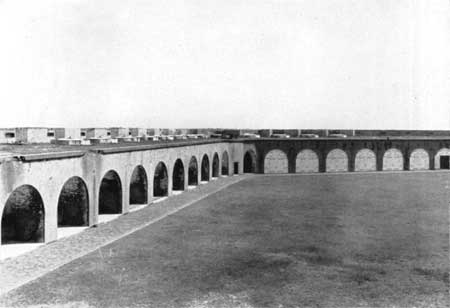 Looking across one corner of the parade toward a section of open casemates and a contrasting tier in which the wooden casemate fronts have been reconstructed. |
In the midst of a series of arduous trips Lee now undertook between Savannah and Charleston in order to supervise the hurried defense measures along the coast, he did not overlook the work under way to strengthen Fort Pulaski. Five days after Federal forces occupied Tybee Island, opposite the fort, on November 24, General Lee from Savannah informed Secretary Benjamin that while the "preparation and arrangement of Fort Pulaski ordered on my first arrival [at Savannah on November 10-11] have progressed slowly . . . I do not think the passage of the [Savannah] river can be forced. . . ."
Following another tour of the coast between Charleston and Fernandina early in January 1862, and from observation of Federal fleet movements in the area, Lee became satisfied that an attack near Savannah was imminent. Late in the month, on the 28th, he wrote from Coosawhatchie to his wife: "There now seem to be indications of a movement against Savannah. The enemy's gunboats are pushing up the creeks to cut off communication between the city and Fort Pulaski on Cockspur Island. Unless I have better news, I must go there [Savannah] today."12
Realizing the necessity for constant supervision of the defense measures under way at Savannah and Fort Pulaski, Lee transferred his headquarters from Coosawhatchie to Savannah early in February. By the middle of the month, establishment of Federal batteries at Venus Point on the Savannah River, a short distance above Fort Pulaski, prevented the return to Savannah of the little Confederate steamer Ida, on one of her frequent trips to the fort and communication by the river between Savannah and Cockspur Island had been cut.
Under the circumstances, there was little that Lee could do further to assist Colonel Olmstead in the defense of Fort Pulaski. However, on February 17, by a messenger through the marshes, Lee sent these final instructions for the protection of the fort to its brave young commander:
Colonel: From the position the enemy has taken in the Savannah River, it becomes necessary that you look to your defense in that direction. I therefore recommend that, if necessary for that purpose, you shift some of your barbette guns [those on top of the fort] to the gorge [rear wall] of the work, and the casemates [bombproof rooms] in the northwest angle, which bear up the river, be provided with guns. I would also recommend that the parapets of the mortar batteries be carried all around, so that the mortars can be protected from the fire up the river as well as from Tybee Island, and that everything be done to strengthen the defenses of your work in the rear.
As far as it is possible your safety will be anxiously cared for, and for the present your communication with the city [Savannah] will have to be by light boats over the marsh . . . or by any other mode by which you can better accomplish it.13
As the late February days of anxiety for the Confederate forces preparing the defenses of Savannah drew slowly to a close, General Lee's difficult assignment on the southeastern coast also neared its end. Signs that the slow-moving Federal naval and land operations in the Savannah area were finally organized for an actual attack were many. The Confederate situation between Savannah and the coast was so filled with danger that by February 23 Lee had begun to believe that Fort Pulaski "may in time be reduced."14 While renewing his efforts to complete his defensive system of earth batteries and waterway obstructions in front of Savannah, President Davis suddenly called him to Richmond on March 2. Leaving Savannah on March 3, General Lee was a few days afterwards assigned to the command of the operations of all Confederate armies, and his task of preparing defenses for the southeastern coast was over.
Defense measures undertaken at Fort Pulaski by his direction did not, of course, prevent the surrender of that fortification to Federal forces on April 11. However, this eventuality, which he previously feared would occur, was accomplished through unforeseen military developments beyond his control. Yet the main defense system between Savannah and the sea, which he commenced, proved so effective that it held the encircling Federal forces at bay until Sherman entered the city late in 1864. Regardless of the material worth of Lee's physical accomplishments while in command of the southeastern military department, the personal experience he gained in directing scattered armed forces and solving problems of defense during this second period of training on the Georgia coast was later of considerable value to him in his larger responsibility as the Confederate commander in chief.
Notes
1 Engineer Order No. 8, August 11, 1829, Engineer Order Book, No. 2, pp. 75-76, Records of the Adjutant General's Office, United States Army, Division of War Department Archives, The National Archives, Washington, D. C.
2 Cf., Douglas Southall Freeman, R. E. Lee, a Biography (N. Y., Charles Scribner's Sons, 1934), I, p. 95. (Hereafter cited as Freeman, Lee.)
3 Ibid., pp. 96-97.
4 Ibid., p. 97.
5 Ibid., pp. 99-100.
6 Ibid., pp. 100-101.
7 R. E. Lee to Eliza A. Mackay, April 13, 1831; used with personal permission of Mrs. Frank Screven, Savannah, Ga., owner of the original letter, as granted the National Park Service in 1934.
Lee apparently gave similar original copies of his sketch of the terrapin and alligator to both Catherine Mackay, whose descendant, Mrs. Screven, now owns the Mackay copy; and also to Sara Anna Minis, of Savannah, whose descendant, Mrs. C. F. Goodrich of Princeton, N. J., owns the Minis copy. Reproductions of the sketch may be seen in this booklet, and facing page 448 in R. E. Lee, Jr., Recollections and Letters of General Robert E. Lee (N. Y., Doubleday, Page and Co., 1924, 2d. ed.; hereafter cited as Lee, Recollections). An interesting account of the Minis copy is given on pages 448-449 of the latter.
8 Freeman, Lee, pp. 606-607.
9 The Charleston Mercury (Charleston, S. C.), November 13, 1861.
10 Charles H. Olmstead, "Fort Pulaski," The Georgia Historical Quarterly, Vol. 1, No. 2, June 1917, p. 102.
11 Col. Charles H. Olmstead to (Mrs.) Florence Olmstead (his wife), November 21, 1861; used with personal permission of Miss Florence Olmstead, Savannah, Ga., owner of the original letter, as granted the National Park Service in 1934.
12 Lee, Recollections, p. 62.
13 The War of the Rebellion: A Compilation of the Official Records of the Union and Confederate Armies, Ser. I, Vol. VI, p. 389.
14 R. E. Lee to G. W. C. Lee, February 23, 1862, cited in Freeman, Lee, p. 627.

|
|

|
|
|
Last Modified: Sat, Oct 20 2001 10:00:00 am PDT |