

|
ARTILLERY THROUGH THE AGES A Short Illustrated History of Cannon, Emphasizing Types Used in America |
 |
THE CHARACTERISTICS OF CANNON (continued)
SIEGE CANNON
Field counterpart of the garrison cannon was the siege gun—the "battering cannon" of the old days, mounted upon a two-wheeled siege or "traveling" carriage that could be moved about in field terrain. Whereas the purpose of the garrison cannon was to destroy the attacker and his materiel, the siege cannon was intended to destroy the fort. Calibers ranged from 3- to 42-pounders in eighteenth century British tables, but the 18- and 24-pounders seem to have been the most widely used for siege operations.
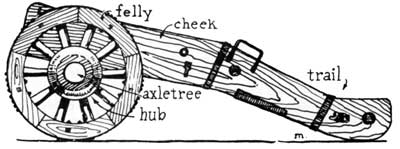
FIGURE 32—SPANISH EIGHTEENTH CENTURY SIEGE CARRIAGE.
The siege carriage closely resembled the field gun carriage, but was much more massive, as may be seen from these comparative figures drawn from eighteenth century British specifications:
| 24-pounder field carriage | 24-pounder siege carriage | |
| 9 feet long | Length of cheek | 13 feet. |
| 4.5 inches | Thickness of cheek | 5.8 inches. |
| 50 inches | Wheel diameter | 58 inches. |
| 6x8x68 inches | Axletree | 7x9x81 inches. |
Heavy siege guns were elevated with quoins, and elevation was restricted to 12° or less, which was about the same as United States siege carriages permitted in 1861. It was considered ample for these flat trajectory pieces.
Both field and siege carriages were pulled over long distances by lifting the trail to a horse- or ox-drawn limber; a hole in the trail transom seated on an iron bolt or pintle on the two-wheeled limber. Some late eighteenth century field and siege carriages had a second pair of trunnion holes a couple of feet back from the regular holes, and the cannon was shifted to the rear holes where the weight was better distributed for traveling. The United States siege carriage of the 1860's had no extra trunnion holes, but a "traveling beds" was provided where the gun was cradled in position 2 or 3 feet back of its firing position. A well-drilled gun crew could make the shift very rapidly, using a lifting jack, a few rollers, blocks, and chocks. When there was danger of straining or breaking the gun carriage, however, massive block carriages, sling carts, or wagons were used to carry the guns.
Sling wagons were of necessity used for transport in siege operations when the guns were to be mounted on barbette (traversing platform) carriages (fig. 10). Emplacing the barbette carriage called for construction of a massive, level subplatform, but it also eliminated the old need for the gunner to chalk the location of his wheels in order to return his gun to the proper firing position after each shot.
The Federal sieges of Forts Pulaski and Sumter were highly complicated engineering operations that involved landing tremendously heavy ordnance (the 300-pounder Parrott weighed 13 tons) through the surf, moving the big guns over very difficult terrain and, in some cases, building roads over the marshes and driving foundation piles for the gun emplacements.
The heavy caliber Parrotts trained on Fort Sumter were in batteries from 1,750 to 4,290 yards distant from their target. They were very accurate, but their endurance was an uncertain factor. The notorious "Swamp Angel," for instance, burst after 36 rounds.

|

|
|
|
Last Modified: Thurs, Sep 11 2003 10:00:00 pm PST |