

|
ARTILLERY THROUGH THE AGES A Short Illustrated History of Cannon, Emphasizing Types Used in America |
 |
GUNPOWDER (continued)
MODERN USE OF BLACK POWDER
Aside from gradual improvement in the formula, no great change in powder making came until 1860, when Gen. Thomas J. Rodman of the U. S. Ordnance Department began to tailor the powder to the caliber of the gun. The action of ordinary cannon powder was too sudden. The whole charge was consumed before the projectile had fairly started on its way, and the strain on the gun was terrific. Rodman compressed powder into disks that fitted the bore of the gun. The disks were an inch or two thick, and pierced with holes. With this arrangement, a minimum of powder surface was exposed at the beginning of combustion, but as the fire ate the holes larger (compare fig. 20f), the burning area actually increased, producing a greater volume of gas as the projectile moved forward. Rodman thus laid the foundation for the "progressive burning" pellets of modern powders (fig. 20).
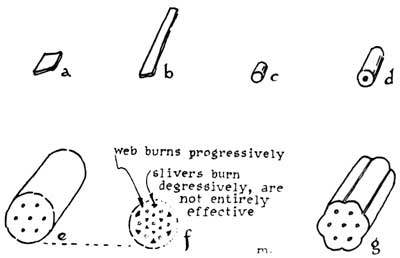
FIGURE 20—MODERN CANNON POWDER. A powder grain has the
characteristics of an explosive only when it is confined. Modern
propellants are low explosives (that is, relatively slow
burning), but projectiles may be loaded with high
explosive, a—Flake. b—Strip, c—Pellet. d—Single
perforation, c—Standard 7-perforation, f—Burning
grain of 7-perforation type. Ideally, the powder
grain should burn progressively, with continuously increasing surface,
the grain being completely consumed by the time the projectile leaves
the bore. g—Walsh grain.
For a number of reasons General Rodman did not take his "perforated cake cartridge" beyond the experimental stage, and his "Mammoth" powder, such a familiar item in the powder magazines of the latter 1800's, was a compromise. As a block of wood burns steadier and longer than a quick-blazing pile of twigs, so the 3/4-inch grains of mammoth powder gave a "softer" explosion, but one with more "push" and more uniform pressure along the bore of the gun.
It was in the second year of the Civil War that Alfred Nobel started the manufacture of nitroglycerin explosives in Europe. Smokeless powders came into use, the explosive properties of picric acid were discovered, and melanite, ballistite, and cordite appeared in the last quarter of the century, so that by 1890 nitrocellulose and nitroglycerin-base powders had generally replaced black powder as a propellant.
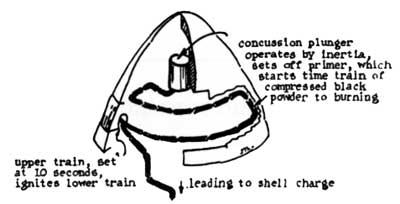
FIGURE 21—MODERN POWDER TRAIN FUZE.
Still, black powder had many important uses. Its sensitivity to flame, high rate of combustion, and high temperature of explosion made it a very suitable igniter or "booster," to insure the complete ignition of the propellant. Further, it was the main element in such modern projectile fuzes as the ring fuze of the U. S. Field Artillery, which was long standard for bursts shorter than 25 seconds. This fuze was in the nose of the shell and consisted essentially of a plunger, primer, and rings grooved to hold a 9-inch train of compressed black powder. To set the fuze, the fuze man merely turned a movable ring to the proper time mark. Turning the zero mark toward the channel leading to the shell's bursting charge shortened the burning distance of the train, while turning zero away from the channel, of course, did the opposite. When the projectile left the gun, the shock made the plunger ignite the primer (compare fig. 42e) and fire the powder train, which then burned for the set time before reaching the shell charge. It was a technical improvement over the tubular sheet-iron fuze of the Venetians, but the principle was about the same.

|

|
|
|
Last Modified: Thurs, Sep 11 2003 10:00:00 pm PST |