

|
AMERICA'S OLDEST LEGISLATIVE ASSEMBLY and Its Jamestown Statehouse |
 |
LATER STATEHOUSES
Accommodations for the functioning of the established government of the growing colony were now an accepted public obligation. This included the maintenance of a statehouse (capitol building) or the rental of space in private homes, taverns, or elsewhere.
The Second Statehouse
It is from the record of a payment to Thomas Woodhouse, a tavern keeper at Jamestown, "for the quarter courts [general court] setting at his house two courts and for the committee's accommodation," that it is possible to fix the burning of the first statehouse as prior to June 1656. There are no rental payments recorded between December 1656 and October 1660 indicating, perhaps, that the second statehouse was functioning in this period. It seems clear that there was such a structure for it is specifically mentioned in a land patent of the period. It appears to have been a building purchased for the purpose and one that, like the first, was burned after some 5 years of use. It was located, it seems, in the main part of town yet some short distance north and west of the earlier structure and not directly on the riverfront. It was necessary, again, in October 1660 to rent space for the Governor and council from Woodhouse and quarters for the assembly from Thomas Hunt, another ordinary keeper at a combined cost of 7,500 pounds of tobacco. Evidently rented quarters such as these were used as needed for the next several years.
The Third Statehouse
In October 1660 the assembly requested Berkeley to contract for a new statehouse. In March 1661 a general subscription was initiated instead of a tax levy yet apparently this did not achieve its objective. With some disgust, and perhaps embarrassment, the Burgesses considered the matter again in 1663 with these comments:
Since the charge the country is yearly at for houses for the quarter courts and assemblys to sit in would in two or 3 years defray the purchase of a state house.
Whether it were not more profitable to purchase for that purpose then continue for ever at the expence, accompanied with the dishonour of all our laws being made and our judgments given in alehouses.
A committee was named to discuss the matter with the governor. Two years later a chance reference in a letter written by Thomas Ludwell on April 10, 1665, states that the colony "had already built enough to accommodate the affairs of the country." This and subsequent references have been taken to mean that Jamestown's third statehouse had been provided, was complete, and in use in 1665. As such it was the first to be planned and built as a statehouse, the others having been purchased from private owners. Its location was determined and its foundations laid bare by Col. Samuel H. Yonge, during excavations in 1903. This confirmed the site suggested by existing land records. It was built on a thin ridge of land near the western extremity of the town and consciously, or unknowingly, on the site of an extensive burial ground that had served the settlement in its early days.
The third statehouse was in use for a decade and its memory was made lasting by the events of Bacon's Rebellion. Those were stirring days that in the end saw Nathaniel Bacon, Jr., return and, in September 1676, apply the torch to much of Jamestown including its statehouse.
Like the first statehouse before it, the third was a part of a row of buildings being the inlandmost of a group of five structures all joined by common walls. It measured 74 by 20 feet. Little is known of the appearance of this significant structure and much that has been said about it is drawn in large part from the fact that the fourth statehouse is thought to have been raised on its foundations and to have used its existing remnants. A reexcavation of the site in 1954—55 yielded little in this respect beyond indicating that the third probably had a tile roof while the fourth had one of slate. Contemporary references indicate that the third was a two-story building and that the council chamber (and courthouse) was on the first floor with the assembly meeting on the second floor in "a long room."
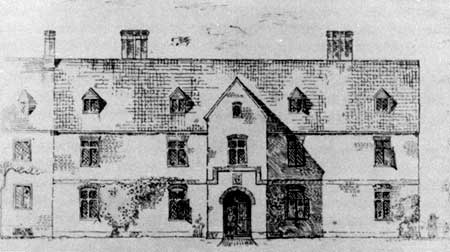
South, or front, elevation of the third statehouse as drawn by
Henry Chandlee Forman for the Virginia 350th Anniversary Commission.
(Copyright applied for by the Commission.)
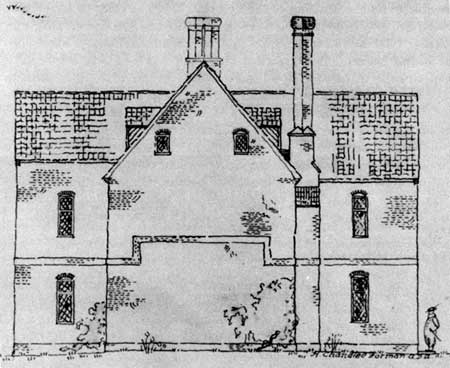
East elevation of the third statehouse as drawn by Hendry Chandler
Forman for the Virginia 350th Anniversary Commission. (Copyright
applied for by the Commission.)
The Fourth (and Last) Statehouse
In the 9-year interval after 1676 the colony was without a statehouse. For a time the assembly, as well as other governing units, met at Green Spring, the home of Governor Sir William Berkeley just 3 miles to the west of Jamestown. Then there was a return to the rental of quarters in homes and ordinaries at Jamestown. Capt. William Armiger, Mrs. Ann Macon, Henry Gawler, and William Sherwood are among those that profited in supplying accommodations for assembly, council, and committee work such rentals including "fire candles and attendance."
It was in 1684 that the matter of building a new statehouse reached the point of specific action in the assembly. After discussion, debate, and some hesitation the decision was reached to rebuild on the same site occupied by the third statehouse and evidently to use any part of its remains that were sound. In 1677 "the walls of brick worke" were "yett standing." In one view, at least, it was thought that they might "yet be serviceable."
An order of the assembly made on December 4, 1685, clearly implies that Jamestown's fourth, and last, statehouse was nearing completion. Payment was cleared (a substantial sum of £400) for Col. Philip Ludwell, "out of the Moneys accruing from the duty of three pence per gallon upon liquors," for "rebuilding the State House." It was not, however, entirely complete since Ludwell had to post bond "for the full compleating of the House in such manner as shall be fully satisfactory to his Excellency, the Council & the House of Burgesses ..." The new building had been sufficiently along on October 1, 1685, that "Several of the Burgesses" met in it. It seemingly was fully operational in 1686.
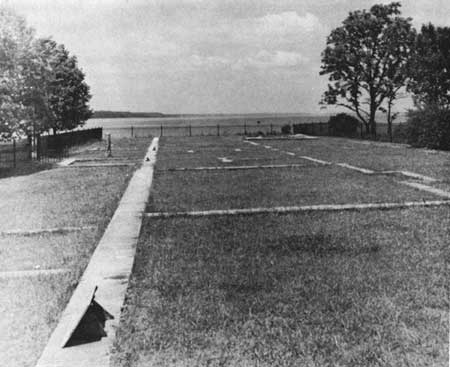
Foundations of the last statehouse group in the
Association for the Preservation of Virginia Antiquities grounds at
Jamestown. The statehouse is in the foreground. Beyond it are the
remains of three houses of Philip Ludwell and then the Country House
which has been partly destroyed by the eroding waters of the James
River.
It was a 2-story building. The ground floor was divided into two parts. One, the courthouse room, was used by the council, and was about 43 feet long. The other room, some 31 feet long, was probably a waiting room. On the second floor there was space for the burgesses and an office for the secretary of state, the latter in a "Porch Chamber" on the south. The assembly, needing the space for their clerk and not considering the secretary of state the proper officer to be so close to its deliberations succeeded in moving him. Space for the secretary was found on the lower floor by appropriating a part of the waiting room.
The fourth statehouse, like all of its predecessors, succumbed to fire. In October 1698, after some 13 years of use, flames destroyed it and very probably all of the structures adjacent to it. The following spring burgesses and councilors met again in private homes and in what space could be had at Jamestown. It was at this time that the decision was made to move the seat of government to a new location—to Williamsburg some 6 miles away. It was here that the assembly convened in 1700 and it was here that the next statehouse (now for the first time called the "Capitol") was constructed.
The 1698 fire which destroyed the fourth statehouse was of great concern to Jamestown for it was the immediate reason for the removal of the seat of government. It was this act that meant the end of "James Citty." With little activity left other than that associated with the government of the colony it could not, and did not survive as an organized urban community for many decades beyond 1700. In its 92 years as Virginia's capital, however, it had been the scene of great events not the least of them being the slow unfolding and growth of a representative legislative assembly. This which began in 1619—the first by Europeans in the western hemisphere—was fast becoming a major instrument of government.

|

|
|
|
Last Modified: Thurs, Sep 11 2003 10:00:00 pm PST |