

|
AMERICA'S OLDEST LEGISLATIVE ASSEMBLY and Its Jamestown Statehouse |
 |
THE ASSEMBLY, 1620-39
It is not known that the General Assembly actually convened the following March. Evidence that it did is lacking, yet there is good likelihood that a meeting did take place. An assembly did meet after the arrival of Governor Sir Frances Wyatt in October 1621. The session continued for several days, although little is known of what actually took place. It seems improbable that there was an assembly during the period of the Indian massacre of 1622. For some months after this destructive blow the problems of sickness, protection, lack of food, and security from further attack were the paramount questions of the day. It seems reasonable to suppose that the Governor, acting with his council, made the necessary rules and regulations to take the colony through this period.
The last assembly under the company met in February and in March of 1624. This meeting was given over for the most part to answering statements relative to the state of the colony. At this time the future of the Virginia Company, which had been directing the affairs of the colony since 1607, was the leading question of the day. The assembly, anxious to preserve the liberties granted in 1619, went on record in a petition to King James I and the Privy Council denouncing the autocratic government that existed in the colony prior to 1619 and asking that this type of government be abandoned for all time. Among other things, the burgesses at this meeting were called on to assist the commissioners who had been sent to Virginia to inquire into the state of the colony. In its relations with these commissioners, one of whom (Sir John Harvey) was later Governor, the assembly refused to associate its name with an attack on the company. It is significant, perhaps, that the burgesses refused to send their papers to England by the commissioners. They chose instead a personal representative of their selection, one John Pountis. In all of its transactions, it seems that the assembly was conscious that the end of the Virginia Company was at hand.
In 1624 the company was dissolved and the guiding hand in Virginia affairs, since the founding of the colony, was removed. Virginia came directly under the control of King James I. A crisis had developed in the affairs of Virginia and many feared that an attack upon popular government would result. The Privy Council appointed a commission—the so-called Mandeville Commission—to administer the colony and to report on the advisability of issuing a new charter for the government of Virginia. On August 24, 1624, a commission was granted to Sir Francis Wyatt, who was to continue as Governor. In this commission there was no mention of a general assembly. Control in the colony now rested with the Governor and council, it would seem. At the same time John Harvey continued in Virginia to collect data for use by the Mandeville Board. It was early in 1625 that Harvey returned to England to present his report.
While these events were taking place Governor Wyatt, in the colony, continued his work of administration and government. Lacking royal orders, or even an expression of royal will, he called an assembly to meet in May 1625, although he did not call it such, as had been the case heretofore. Wyatt preferred to speak of this meeting as the "Govr Councell and Collony of Virginia assembled together." He wanted to get an expression of popular feeling regarding the fall of the company. In assembly the Governor, council, and representatives of the colony made copies of its former petitions and declarations, issued statements regarding new plans of government, and expressed the hope that men placed in charge of Virginia affairs would be men in whom the colony had confidence. The documents prepared in the "Convention" were sent to England by former Governor Yeardley, who was authorized to present at court the case of the colony.
From this brief statement it is apparent that the future of the Virginia Assembly was for some time in doubt. Modern research has revealed, however, that there was little basis for the strong fear of the colonists that the King intended a direct move against their free institution. It is true that there was a drive to set up a more closely knit and a more responsible form of government in London. It is even possible that the assembly could have been rejected on the theory that it would interfere with such a system. It is difficult, however, to support the thesis that there was a crusade afoot against free and representative institutions in America. The assembly received no formal recognition for a time, yet there is no recorded attempt to prevent its continuance.
The death of James I, in March 1625, brought the deliberations of the Mandeville Board to an end. Charles I became King of England with direct control of Virginia affairs. Not as bitter against the company as had been his father, he consented to reopen the case of the company, yet in May he, like his predecessor, rejected all the company pleas. It was not until later in 1625 that Yeardley arrived in England with the instructions of the assembly. Evidently he gained admission to the Privy Council and presented the case of the colony. Obviously he presented a strong case that was favorably received, since the council approved many of the things that he sought. On one point, however, the continuation and the confirmation of the "liberty of the General Assembly," the Privy Council was evasive, although it implied that there would be later favorable action. Despite this, Charles I did not hasten to give his approval for the assembly.
For the period 1624 to 1629, it would seem that government in Virginia fell directly to the Governor and council. They exercised judicial, executive, and legislative powers. In some of the proclamations there is reference to existing laws—those in the great charter or those passed by the assembly from 1619 to 1624, perhaps—yet other regulations seem to have emanated directly from the Governor and council. Governor Wyatt secured permission to leave his post and return to England, and Yeardley became Governor, for a second time, in May 1626. His in structions and commission, however, said nothing regarding the assembly.
It should be mentioned at this point that Wyatt, in a letter to the Privy Council before he left Virginia, suggested that the assembly be allowed to meet "in spetial cases when it was desirable to get the expression of the planters." To this the King and his council did not reply. Despite this, the suggestion must have been given consideration for when a "spetial case" arose in the form of the tobacco contract, a monopoly for the importation and sale of this commodity from Virginia, it was thought necessary to instruct the new Governor for Virginia, Capt. Francis West, in November 1627, to call an assembly to discuss the tobacco issue. This assembly met in March 1628, discussed the tobacco question, and adjourned. This meeting of representatives of the colony does not seem to have constituted a real legislative body, for it appears to have exercised few, if any, real legislative functions. As in 1625, it had been called for a specific purpose and did not go much beyond this. It differed from the Convention of 1625, as this meeting came to be called, in that it had royal sanction. It did go so far as to levy a tax to pay its expenses.
In the instructions to Governor Harvey, August 6, 1628, there is reference to a "grand Assembly" to discuss and provide for a palisade from Martin's Hundred to York—across the Virginia Peninsula—for protection against the Indians. Perhaps the royal authorities thought that this would encourage wholehearted cooperation in a defense measure against the Indians. An assembly did convene in October 1629, and its chief work was the adoption of various measures of protection against the Indians, followed by a tax law affecting all freemen in the colony for the support of the measure. The assembly went beyond a discussion of defensive measures, passing legislation regarding the planting of tobacco and reenacting the law of 1624 regarding compulsory church attendance.
In 1629 propositions touching Virginia, endorsed by Sir John Harvey, asked the King for the confirmation of former privileges and for the approval of a general assembly to meet on "necessary occasions, wherein to propound laws & orders for the good government of the people." In answer to this last proposition it was stated that:
. . . the governor may be authorized shortly after his first coming into Virginia to call a grand assembly, and there to set downe an establishment of the Government, and ordaine lawes & orders for the good thereof, and those to send hither to receive allowance, and such as shall be soe allowed to be returned thither under the great seale and put in execucon, the same to be temporary & changeable at his Majesties pleasure, signified under the like great seale.
In March 1629/30 another assembly was called to meet at Jamestown. It assembled and business began after "The oathes of alleidgeance and supremacy were administered to the Governor and Council, and afterwards to all the Burgesses then assembled"—46 in number. This meeting, much more than that of October 1629, exhibited the characteristics of a regular legislative body. At this March session various topics came before the burgesses, and legislation followed on religious questions, on fortifications and defense against the Indians, on the engrossing and forestalling of commodities, on staple commodities, and on tobacco.
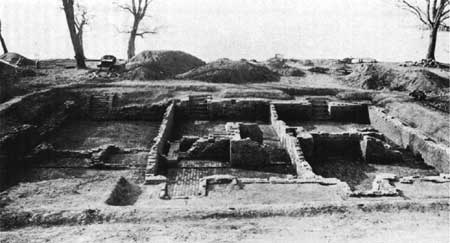
The foundations of the first statehouse at
Jamestown as excavated in 1935.
It may be that the conventions of 1628 and 1629 were sufficient precedent for the reassumption of law-making powers by the assembly, or it may be the colonists assumed, on the faith of repeated promises, that they could resume the old privilege. In any case various meetings of one kind or another had been authorized by the Crown in instructions to the Governors without, it seems, stating that the assembly was renewed in its old sense of regular or periodic meetings. It is a fact that from 1629 regular yearly meetings took place in the colony. These meetings passed legislation, and there seems to be little doubt that the burgesses assumed all the rights and privileges of regular representative bodies following the current variety of parliamentary practice. When Governor Harvey returned to Virginia in 1637 he brought instructions to call an assembly, yet these did not specify a regular-meeting legislative body. It was in the instructions to Governor Sir Francis Wyatt, returning to Virginia for his second administration in 1639, that there was the first clear and unmistakable renewal and guarantee of the assembly.
The state of Virginia's assembly from the dissolution of the company in 1624 until 1639 is difficult to trace. It appears that until 1637 the King governed Virginia through committees in the Privy Council. During this period there were various efforts to derive a system of administration for the colony. It would appear that the royal commission set up to make recommendations concerning Virginia in 1631 assumed that an assembly was functioning in the colony. Even though assemblies convened after 1628, the planters, it would appear, were none too sure of their rights in this matter.
Charles M. Andrews, in his study of the evolution of the assembly in The Colonial Period in American History, has concluded that the Virginia planters themselves were largely responsible for the establishment of self-government in the royal colony of Virginia. Charles I did not purposely intend to deprive Virginia of its assembly, yet he seemed reluctant to give it his seal of approval. The colonists, acting without direct or explicit consent, yet with something of an implied sanction, proceeded to keep the assembly alive through regular meetings—through action and then explanation. Over a 15-year period a precedent was established, and the King came slowly to a decision. The case was settled in Wyatt's instructions of January 1639 when he was instructed "Once a year to call a General Assembly and the Governor therein to have a negative voice. A similar instruction was issued to the next Governor, Sir William Berkeley, in 1641. A year later the colony expressed its satisfaction at its "freedom of yearly assemblies" under the Crown. Summing up this development, Professor Andrews has stated:
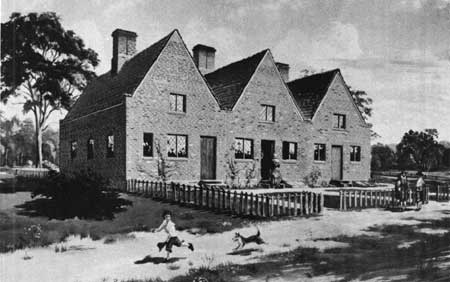
"The First Statehouse of Jamestown." A painting by Sidney King.
One of several possible architectural interpretations based on
a study of its foundations and contemporary references.
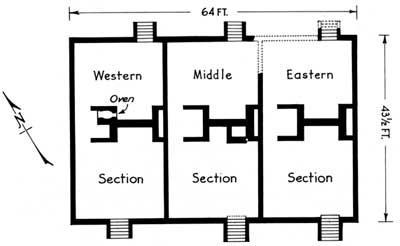
A plan of the foundations of the first statehouse
at Jamestown.
Not only was the Virginia settlement assured of its future, but what was even of greater importance for the later history of the royal colonies in America, a precedent was set according to which the people of any royal colony was assured of their right to share in the making of laws, the levying of taxes, and the taking into consideration those many other things, chiefly of a local and prudential nature, that meant most to men two and three hundred years ago. As the result of fifteen years indecision on the part of the crown and of action on the part of the colony, the principle was finally laid down that a royal colony should be, in part at least, a self-administering community, with a governor and council appointed in England and a representative assembly chosen by the freemen or freeholders in the colony. Though self-government was in no sense of the word democratic government and though popular interest in lawmaking was never very keen during colonial times, nevertheless the very presence of such a gathering in a royal British colony in America was a factor of vast consequence in the development of American political practices.

|

|
|
|
Last Modified: Thurs, Sep 11 2003 10:00:00 pm PST |