

|
AMERICA'S OLDEST LEGISLATIVE ASSEMBLY and Its Jamestown Statehouse |
 |
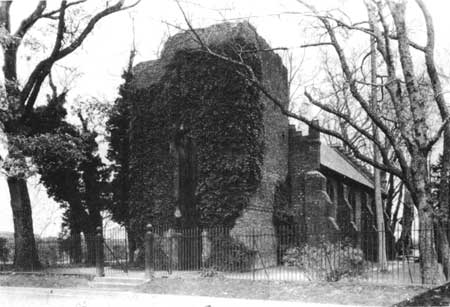
The old church tower at Jamestown within the grounds of the Association
for the Preservation of Virginia Antiquities. On this site the
first legislative assembly met in 1619.
INTRODUCTION
IN 1932 George C. Gregory, of Richmond, Va., long interested in the early history of Jamestown, while investigating the old townsite on Jamestown Island encountered below ground, at a point near the river and down stream from the old brick church tower, the ruined foundations of a 17th-century building. He excavated a part of the site and carried his operations far enough to outline the entire building. He identified this structure the "First Statehouse" at Jamestown—the first real capitol building—acquired by the colony in 1641. Later in 1934 and 1935 the National Park Service, through its architects, historians, and archeologists working in Colonial National Historical Park, made a complete study of this site, opening and uncovering the entire structure, collecting and preserving objects found in and about the ruins, and preparing the results of observation and study in permanent record form for future reference. The evidence shows that this structure, a three section brick building of 17th-century construction, since it satisfies most of the known facts about the first statehouse, is in all probability the ruins of that building.
It was in the statehouse that much of the activity of the colonial government originated, and from it most of that activity was directed. First and foremost the statehouse was the meeting place for the council and the elected House of Burgesses sitting as Virginia's General Assembly, the oldest legislative body in English speaking America. Twenty-two years before the colony acquired its first publicly owned statehouse, the first assembly met at Jamestown. This meeting, which convened in the framed, cedar-interior-trimmed church on July 30, 1619 (August 9 New Style) was the beginning of representative government in America. Because of what it later came to mean, this event ranks as one deeply significant in the development of free America.
Much has been said about the origin of representative government in America and perhaps, as yet, the complete story has not been told. It is stating the obvious, however, to say that the first assembly, in 1619, did not spring fully developed as an organ of representative democracy. The first assembly, in 1619, was the first meeting of an assembly set up for Virginia as a part of a general reorganization introduced by the Virginia Company of London1 to improve conditions in the colony which it was directing. It was the gradual evolution and development of this assembly in Virginia, of similar bodies later in the other colonies, that made it the fundamental mechanism of free government as we know it today.
1 The Virginia Company of London was an organization operating under charter from King James I of England for the general purpose of discovery, colonization, and trade. It was, strictly speaking, a business undertaking operated by means of capital invested by adventurers (from various sections of English life) who expected returns on their investments. The first charter was approved in 1606 with authority for the company to operate in a prescribed section of America. It was through the Virginia Company that Jamestown was settled in 1607 and that Virginia was governed and managed until the company was dissolved in 1624.
The Virginia colony, begun in 1607, did not grow and develop as rapidly as its founders had hoped. The obstacles were great, it is true, yet the adventurers of the Virginia Company maintained their fixed determination to establish a paying enterprise. This led to a program of reform adopted by the company in 1618. Motivated by a lack of progress in the colony, the authors of the new plans aimed solely at strengthening the company and building up the colony. Political reform was merely one phase of a much broader reorganization of company affairs. Such reform seemed necessary preparation for the projected economic policies which, it was hoped, would bring prosperity and stability. The attempt at popular government owes a great deal to Sir Edwin Sandys who saw the need for a change in the management of affairs as a prelude to securing better colonists, a wider range of agriculture and industry, and the introduction of schools, inns, and comfortable homes. The popular control advocated, it appears, was taken for the most part from the practices of the company itself in its quarterly gatherings, or courts. The program was the work of the whole company, and there is nothing to indicate any real opposition to it in 1618.
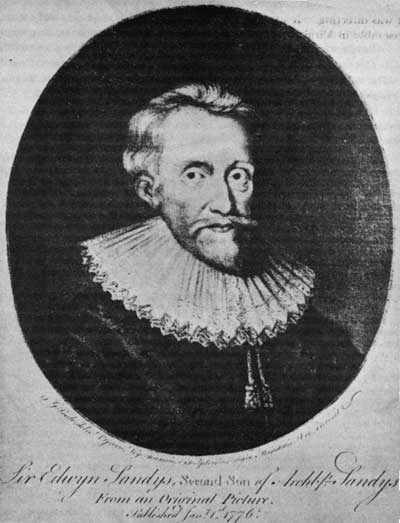
SIR EDWIN SANDYS—a leader in the movement for popular government in
Virginia. He was an uncle of Margaret Sandys, wife of Governor Sir
Francis Wyatt, of Virginia, who also favored the practice of
representative government in the Virginia Colony. (Portrait from
Alexander Brown, The First Republic in America. Courtesy,
Houghton, Mifflin and Company.)
Of the political reforms voted for Virginia in 1618 one of the greatest was the abolition of martial law and the substitution of English common law. The second main feature was the grant of a legislative assembly. There was nothing especially radical about this second feature. As planned, it would operate very much as did the older council of the company. Moreover, it brought no immediate weakness in the company's government, and it left the company in supreme control without altering its position. It was a device whereby the company expected to reap benefits of cooperation, better unity, and better spirit in the colony. It would shift much local detail to a local body; it would promote the application of new economic policies; and it would bring better conformity with practices in England and with English institutions.
When Sir George Yeardley left England in the winter of 1618—19 for his new post as Governor of Virginia he had with him instructions embodying the reforms recently passed by the Virginia Company. One body of instructions authorized him to summon a general assembly once each year and no oftener, unless, because of an "extraordinary and exigent necessity," for the purpose of finding out and executing "those things as might tend to their good." Soon after his arrival in April 1619, he moved to carry out this part of his instructions. He first issued a proclamation making public a part of the new program and including a statement about the assembly:
And that they might have a hande in the governinge of themselves, it was granted that a general assemblie should be helde yearly once, wherat were to be present the Govr and Counsell with two Burgesses from each Plantation freely to be elected by the inhabitants thereof; this assembly to have power to make and ordaine whatsoever lawes and orders should by them be thought good and proffittable for our subsistance.

|

|
|
|
Last Modified: Thurs, Sep 11 2003 10:00:00 pm PST |