.gif)

Cover Page
MENU
|
The National Park Story in Pictures
THE SERVICE UP-TO-DATE |
NOW THE National Park Service, through its central Washington headquarters, its five administrative regional offices, and two field offices of Design and Construction, coordinates and directs the work of the approximately 180 areas that make up the National Park System. In the public mind, the words "national park" may be applied to any of them. Actually, there are 29 national parks as such—great wilderness areas with scenery and other national wonders so outstanding in quality that their preservation intact for the benefit, enjoyment, and inspiration of the people is a national concern.
So with the scientific national monuments, which in general also are scenic.
|
CAPE HATTERAS NATIONAL SEASHORE. In the Cape Hatteras National Seashore Recreational Area is preserved one of the few remaining extensive stretches of undeveloped seashore on the Atlantic Coast—one that remains much the same wild lonely beach it was in the days of the Spanish Main, Sir Francis Drake, and Blackbeard the Pirate. The State of North Carolina contributed State-owned lands and an appropriation of more than $600,000 for land acquisition in the area; and the same amount was donated by the Avalon and Old Dominion Foundations. (Photograph by Ralph H. Anderson.) 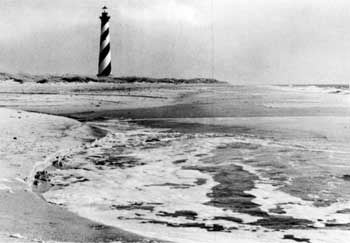
|
The numerous historic parks, monuments, and sites, which fall into a variety of classifications according to the mode of establishment at different times and under different Departments, are as sedulously guarded as the 29 national parks and the scientific monuments. Since, however, their principal exhibits are manmade, there is not the obligation in them to preserve the untamed wilderness. Rather, the goal in the historical parks and sites is to preserve the historic scene for which each was established; and often to restore, where practicable, the conditions that existed when the principal historic event commemorated took place. A fundamental of national historical area preservation is that the event commemorated in each be of national significance.
The National Park Service also administers several national parkways, the National Capital Parks of Washington, D. C. and its environs, a national seashore, and four national recreational areas that include great lakes created in connection with mammoth dam projects. Primary jurisdiction over the recreational areas remains with the Bureau of Reclamation, the Park Service handling recreational developments under cooperative agreements. In all three of these categories the high standards of the National Park Service apply where practicable. Since they all are established for distinctly recreational use, however, they are developed with more latitude than the national parks, monuments, and historic areas.
| <<< Previous | >>> Contents <<< | Next >>> |
 Top
Top
|
|
Last Modified: Sat, Oct 5 2002 10:00:00 pm PDT
story/storyd.htm