.gif)

Cover Page
MENU
|
The National Park Story in Pictures
|
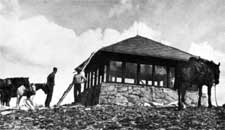
LOOKOUT AT HIS LOOKOUT. Supplies are packed in periodically to the lonely lookouts, who watch constantly for signs of smoke that may mean the beginning of a forest fire. Mount Holmes, elevation 10,300 feet, is in the Gallatin Mountain Range in the northwest cornet of Yellowstone National Park, a dozen miles or so north of the famous Madison junction Campfire of 1870. (Photograph by Miller.) |
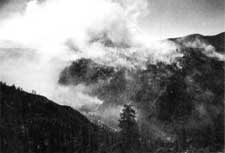
FOREST FIRE RAGING IN THE MOUNTAINS. Dry lightning may have started it—or a carelessly thrown match or cigarette—or a campfire not completely extinguished. Park rangers and fire-fighting crews often have their own lives endangered because someone just didn't think. (Photograph by Ralph H. Anderson.) |
|
DIGGING IN. Rangers on ski or snowshoe patrols in the course of protecting the park wildlife and in taking snow measurements often are out overnight. Here a ranger in Lassen Volcanic National Park, with snow from 20 to 25 feet deep, digs into the Lake Helen Ski Patrol and Snow Measuring Hut. These cabins are stocked with staples—but sometimes hungry bears before hibernation break in and have themselves a feast, leaving the wistful ranger to fall back on the hard rations he carries. 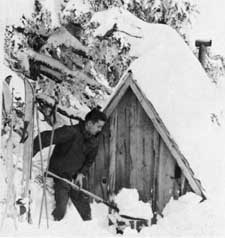
|
YELLOWSTONE'S HARRY YOUNT. A government game-keeper, he spent the winter of 1880 in Yellowstone National Park, to keep poachers from some 3,300 square miles. Afterwards he reported that one man could not protect the park and urged the formation of a protective force sufficient to cover this large area. So he is credited with being the "father" of the ranger service. Today, in national park areas, about 350 permanent and 950 temporary park rangers are employed. Naturalists and historians aid in protection in emergencies. (Courtesy, Haynes Studios, Inc.) 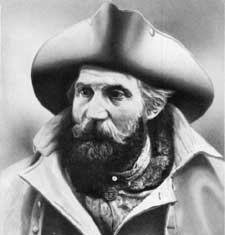
|
| <<< Previous | >>> Contents <<< | Next >>> |
 Top
Top
|
|
Last Modified: Sat, Oct 5 2002 10:00:00 pm PDT
story/story61.htm