|
Pinelands National Reserve New Jersey |
 |
|||||
 NPS photo
| ||||||
|
| ||||||
The Pine Barrens [Pinelands] seem vast because of the accretion of many small things: a million acres of forests with small trees; more than 17 trillion gallons of water in one aquifer made from raindrops that filter through the soil; extraordinary numbers of endangered plants and animals, none larger than an eight-foot snake and most smaller than a green frog...
Jonathan Berger, John W. Sinton, Environmental Planning in the New Jersey Pine Barrens, 1985.
Congress designated the Pinelands National Reserve in 1978. It was a bold act of stewardship—protecting an ecologically sensitive region while respecting the people who live here. We invite you to explore this treasure.
Where Nature and Culture Are Closely Intertwined
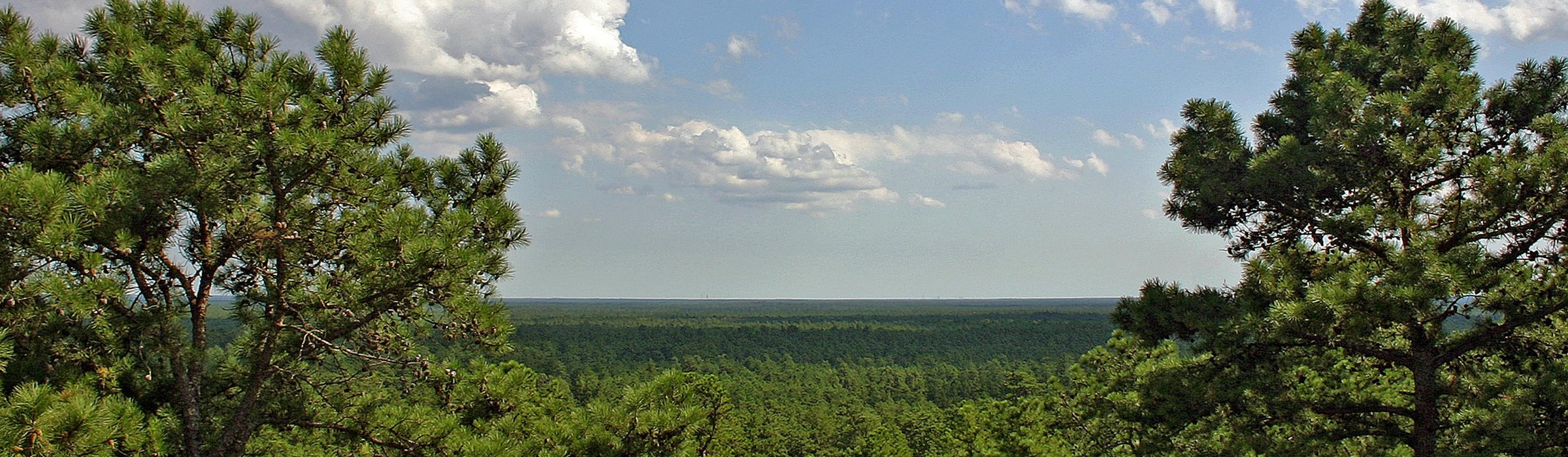
The 1.1-million-acre Pinelands National Reserve in New Jersey is the largest open space on the eastern seaboard between Boston, Mass. and Richmond, Va. It lies next to the most concentrated highway, railroad, and air-traffic corridors—and the most densely populated region—in America. But if you stand on Apple Pie Hill (209 feet), the highest spot in the Pinelands, what will you see? Not turnpikes, not trains, not airports, not people, but forests—a canopy of trees that stretches as far as you can see. The primary trees are pitch pine and oak, along with Atlantic white cedar that trace forest streams. Only cranberry bogs, tea-colored rivers, a few meadows, and white, sand roads punctuate this landscape. The Pinelands, with few villages, sparse population, and vast forests, offers you a chance to experience its distinctive cultural and natural heritage.
Pine Barrens? Early settlers called this area the Pine Barrens because they couldn't grow traditional crops in the sandy, fast-draining, acidic soil. What does grow is diverse and often unique. Sticky sundews and other carnivorous plants get nitrogen by eating insects. Blueberries and cranberries thrive in the acidic soil. Pine and pine-oak forests are home to thousands of animals and plants like the yellowthroat, turkey beard, and Pine Barrens gentian. There are no natural lakes, but wetlands, including streams, bogs, and cedar swamps, cover over 385,000 acres, 35 percent of the Reserve.
People of the Pines Natural resources gave rise to important industries. People used bog iron for cannonballs and household goods, sand for glass, and wood for shipbuilding, charcoal, lumber, paper, and cordwood. When the bog iron and glass businesses failed in the mid-1800s most residents moved away, leaving the ghost towns you find today. The few that stayed (often called Pineys) lived off the land, cutting wood and collecting berries, moss, and pine cones to earn a living. Piney, once a derogatory term, is now worn with pride, as seen on bumper stickers, T-shirts, and signs. Many descendants run blueberry and cranberry farms that are among the nation's top producers.
Folklore includes tales of the Jersey Devil, a mysterious creature with hooves, a horse head, bat wings, and a forked tail. Not sure? Special events honor the beast.
All this Sand—Where's the Water? Beneath the Pinelands lies a huge natural reservoir—the Kirkwood-Cohansey aquifer system. It extends over 3,000 square miles and holds an estimated 17 trillion gallons of water, enough to cover New Jersey in a lake 10-feet deep. The water table, which is just a few inches to several feet below the surface, is recharged annually by precipitation as rain and snow percolate through the gravel and sand. We must protect this precious, local resource from pollution——it is the region's primary source of drinking water.
Adapting to Rigors of the Pinelands Plants and animals living here face extra challenges, including nutrient-poor, acidic, sandy soil. Yet over 850 plant and 500 animal species, like the tiny Pine Barrens tree frog, make their homes here. Some plants love acidity, including Atlantic white cedars, sphagnum moss, and orchids. Carnivorous species, like pitcher plants, absorb nutrients from insects.
The Importance of Fire—a Balance Few natural forces have shaped the Pinelands like fire. Fire prevents woody undergrowth, allowing seedlings to sprout and regenerate the forest. Intense heat helps pitch pines release seeds from their cones. Dwarf pygmy pines grow extensive root systems, perhaps in response to frequent fire. Today the N.J. Forest Fire Service uses controlled, prescribed fires to protect human life and help keep the ecosystem healthy.
Harvests from the Land Towns in the 1700s sprang up around two industries: bog iron manufacture and glassmaking. Acidic groundwater percolating through layers of sand and iron-rich clay leached soluble iron and deposited it along riverbanks and in swamps, where it was mined and smelted into bog iron. Ironmasters helped supply a young nation with weapons, tools, and monogrammed objects like the fireplace cypher for George Washington. Local sand high in silica produced window glass, blown glass objects, and the first Mason jars. Forests fueled iron and glass furnaces; by the mid-1850s these industries declined.
James Still 1812-1885 James Still was born near Indian Mills, N.J., the son of formerly enslaved parents. Still was fascinated by the potential healing powers of plants. With three months' formal education, but self-educated in medical botany, he treated a range of illnesses—not by "the scientific manner," he wrote, but by "the laws of nature," which led to the accolade Doctor of the Pines. His son James, Jr., followed his father's passion for medicine and, in 1871, became the third African American to graduate from Harvard Medical School.
Elizabeth C. White 1871-1954 At age 22 Elizabeth White began working on her family's cranberry farm at Whitesbog. In 1911 she convinced botanist Frederick V. Colville—and her father—to try growing blueberries. At that time blueberries were wild and not uniform. They were pear-shaped or flat, sour or sweet, tiny or large. People said "blueberries could not be cultivated." White proved otherwise. She paid locals to bring her shrubs with berries 5/8-inch or larger in diameter and named the cultivars after their finders. Today New Jersey is second in U.S. production.
Chronology of Human Activity in the Pinelands
Before 1600 Ancestors of Lenape Indians live here centuries before European explorers arrive in 1609.
1650 Growing whaling industry attracts settlers to southern New Jersey.
1688 Shipbuilding begins, using local Atlantic white cedar, oak, pitch, tar, and turpentine (wooden shipbuilding continues into the 1900s).
1740 Charcoal making begins.
1758 Brotherton, America's first Indian reservation, established at today's Indian Mills, Shamong Township. By this time few Lenape remained in the region.
1765 Bog iron furnaces built.
1776 American Revolution begins.
1778 Battle of Chestnut Neck, near Port Republic; British fail to capture Batsto Iron Works, supplier of weapons and iron products to the Continental Army.
1799 First glass-producing factories established at Port Elizabeth.
1800 Whaling ends; efforts shift to harvesting fish and shellfish.
1830-1832 Earliest cranberry bogs cultivated at Burrs Mill and Cassville. Paper mill opens at McCartyville.
1854 Railroads link Pinelands communities to Atlantic City, now a popular resort.
1878 Financier Joseph Wharton proposes piping Pinelands water to Camden and Philadelphia, is blocked by N.J. legislature 1905 Bass River State Forest created.
1906 State legislature establishes N.J. Forest Fire Service; its wildfire suppression and mitigation programs, like prescribed burning, continue today.
1916 Whitesbog produces first US commercial blueberry crop.
1928 Mexican aviator Emilio Carranza dies as his plane crashes in Tabernacle Township on a goodwill flight between Mexico City and New York City.
Taking Action To Save the Pinelands
1955 Wharton State Forest created.
1963 Largest N.J. wildfire in recorded history burns 190,000 acres, destroys 185 homes, and kills seven people.
1967 John McPhee's The Pine Barrens spurs outcry to protect the Pinelands.
1977 Casino gambling begins in Atlantic City, increases development pressure on nearby Pinelands.
1978 Congress establishes 1.1-million acre Pinelands National Reserve—the nation's first such designation.
1979 Pinelands Commission created; Pinelands Protection Act becomes law.
1981 Pinelands Comprehensive Management Plan enacted.
1983 Pinelands National Reserve designated a U.S. Biosphere Reserve by UNESCO (a United Nations agency).
2006 The Pinelands Commission marks the 25th anniversary of the Pinelands Protection Program; over 53 percent of the land in the Pinelands National Reserve is permanently protected.
Partnerships To Preserve the Pinelands
I was in the pines because I found it hard to believe that so much unbroken forest could still exist so near the big Eastern cities, and I wanted to see it while it was still there. John McPhee, The Pine Barrens, 1967.
Grassroots efforts in the 1950s-1960s and John McPhee's 1967 national best-seller sparked public pressure to protect the Pinelands. In 1978 Congress created the Pinelands National Reserve. In 1979 New Jersey's Pinelands Protection Act established the New Jersey Pinelands Commission to administer the Pinelands Comprehensive Management Plan (CMP). The Commission uses the CMP to protect natural and cultural resources and promote appropriate growth by managing regional growth areas, transitional zones, and preservation areas. Its 15 members include representatives from the state, seven counties, and one federal agency. Today the Pinelands Commission, National Park Service, New Jersey Division of Parks and Forestry, and non-profit groups work together to interpret, protect, and preserve the Pinelands National Reserve.
Discover the Pinelands
Planning Your Visit Day trips are fun, but to experience the Pinelands National Reserve fully you should spend a few days. It is a vast area—over 1.1 million acres——comprised of public and private lands. Public lands include parks, forests, wildlife refuges, wetlands, streams, and military installations. Private lands include 56 communities, from hamlets to suburbs, with over 700,000 permanent residents. The Pinelands, often called the Pine Barrens, hosts rare and endangered species, wetlands, dwarf forests, and vanished towns. The Pinelands' designation as a U.S. Biosphere Reserve underscores its significance to New Jersey and the world.
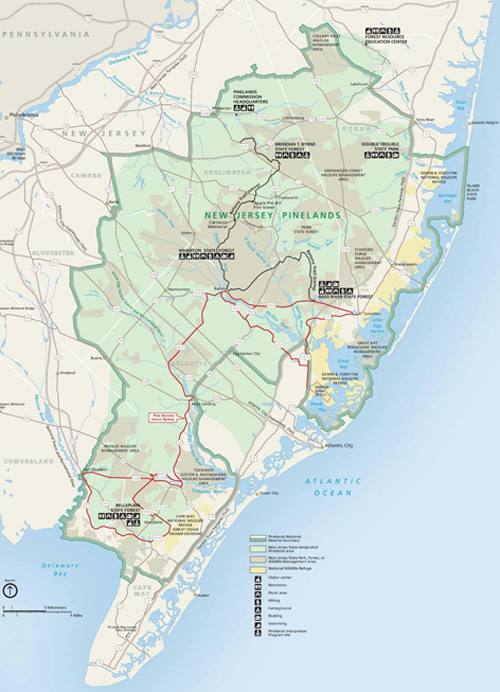
Things To See and Do Six major sites are listed below and shown on the map. These are popular spots for enjoying nature and appreciating the history of the Pinelands. For information and ideas about opportunities available at these sites and at many others, contact the agencies listed below and check their websites.
Batona Trail This 50-mile, easy walking trail, marked with pink blazes, goes through Brendan T. Byrne, Wharton, and Bass River state forests. It traverses streams and passes through areas once home to bustling towns with names like Martha and Washington.
Southern Pinelands Natural Heritage Trail Scenic Byway This vehicular route, designated in 2005, passes through five counties, all offering a variety of attractions. Watch carefully for road signs in remote areas. Stops along the way include historic villages, river ports, forests, and wildlife areas.
For Your Safety Regulations differ among areas managed by state, county, local, federal, and private agencies. It is your responsibility to know the regulations. • Be alert for poisonous or irritating plants, biting insects and ticks, and other animals. • Plants, wildlife, and cultural artifacts on public lands are protected by state or federal law. • About two-thirds of the Pinelands is privately owned; respect private property and its owners. • Please help preserve the Pinelands, so that it remains an inspiration and learning experience for you and for future generations. Emergencies: call 911.
Popular Pinelands Destinations
 (click for larger map) |
WHARTON STATE FOREST
This state park in the heart of the Pinelands covers over 115,000 acres.
The park has rivers, lakes, cedar swamps, varied Pinelands habitats, and
nearly 500 miles of sand roads for hiking and exploring. Hiking trails
include a major section of the 50-mile Batona Trail.
Wharton State Forest: 609-561-0024
Atsion: 609-268-0444
www.njparksandforests.org
Activities Canoeing, boating, swimming, picnicking, camping, fishing, birdwatching, visiting historic sites.
Batsto The village was a bog iron and
glassmaking center, 1766-1867. Joseph Wharton bought the property in
1876 and launched new enterprises, including a sawmill and commercial
cranberry bogs. It has a visitor center, nature center, museum shop,
exhibits, tours, and 33 historic buildings
www.batstovillage.org
BASS RIVER STATE FOREST
This is one of the best places to see the rare, stunted forest ecosystem
known as the Pygmy Forest—pitch pines and oaks that often reach a
mature height of only four to six feet. The park has a 67-acre lake and
trails that wander through wetlands where you can see Atlantic white
cedars, orchids, and insect-eating plants. The Batona Trail ends in the
park
609-296-1114
www.njparksandforests.org
Activities Boating, swimming, picnicking, camping, horseback and bicycle riding, fishing, hiking.
BRENDAN T. BYRNE STATE FOREST
In the 1800s this forest was denuded by a glassmaking industry that
burned wood in its furnaces. Today you can follow trails through
restored forests and around historic cranberry bogs. The Batona Trail
starts in the park.
609-726-1191
www.njparksandforests.org
Activities Hiking, camping, picnicking, visiting historic sites, festivals.
Whitesbog The Whitesbog community produced
cranberries and blueberries into the 1900s. Many buildings remain,
including Elizabeth White's home. She perfected blueberry shrubs
nearby.
www.whitesbog.org
DOUBLE TROUBLE STATE PARK
Industries at Double Trouble, an 1800s company town, featured cranberry
farming and logging and milling of Atlantic white cedar. Today 14
original structures remain, including a schoolhouse.
732-341-4098
www.njparksandforests.org
Activities Visiting the historic village, canoeing, exploring bogs and uplands.
BELLEPLAIN STATE FOREST
Forests here reflect better soil conditions and less fire damage than
elsewhere in the Pinelands. In the late 1930s the Civilian Conservation
Corps (CCC) converted Meisle Cranberry Bog into Lake Nummy, honoring the
last Lenape chief to rule in Cape May County.
609-861-2404
www.njparksandforests.org
Activities Boating, swimming, hiking, camping, fishing, birdwatching.
FOREST RESOURCE EDUCATION CENTER (FREC)
FREC has an interpretive center and a forest nursery. Learn about forest
stewardship and how you can help protect our natural resources, so that
we can have healthy trees, clean air and water, and outdoor recreation
areas
732-928-2360
www.njforestrycenter.org
Activities Educational programs, special events, nature study, fishing.
Source: NPS Brochure (2008)
|
Establishment Pinelands National Reserve — November 10, 1978 |
For More Information Please Visit The  OFFICIAL NPS WEBSITE |
Documents
Decadal-Scale Reduction in Forest Net Ecosystem Production Following Insect Defoliation Contrasts with Short-Term Impacts of Prescribed Fires (Kenneth L. Clark, Heidi J. Renninger, Nicholas Skowronski, Michael Gallagher and Karina V.R. Schäfer, extract from Forests, 2018)
Fire Management and Carbon Sequestration in Pine Barren Forests (Kenneth L. Clark, Nicholas Skowronski and Michael Gallagher, extract from Journal of Sustainable Forestry, Vol. 34, 2015)
Monitoring Fire Effects in the New Jersey Pine Barrens with Burn Severity Indices (Michael Richard Gallagher, October 2017)
One Space, Many Places (Mary Hufford, 1986)
Pinelands Comprehensive Management Plan (Pinelands Commission, October 10, 2025)
The Pinelands of New Jersey: A Resource Guide to Public Recreation Opportunities (April 1985)
Pinelands Preservation Alliance: Advocates for New Jersey's Suburban Wilderness
pine/index.htm
Last Updated: 20-Oct-2026