|
Ulysses S. Grant Memorial National Mall and Memorial Parks District of Columbia |
 |
|||||
 NPS photo
| ||||||
|
| ||||||
Although a soldier by profession, I have never felt any sort of fondness for war, and I have never advocated it, except as a means of peace.
—Ulysses S. Grant
Early Years
Ulysses Grant was born on April 27, 1822, in Point Pleasant, Ohio, the oldest of six children of Jesse and Hannah Grant. He was named Hiram Ulysses, but upon arrival at the U.S. Military Academy at West Point, he found himself listed on the muster role as Ulysses Simpson Grant. The Congressman who nominated him made the mistake and Grant never corrected it. After his 1843 graduation, he served at frontier forts until the Mexican-American War (1846-1848). During that war, Grant took part in every major battle that led to the capture of Mexico City, and was promoted for his skillful leadership and bravery. In. 1860, the Southern states opposed Abraham Lincoln's election and began seceding from the Union to form the Confederate States of America. Grant had resigned from the military in 1854, but immediately offered his services to the Union in the Civil War (1861-1865).
Civil War
President Lincoln appointed Grant brigadier general in August 1861, and he soon commanded an army in the lower South. Grant's chance to show his abilities came in February 1862 when he delivered the first Union successes in the West by capturing Forts Henry and Donelson. The victories opened Tennessee to military invasion and secured Kentucky for the Union. This earned Grant a promotion to major general.
In April 1862, commanding the Army of the Tennessee, he engaged the Confederate Army of Tennessee at Shiloh. After two days of bloody fighting, Grant again emerged the victor. He then laid siege to Vicksburg, Mississippi, May 19-July 4, 1863, forcing that Confederate stronghold to surrender. This opened the Mississippi River to Union gunboats and split the Confederacy in two. Grant next was detailed to Chattanooga, to rescue the Army of the Cumberland, trapped against the Tennessee River. Grant captured Chattanooga in just three days. Taking this major railroad center was significant in defeating the South, because it deprived the Confederates of much needed food and arms.
Lincoln promoted Grant to the rank of lieutenant general, and gave him command of all Union armies. Grant directed the command of the Army of the Potomac to pursue relentlessly the Confederate Army of Northern Virginia, commanded by General Robert E. Lee. Using bulldog tactics, Grant tenaciously pounded and pushed at Lee's lines until Lee's army was surrounded at Appomattox Court House, and forced to surrender to avoid further bloodshed. In an effort to begin the nation's healing process, Grant offered generous terms to Lee and his army, and Lee accepted them without question. The respect and compassion that Grant showed Lee and his army that day, revealed a gentler side of Grant's character. This set the precedent for the peoples of the North and South to come together again, under one flag and as one nation.
Later Years
Because of his popularity as a hero responsible for ending the Civil War, Grant was encouraged to run as a Republican candidate for President in 1868. He had no interest in politics but ran because he thought the people wanted it. He was overwhelmingly elected the i8th President of the United States. During his two terms in office, Grant tried to protect the rights of newly freed African Americans as well as prevent violence from erupting in the South. A few years after he had retired from public life, he settled with his family at Mount McGregor, New York. He had been diagnosed with terminal throat cancer. During this time, he worked to complete his personal recollections of the Civil War. Despite intense pain, Grant labored hours at a time until he finished the two-volume Personal Memoirs. He died quietly on July 23, 1885. Burial followed, taking place at the Grant Tomb in New York City. He left behind a war legacy that has been studied the world over, and his Memoirs are one of the better war commentaries ever published.
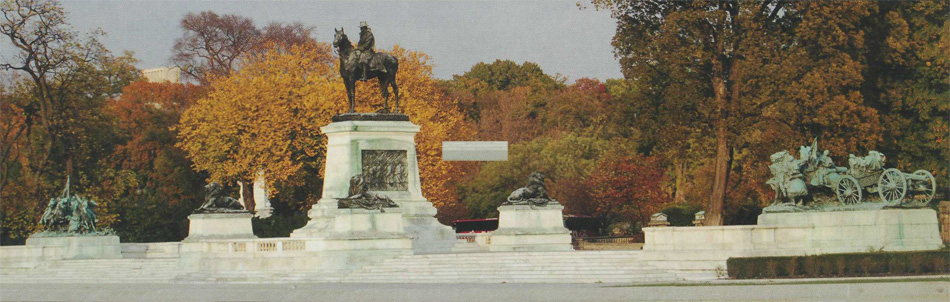
Astride his favorite warhorse, Cincinnati, Lieutenant General Ulysses S. Grant gazes westward toward the nation's heartland and the memorial to his benefactor, Abraham Lincoln. Both men rose from Midwestern obscurity to preserve George Washington's Union during its most "fiery trial."
It is appropriate that the Ulysses S. Grant Memorial and the Lincoln Memorial stand like bookends on the National Mall, symbolizing the relationship between the General and his Commander-in-Chief Lincoln wanted to end the war quickly to prevent permanent damage to the nation from the bitterness and destruction it had caused. Grant agreed with Lincoln and set out with conviction to bring the war to a swift end. Lincoln is honored for "saving the Union," but Grant was the instrument that brought it about.
Memorial to the Spirit of Battle
Grant's equestrian statue presents an impressive figure that clearly commands the scene. His military bearing while on the battlefield, instilled faith in his men and testified to his leadership.
The Society of the Army of the Tennessee started the movement in 1895 to honor General Grant with a memorial that was to be "purely military in design and character." The selected memorial site was occupied by the U.S. Botanic Garden, which eventually was relocated to its current position. The Grant Memorial stands just west of the Capitol Building, at the head of the National Mall. Edward Casey designed a base of white Vermont marble and brown Tennessee marble that measures 252 feet long, and 71 feet wide.
Henry Shrady started his sculptural masterpiece in 1902, and for twenty years diligently worked to complete the twelve horses, eleven soldiers, four lions, and the General Grant equestrian statue that towers 65 feet above the ground. The bronze artillery and cavalry groups each measure 23 feet long, 10 feet wide, and 11 feet high, and weigh 14 tons apiece. Grant's bronze equestrian statue is 17 feet, 2 inches tall and weighs 10,700 pounds. It was cast at the Roman Bronze Works in Brooklyn, New York. The memorial was dedicated on April 27, 1922, on the 100th anniversary of Grant's birth. The dedication ceremony started with a parade down Pennsylvania Avenue and concluded with the unveiling by General Grant's granddaughter, Princess Julia Cantacuzen of Russia. Veterans of both Union and Confederate armies were in attendance, as was Vice President Calvin Coolidge.
The Cavalry Group
There is determination on the young commander's face as he leads the charge, but he does not see the fallen trooper. The other men fear that their compatriot will be trampled in the charge.The Fallen Trooper
Unable to get the look he sought from other models, the sculptor used himself as the model for this cavalryman. Using a system of mirrors, he sculpted his own expressions to capture the anguish on the fallen trooper's face.The Artillery Group
A field artillery crew wheels into battle position with an expression of resolve and a hint of uncertainty over what the battle may bring.
The Sculptor and Architect
Henry Shrady
Schooled in law, Henry Shrady took up sculpting while recovering from typhoid.
Completely self-taught, and relatively unknown, he won the Grant Memorial
competition and devoted the final twenty years of his life to the memorial. His
health deteriorated toward the end of the project, and tragically, he died
fifteen days before the dedication of his life's work. Interestingly, his father
was Dr. George F. Shrady, the physician that had attended General Grant in his
losing battle against cancer.
Edward Casey
Edward Casey was already an accomplished architect in Washington, DC, when he
was selected to design the Grant Memorial's plaza and sub-structure. His father
was Colonel Thomas L. Casey, the U. S. Army engineer responsible for finishing
the Washington Monument. Grant signed the bill to complete the monument in
1876.
Source: NPS Brochure (2009)
Documents
No documents currently available.
nama/places/usgm/index.htm
Last Updated: 01-Aug-2024