|
Old Post Office Tower National Mall and Memorial Parks District of Columbia |
 |
|||||
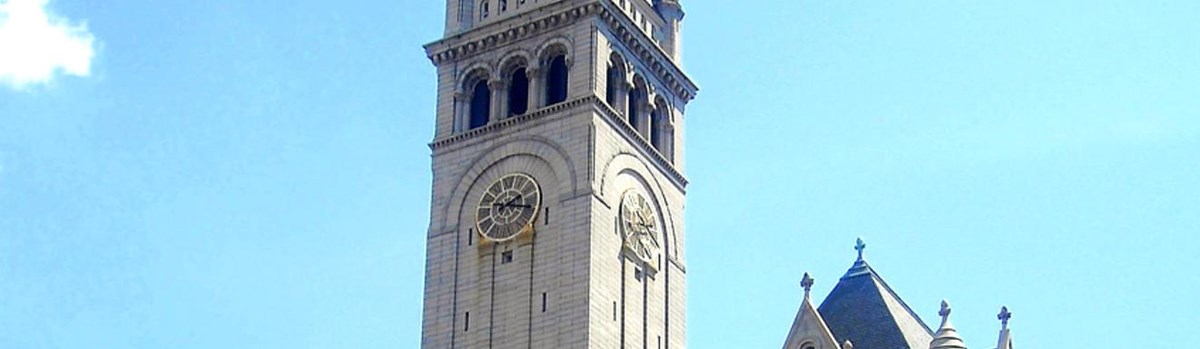 NPS photo
| ||||||
|
| ||||||
Bold and resilient, the Old Post Office is an architectural expression of the American spirit. Its story symbolizes the fight to save our past amid changing ideas, values, and visions. Its preservation provides a link between the historic past and possibilities for the future.
The building now known as the Old Post Office was constructed in the 1890s as a technological marvel. Its 315-foot height made it the tallest building in the District of Columbia. Even today, only the 555-foot Washington Monument and the 329-foot Basilica of the National Shrine, of the Immaculate Conception are taller. The Old Post Office's French Gothic dormers, massive granite veneer walls, double-arched stone entrances, and clock tower establish it as one of the country's last examples of Richardsonian Romanesque Revivalism, a style considered America's first innovative architectural contribution. Willoughby J. Edbrooke, the Supervising Architect of the Treasury when construction began, intended the building to reflect "light and ventilation and convenience."
Designed as the headquarters for the Postmaster General of the United States and the U.S. Post Office Department, as well as the location of the city post office, the building garnered immediate attention for housing Washington's largest uninterrupted enclosed interior and two glass ceilings arching over the huge interior. Additionally, the building achieved fame as one of the first major steel frame buildings erected in Washington and one of the largest government buildings built to that date. Affording the highest public clock in the District, it also became the tallest federal building and the first government structure with an electrical power plant.
"The Old Tooth"
Ironically, no sooner had construction commenced on the building than its architectural idiom fell into disfavor with government planners who preferred to cast future federal buildings in the neoclassical mold. The Old Post Office soon became an object of derision. Critics referred to it as "The Old Tooth" and called for its demolition.
The building served as the city post office from 1898 to 1914 and as offices for the United States Post Office Department from 1899 to 1934. During that period, many of the measures that modernized the delivery of mail, particularly the advent of airmail, came into being. The building also became famous for its elaborate Flag Day pageantry and held the singular distinction of hanging within the large interior one of the larger flags then in existence.
The Federal Triangle
The Old Post Office also became the first federal building to be constructed along the most hallowed stretch of Pennsylvania Avenue, the one and one-half miles between the Capitol and the White House. It also became the first federal building erected on Washington's famed Federal Triangle, the first large area to be set aside for government use. The Federal Triangle resulted from a plan by architectural consultants authorized by Treasury Secretary Andrew Mellon in 1928. The so-called Mellon Board recommended that the entire Triangle comprise new buildings constructed in the neoclassical style, with all previous architectural anomalies to be demolished. A shortage of funds during the Great Depression handed the Old Post Office a reprieve. Over the years, the building has had numerous tenants including the Departments of Agriculture, Defense, Interior, and Justice, the Federal Bureau of Investigation, the General Accounting Office, the Interstate Commerce Commission, the Smithsonian Institution, and the United States Information Agency.
"A Jewel"
During succeeding decades, public opinion gradually changed. People looked at the clock tower, rising above the low Pennsylvania Avenue skyline, as an anchoring point. The building itself became a revered relic. A 1970 National Park Service Section Report called the tower of the Old Post Office "one of the most powerful visual landmarks in downtown Washington," one that "dominates the skyline from many viewpoints more than either the Capitol or the Washington Monument." In 1974, the Washington Star-News said it possessed "terrific character." Three years later, a Preliminary Historic Structures Report for General Services Administration called the Old Post Office "a jewel adorning Washington and more specifically Pennsylvania Avenue with a massive verticality that relieves the continuous horizontalness of the Federal Triangle" and "a pleasing pedestrian attraction linking present and past into a continuum of time and place."
Old buildings are like old friends, they reassure people in times of rapid change. They encourage people to dream about their cities—to think before they build, to consider alternatives before they tear down.
—Nancy Hanks Testimony before Congress
Preservation
In the early 1970s, individuals and groups mobilized against the government's long-delayed plan to raze the building. In 1971, a few dozen people formed "Don't Tear It Down," the forerunner of the current D.C. Historic Preservation League. Also, Nancy Hanks, the second chairperson of the National Endowment for the Arts, launched an aggressive campaign to recycle the building. The result was Congress' adoption of the Public Buildings Cooperative Use Act of 1976, legislation that for the first time allowed both government agencies and commercial enterprises to share federally-owned buildings.
Beginning in 1978, the building underwent renovation. Rededicated in 1983, the Old Post Office now takes its rightful place as the pioneering federal building on the Federal Triangle.
In the words of the 1977 Preliminary Historic Structures Report, it is now both "a landmark for the Nation, the Federal City, and the Post Office, and to building construction and development" and "also a monument and a landmark to the foresight and vision of modern preservationists devoted to the conservation of our built environment, our historic patrimony, and the quality of life within our cities."
The Congress Bells
The Ditchley Foundation of England, an organization founded by Sir David Wills to promote Anglo-American education and communication in international issues, presented a gift of ten bells to the United States Congress, in "honor of American Bicentennial, in 1976. Congress directed the bells to be placed in the tower of the Old Post Office. The belts were installed on the tenth floor of the tower in 1983 following the completion of the buildings' renovation. The bells rang for the first time on April 19, 1983, the 200th anniversary of the congressional proclamation that ceased hostilities between England and America in the Revolutionary War.
The bells range in weight from 581 to 2,953 pounds and total nearly six tons. The Whitechapel Foundry in London cast the bells in a ratio of three-quarters copper and one-quarter tin in 1976 as replicas of the famous beils in London's Westminster Abbey. The great seals of both countries decorate each bell.
Members of the Washington Ringing Society, a volunteer group based in the District of Columbia, areas ring the bells in performance during all American holidays and on days of national significance and state occasion. Distinguished visiting change ringing groups are also frequently permitted to perform. Practice sessions occur Thursday nights from 7 to 9 o'clock. The tower is closed during bell ringings, but the sound may be heard at street level outside the building.
Nancy Hanks
As chairperson of the National Endowment for the Arts from 1969 to 1977, Nancy Hanks became a visible force in petitioning the government to preserve the Old Post Office. "Old buildings are like old friends," she observed about the assurance and stability that a familiar building can impart. She testified before a Senate subcommittee on behalf of saving the Old Post Office. Her efforts proved instrumental in influencing Congress to pass the Public Buildings Cooperative Use Act in 1976 which preserved the landmark.
She died of cancer on January 7, 1983, at 56. On February 2, Congress passed a bill honoring her legacy by renaming the Old Post Office and its adjacent plazas the Nancy Hanks Center. President Ronald Reagan signed the legislation into law on February 15.
Source: NPS Brochure (undated)
|
Establishment Old Post Office Tower — 1892-1899 (constructed) |
 |
Documents
No documents currently available.
nama/places/opot/index.htm
Last Updated: 01-Aug-2024