 | ||
 | ||
 | ||
 | ||
 | ||
 | ||
 | ||
 | ||
 | ||
 | ||
 | ||
 | ||
 | ||
 | ||
 | ||
 | ||
 | ||
 | ||
 |
 |
 |
Going-to-the-Sun Road: An Engineering Feat
Glacier National Park, Montana
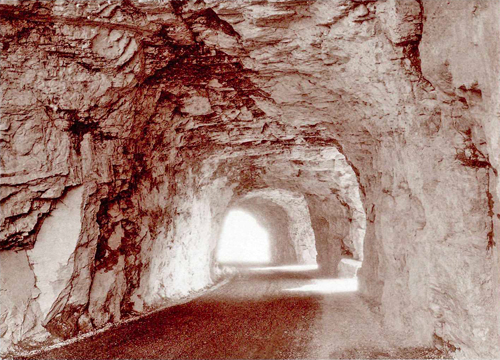
The West Side Tunnel was constructed with windows and viewing galleries from which motorists could observe Heaven's Peak. The reinforced concrete lining you see today was added during the winter of 1966-67. National Park Service photograph by Ted Marble, circa 1930 |
ALONG THE ROAD
During the road construction, access to the con.tractors' camps was often difficult. As a result, they built many trails and tote roads used for carrying in supplies. When building the East Side Tunnel, Colonial building Company built a tote road on Mt. Peigan from Logan Pass to the tunnel. This tote road, about 200 feet above the Going-to-the-Sun Road, is visible from the Logan Pass Visitor Center.
The East Side Tunnel is 408 feet long and the West Side Tunnel is 192 feet long.
The retaining wall near the Golden Staircase contains 788 cubic yards of masonry.
Each contractor typically established a camp to accommodate their laborers. These camps were scattered every few miles along the road. Some of the camps were at Rising Sun, Baring Creek, Lunch Creek, the switchback just west of Logan Pass, the Loop, Logan Creek, and Avalanche Creek. A small cabin originally used by engineers is still visible on Logan Creek upstream from the road.
Notice the six percent climb between the Loop and Logan Pass. During the 1920s, a six percent grade was the maximum recommended grade because a car had to shift down to second gear at a seven percent grade.
During the 1930s reconstruction, the alignment of the Going-to-the-Sun Road changed in several places, particularly on the west side. Some of these old alignments are still visible as cuts through the forest. Look for the old alignments near Avalanche Creek, Lake McDonald Lodge, and especially between Apgar and West Glacier where there have been two previous alignments.
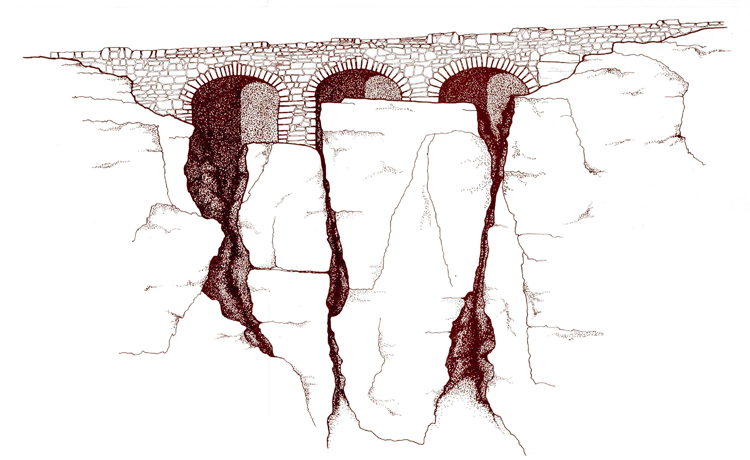
The Triple Arches was the product of an unplanned substi.tute for an excessively large retaining wall. The plans for the arches were worked up on site. Notice that the left arch was constructed askew. Drawing by William S. Withers, Historic American Engineering Record, NPS 1990 |
When preparing to blast one particularly large cliff one mile east of the Loop, the laborers wore wool socks over their boots to prevent sparks.
The contractor of the East Side Tunnel could bore 5 feet 4 inches every 24 hours.
A Caterpillar 30 tractor slipped off the road in 1931, rolled down the mountainside, and climbed back up the 200 feet with only minor damage.
Three men died during road construction.
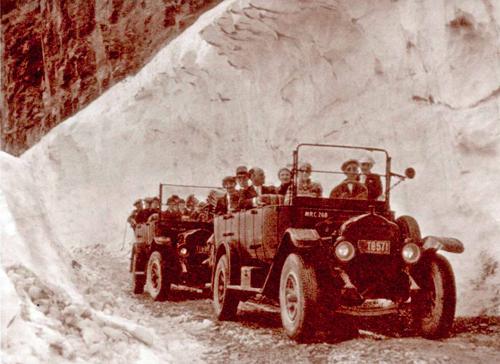
The first two buses over Logan Pass during the Dedication Ceremony July 15, 1933. The first automobile crossed Logan Pass the previous fall. National Park Service photograph, 1933 |
| Introduction | Acadia | Blue Ridge Parkway | Chickamauga and Chattanooga | Colonial Parkway | Generals Highway | George Washington Memorial Parkway | Going-to-the-Sun Road | Great Smoky Mountains | Mount Rainier | Rock Creek and Potomac Parkway | Shenandoah's Skyline Drive | Southwest Circle Tour | Vicksburg | Yellowstone | Yosemite |
