 | ||
 | ||
 | ||
 | ||
 | ||
 | ||
 | ||
 | ||
 | ||
 | ||
 | ||
 | ||
 | ||
 | ||
 | ||
 | ||
 | ||
 | ||
 |
 |
 |
Going-to-the-Sun Road: An Engineering Feat
Glacier National Park, Montana
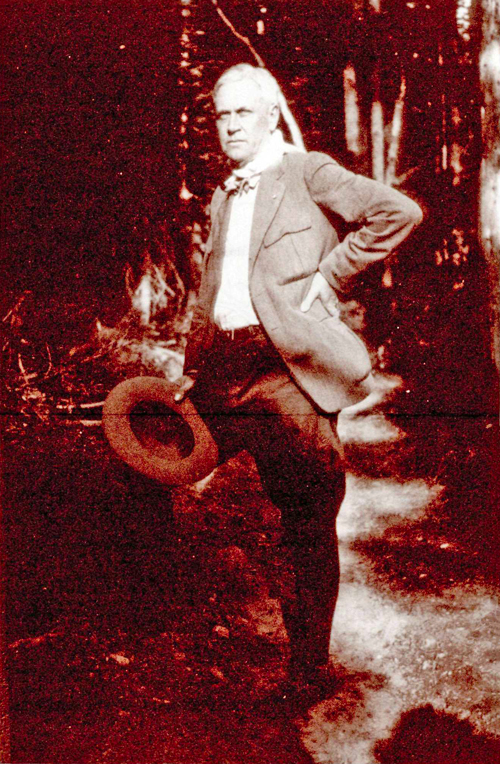
Stephen Mather, first Director of the National Park Service, was the agency's driving force for 15 years. National Park Service photograph by C. J. Kraebel, August 1924 |
BUILDING THE ROAD
After the Bureau of Public Roads and the National Park Service landscape architects completed the specifications in 1925, they accepted bids for the construction of a 12-mile section of road from Logan Creek up to Logan Pass. The Williams and Douglas Construction Company of Tacoma, Washington won the contract with the low bid of $869,145 and worked on the steep west side of the road for four seasons. Along this section of the Going-to-the-Sun Road, Williams and Douglas built most of the structures including the retaining walls, the Logan Creek Bridge, the West Side Tunnel, the Haystack Creek Culvert, and the Triple Arches. Williams and Douglas used power shovels as will as a "dinky" train—a small gasoline-powered locomotive with twelve cars—to move excavated material to places that needed fill.
In 1931 and 1932, two contractors, the Colonial Building Co. of Spokane, Washington, and A.R. Guthrie of Portland, Oregon, finished the remaining ten miles of road on the east side of Logan Pass. The most difficult construction on Colonial's contract was the 405-foot East Side Tunnel. No power equipment could reach the tunnel so laborers carried all the exca.vated rock out by hand. Access was also a challenge on A.R. Guthrie's sec.tion of the road. He floated a power shovel up St. Mary Lake on a barge to reach his company's construction site.
In the late fall of 1932, after three decades of construction and more than $2,000,000, the first automobile passed over the entire 51 miles of the Going-to-the-Sun Road. Glacier National Park formally opened the Going.to-the-Sun road in a special ceremony on July 15, 1933. Over 4000 people gathered on Logan Pass for an afternoon filled with congratulatory speech.es extolling the hard work of the past 20 years. Glacier National Park Superintendent Eivind Scoyen presided over the program and read aloud messages from Secretary of the Interior Harold Ickes and National Park Service Director Horace Albright. The chairman of the Montana State Highway Commission delivered a speech honoring the late Stephen Mather. The Civilian Conservation Corps organized a chorus, and the Blackfeet Tribal Band played the Star Spangled Banner. The afternoon ended with a ceremony of peace among the Blackfeet, Flathead, and Kootenai tribes.
In 1933 the Going-to-the-Sun Road was a complete road, but sections built before 1925 had been constructed to lower stan.dards. Using New Deal public works fund.ing throughout the 1930s, the park contract.ed to improve both the west and east sides of the road. Until the late 1930s, the Going.to-the-Sun Road had only a crushed rock surface; however, the park started to lay an asphalt pavement in 1938. World War II interrupted the series of pavement contracts, but by the end of 1952, the road was paved in its entirety.
| Introduction | Acadia | Blue Ridge Parkway | Chickamauga and Chattanooga | Colonial Parkway | Generals Highway | George Washington Memorial Parkway | Going-to-the-Sun Road | Great Smoky Mountains | Mount Rainier | Rock Creek and Potomac Parkway | Shenandoah's Skyline Drive | Southwest Circle Tour | Vicksburg | Yellowstone | Yosemite |
