|
|
|
REPORT OF THE SUPERINTENDENT OF CRATER LAKE NATIONAL PARK
1914 DEPARTMENT OF THE
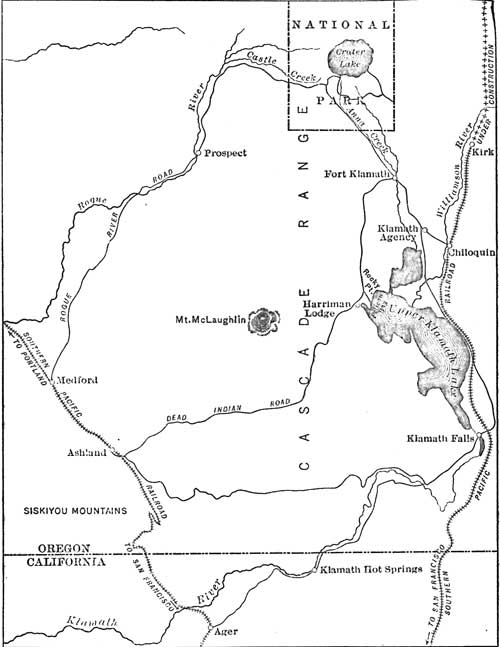
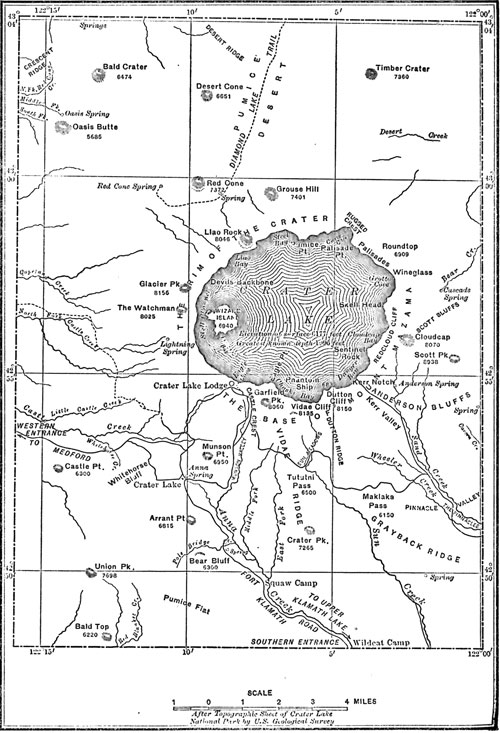
INTERIOR, SIR: The annual report of conditions in the Crater Lake National Park, since the fiscal year ended June 30, 1913, is herewith submitted for your consideration. GENERAL STATEMENT. Crater Lake National Park was created by act of Congress approved May 22, 1902, and is located on the crest of the Cascade Mountains in southern Oregon, about 60 miles from the California line. It is approximately 13-1/2 miles east and west and 18 miles north and south, and contains 249 square miles, including the wreck of Mount Mazama, at one time a giant among the mountains of the world. Subsequently all that portion above 8,000 feet elevation disappeared; sank into the bowels of the earth, leaving a vast crater 5-1/2 miles in diameter, which gradually filled with pure, crystal water to a depth of 2,000 feet, on all sides of which the walls of the cauldron still tower to a height of from 500 to nearly 2,000 feet. It was first discovered by white men on June 12, 1853. There were 22 prospectors in the party, of whom but one survives, Mr. John W. Hillman, of Hope Villa, La., who was also the leader, and was probably the first one to see it. It was scarcely known, even among residents of southern Oregon, when the writer, on August 16, 1885, started a movement for the creation of a national park, which was only successful after 17 years of strenuous labor. Then came a long struggle for development, which is just now beginning to bear fruit. Probably the first step in that direction consisted in stocking the lake with rainbow trout, which was also done by the writer, who, in 1888, carried a few minnows 49 miles and got them in the waters of the lake in good shape. The fishing now is unsurpassed and the fish are of excellent quality. ROADS. Several years ago an appropriation was made by Congress for the survey of a comprehensive system of roads within the park, the main feature of which consisted in a road entirely around the lake, close to the rim whenever possible. This survey was made under the direction of the Secretary of War, two seasons being required to complete it, and a report thereof was submitted to Congress, estimating the total cost, including $65,000 for a sprinkling plant, at approximately $700,000, and recommending that it be placed under the continuing contract feature in a manner similar to certain harbors. Of this amount an appropriation was made of $125,000 for use during the season of 1913 and $85,000 for 1914.
Under these appropriations grading and draining have proceeded steadily, resulting in a new road from the Klamath entrance to the rim of the lake, a distance of 13 miles, as also one from the southeast; or Pinnacles entrance, to the rim of the lake at Kerr Notch, a distance of 6-1/2 miles. Before the season closes the Rim Road will be completed from Crater Lake Lodge to a junction with the Pinnacles Road and from Kerr Notch to a point a little beyond Sentinel Rock, or a total completed by grading and cross drainage this season of 10-1/2 miles, which, added to the work of 1913, gives about 25 miles of newly graded roads within the park, including about half a mile on the Medford Road, built this season, by means of which a bad switchback, commonly known as the Corkscrew, has been entirely eliminated. I understand it is the intention of the War Department to commence surfacing as soon as climatic conditions will permit in the spring of 1915. This plan is questionable, for the reason that if this is done it will be impossible for many years to get anything better, whereas if surfacing is left for the present it will permit of an effort being made to secure from Congress money with which to construct paved roads.
The time has forever passed when macadam roads will satisfy the desires of a progressive community, and they are rapidly being changed for something very much better. Then why construct something that will be unsatisfactory from the very beginning? According to estimates of the War Department it will cost $20,000 per annum merely to sprinkle such roads. It is the part of wisdom to build roads of such a character as that this heavy burden will not have to be borne. I hope to make the Crater Lake National Park self-sustaining in a few years, but if this great burden is to be added that happy condition will be delayed indefinitely. TRANSPORTATION. A line of automobile stages is maintained by the Crater Lake Co. from Medford, on the main line of the Southern Pacific, and from Chiloquin, on the northerly extension of the Southern Pacific from Klamath Falls, that has rendered eminently satisfactory service. For the first time in the history of the park it has been possible to buy a ticket from Portland to California points, or vice versa, and go via Crater Lake, at an additional expense of $13 for automobile fare between Medford and Chiloquin. Doubtless this arrangement will hold good in 1915. Private automobiles and vehicles will find good roads leading to the park during the season from both the Klamath region and from the Rogue River Valley. Next year visitors from the northerly points of eastern Oregon will find it much nearer by way of the Pinnacles entrance. HOTELS. There are two permanent camps in the park where meals are served indoors, but in both of which it has heretofore been necessary to sleep in tents. One is located near park headquarters, 5 miles from the lake, and the other directly on the rim. At the latter point a handsome stone building is under construction and, to a limited degree, will be used during the season of 1915. Tents will also be provided for those desiring them. Free camping privileges are open to the public, subject only to rules and regulations of the Interior Department. FISH AND GAME. There are no fish in any of the waters of the park, except the lake itself and Anna Creek below the falls. Crater Lake is abundantly supplied with a fine quality of rainbow trout and at least one other variety, the name of which I am unable to determine. No fishing is permitted except with hook and line, and a limit of five in one day is maintained. The fish are large and the flesh is firm. A few have been taken 28 inches long, weighing 6 or 7 pounds. During the past season the Crater Lake Co. placed 2,000 rainbow fry in the lake, in addition to which I placed 20,000 steelheads therein. In my opinion there should be no more planting of fish until the matter of food has been fully and satisfactorily settled. It must be borne in mind that there are no enemies to the fish already in the lake, and that they have increased enormously in numbers, until the lake is fairly teeming with them, and during all these years nothing whatever has been done to increase the food. The park abounds in black and brown bear, black-tailed deer, cougar, lynx, timber wolves, coyotes, pine marten, fisher, several varieties of squirrels, ringtail grouse, the common pheasant, Clark crow, and numerous varieties of birds common to the country at large. FOREST FIRES. Without exception the past season was the longest dry spell in the history of Oregon, so that extraordinary precautions had to be taken against forest fires, which were kept under control throughout the summer. As the season progressed they became more frequent, until over 20 were extinguished without any material damage resulting. BRIDGES. Before the building of new roads was commenced by the War Department there were 16 bridges to care for, but with the construction of new roads they have been abandoned until there are now only five, all of which have been kept in good repair throughout the season. Plank removed from them have been taken to headquarters and used for the construction of new sidewalks. BUILDINGS AND FENCES. Considerable damage was done to buildings and fences during the winter by heavy snowfall and by intruders, who broke into and injured the former, as well as stole supplies left therein for the use of men to be sent in to ascertain winter conditions. However, full repairs have been made and everything is now in excellent condition. As was outlined in my report for 1913, the Klamath Road was constructed through a portion of the yard at headquarters, but advantage was taken of the opportunity to get good loose earth, and the yard was filled, then a surfacing of rich manure from the barn was placed over it at a nominal cost. SANITARY CONDITIONS. Under an agreement entered into with the War Department engineers last winter, a water tank was constructed near headquarters at an elevation sufficient to provide a gravity system, but nothing was done on it until late in September, so that it was impossible to complete it thereafter. However, I expect to get the plumbing and other necessary work completed in time for use early next season. If possible to get funds, I will also establish a sewerage system, so that the best of sanitary conditions will prevail at park headquarters. Steps will also be taken to establish permanent camps, with regulations and facilities for disposing of garbage, tin cans, etc., together with an adequate patrol. ELECTRIC LIGHT AND POWER. An electric light and power plant is badly needed, for which abundant water power is available close to headquarters. Not only is the light needed, but power also for light machinery. In this connection it is well to observe that it is unwise and unnecessarily expensive to send out of the park for work that can be produced there. Many things now impossible of production within the park can be easily provided with a little power for light machinery. When a plant of this character is established advantage should be taken of the power provided by the falls of Anna Creek, which should be used to their full capacity as far as park headquarters. Subsequently the expense of carrying it to the rim of the lake will be comparatively light, when a fair revenue will result by supplying light and power to concessionaires. GAME PROTECTION. But two temporary rangers are allowed during the season, one of whom is constantly employed in issuing licenses and registering visitors, so that one man must patrol the entire park. Then is it strange that there is always a report current that deer are slaughtered by poachers, who only need keep track of the ranger to carry on their nefarious practices? However, hunting in the park is not general by any means and is only carried on by an irresponsible class of semicriminals. Because of the protection afforded deer in the park become very tame during the summer and when driven to the lower levels by the first heavy snow, fall an easy prey to the despised deer skinners. If the department will allow five additional rangers, three of them will be needed for issuing automobile licenses and registering visitors at park entrances, one will be detailed for clerical work at headquarters, and three will be used to patrol the park. Of the latter one should be stationed at the Medford entrance to patrol north of the Medford Road and west of the lake, one at the Pinnacles entrance to patrol the eastern side of the park, and one at headquarters to patrol the southern portion, together with that portion of the rim in the vicinity of Crater Lake Lodge. By this arrangement fairly good patrol of the park can be maintained and deer hunters held in check. Besides this the danger of forest fires would be materially reduced and the work of park administration greatly improved. PATENTED LANDS. There are approximately 1,200 acres of private land within the park, all of which is held for speculation. It is covered with excellent timber, and it is only a question of time when some speculator or millman will gather it up; then the next move will be to cut off the trees and leave it as "logged-off land" is usually left—covered with kindlings but denuded of trees. Early action should be taken to extinguish these titles, either by the ordinary method of condemnation and purchase or by offering therefor other lands located outside of the park. DRIVING LOOSE STOCK THROUGH THE PARK. Two permits were issued during the season for driving loose stock through the park, as follows: On June 11, 1914, a permit was granted to Mr. J. E. Pelton to drive 195 loose cattle from Roseburg, Oreg., to Fort Klamath, Oreg., and on August 13, 1914, one was issued to Mr. W. O. Johnson to drive 24 head of cattle from Fort Klamath, Oreg., to Prospect, Oreg. CONCESSIONS. The following concessions have been granted:
AUTOMOBILES AND MOTOR CYCLES. During the 1914 park season there were issued 1,047 round-trip automobile permits at $1 each and 8 season automobile permits at $5 each (apart from the 7 automobiles used by the Crater Lake Co. for commercial transportation business; also 18 round-trip motor-cycle permits at $1 each, with a total return of $1,105, as against 760 round-trip auto permits at $1 each and 13 round-trip motor-cycle permits at $1 each, with a total of $773 during the 1913 park season. VISITORS. At the close of September there were 7,096 visitors, as against 5,826 at the same time in 1913, divided as follows: Visitors to Crater Lake National Park.
It may be interesting to know that by States they were divided as follows: Visitors by States.
The total number of guests entertained by the hotels was 2,085, as against 2,240 in 1913, or a loss of 155. The post-office business showed a remarkable increase. In 1913 the cancellations amounted to $46.43, whereas this season it was $108.43, a gain of $62, or more than double. RECOMMENDATIONS. GOVERNMENT OWNERSHIP. The frequent changes of administration in this Government, together with the unsatisfactory condition in which the national-park service is left by Congress, are so pronounced that capitalists are unwilling to advance funds on park concessions in amounts adequate to their needs, in consequence of which rapid development is seriously impaired, and the impression is gaining ground among men of large means that such investments are extra hazardous. Under such conditions it seems to me imperative that the General Government acquire possession of all hotels and other permanent improvements of a private nature within the parks, and that they then be leased to desirable parties for a reasonable consideration. This would be an important step toward making the parks self-sustaining, which they should be. With the road system completed, this revenue, together with that received from automobiles, would make the Crater Lake Park self-sustaining from the start, providing a comprehensive plan of management were developed to meet new conditions. Construction of private improvements at Crater Lake is yet in its infancy, for which reason I would recommend that the experiment be tried here, where the initial outlay would be comparatively light. PARK BOUNDARIES. Boundaries of the Crater Lake National Park were not originally located wisely, for the reason that but little was then known of the necessities of the case, or of physical conditions. Experience has shown that they should be changed to meet new and permanent conditions. I have given the matter a great deal of thought, and feel that they should be changed as follows: Extending the south line of the park westward on a direct line to a point on the boundary between Jackson and Klamath Counties and eastward to a point on the west boundary of the Klamath Indian Reservation. From the latter point north along the west line of the Klamath Indian Reservation, extended, to a point on the line between townships 26 and 27, south of the Willamette meridian, thence along said line between said townships west to a point due north of a point on the south line of Douglas County and between Jackson and Klamath Counties, thence south to said point, then following the line between Jackson and Klamath Counties south to the place of beginning on the south line of the Crater Lake National Park, extended, west. In support of the foregoing, will say there are no settlers within the new boundaries. On the west there is a narrow strip of Klamath County that should be eliminated and the park made to conform with the county line. On the east there is also a narrow strip between the park and the Klamath Indian Reservation that should be eliminated and the park boundary made to conform with the Indian reservation. On the north is located an extremely interesting region that is wholly within the Crater National Forest and should be included in the Crater Lake National Park in time to extend to it the road system now under construction. It is neither valuable for agriculture nor mining, and there is no public reason why this extension should not be made. On the other hand, I believe it will meet the approval of a vast majority of the people of the State. Within the proposed extension is located Diamond Lake, one of the most beautiful and attractive in the mountain range, and Mount Thielsen, a sharp peak standing over 9,000 feet above sea level and commonly known as the Lightning Rod of the Cascades, because of the brilliant displays of lightning about its pinnacle in stormy weather. PREVENTION OF FOREST FIRES. The construction of roads within the park will mark the beginning of a new era of prosperity and development, and will cause improvements to advance in quick succession so that in the near future Crater Lake will come into its own. However, to secure all this requires a vast amount of labor, accompanied by great accumulations of inflammable material along the new roads that will constantly threaten the forests with destruction, and unless immediate steps are taken to meet these conditions the park will be marred and scarred by desolate wastes of former forests. Prompt action should be taken to protect the park against this desolation of fire by an appropriation of $20,000, for use in destroying dead and down timber and underbrush along the new roads. Danger from this source has been emphasized during the past season, by the fact that one of these piles of debris was mysteriously fired and a destructive conflagration avoided only by the vigilance of park employees, who discovered it in time to control it. Very sincerely, WILL G. STEEL, The SECRETARY OF THE INTERIOR. RULES AND REGULATIONS. GENERAL REGULATIONS OF MARCH 30, 1912. By an act of Congress approved May 22, 1902, the tract of land bounded north by the parallel 43° 4' north latitude, south by 42° 48' north latitude, east by the meridian 122° west longitude, and west by the meridian 122° 16' west longitude, having an area of 249 square miles, in the State of Oregon, and including Crater Lake, has been reserved and withdrawn from settlement, occupancy, or sale under the laws of the United States, and dedicated and set apart forever as a public park or pleasure ground for the benefit of the people of the United States, to be known as Crater Lake National Park. The park by said act is placed under the exclusive control of the Secretary of the Interior, and these rules and regulations are made and published in pursuance of the duty imposed on him in regard thereto. 1. It is forbidden to injure, or destroy in any manner, any of the natural curiosities or wonders within the park, or to disturb the mineral deposits in the reservation, except under the conditions prescribed in paragraph 11 of these regulations. 2. It is forbidden to cut or injure any timber growing on the park lands, except for use in the construction of places of entertainment and in connection with the working of located mining claims, or to deface or injure any Government property. Camping parties and others on the reservation will be allowed to use dead or fallen timber for fuel in the discretion of the superintendent. 3. Fires should be lighted only when necessary and completely extinguished when not longer required. The utmost care must be exercised at all times to avoid setting fire to the timber and grass. 4. Hunting or killing, wounding or capturing any bird or wild animal on the park lands, except dangerous animals when necessary to prevent them from destroying life or inflicting an injury, is prohibited. The outfits, including guns, traps, teams, horses, or means of transportation used by persons engaged in hunting, killing, trapping, ensnaring, or capturing such birds or wild animals, or in possession of game killed on the park lands under other circumstances than prescribed above, will be taken up by the superintendent and held subject to the order of the Secretary of the Interior, except in cases where it is shown by satisfactory evidence that the outfit is not the property of the person or persons violating this regulation and the actual owner thereof was not a party to such violation. Firearms will only be permitted in the park on written permission from the superintendent thereof. 5. Fishing with nets, seines, traps, or by the use of drugs or explosives, or in any other way than with hook and line, is prohibited. Fishing for purposes of merchandise or profit is forbidden. Fishing may be prohibited by order of the superintendent in any of the waters of the park, or limited therein to any specified season of the year, until otherwise ordered by the Secretary of the Interior. All fish less than 8 inches in length should be at once returned to the water with the least damage possible to the fish. Fish that are to be retained must be at once killed by a blow on the back of the head or by thrusting a knife or other sharp instrument into the head. 6. No person will be permitted to reside permanently, engage in any business, or erect buildings, etc., upon the Government lands in the park without permission, in writing, from the Secretary of the Interior. The superintendent may grant authority to competent persons to act as guides and revoke the same in his discretion. No pack trains will be allowed in the park unless in charge of a duly registered guide. 7. Owners of patented lands within the park limits are entitled to the full use and enjoyment thereof; the boundaries of such lands, however, must be determined and marked and defined, so that they may be readily distinguished from the park lands. While no limitations or conditions are imposed upon the use of such private lands so long as such use does not interfere with or injure the park, private owners must provide against trespass by their stock or cattle, or otherwise, upon the park lands, and all trespasses committed will be punished to the full extent of the law. Stock may be taken over the park lands to patented private lands with the written permission and under the supervision of the superintendent, but such permission and supervision are not required when access to such private lands is had wholly over roads or lands not owned or controlled by the United States. 8. Allowing the running at large, herding, or grazing of cattle or stock of any kind on the Government lands in the park, as well as the driving of such stock or cattle over same is strictly forbidden, except where authority therefor has been granted by the superintendent. All cattle or stock found trespassing on the park lands will be impounded and disposed of as directed in regulations approved March 30, 1912. 9. No drinking saloon or barroom will be permitted upon Government lands in the park. 10. Private notices or advertisements shall not be posted or displayed on the Government lands within the reservation, except such as may be necessary for the convenience and guidance of the public. 11. The act provides that, under such regulations as the Secretary of the Interior may prescribe, the reservation shall be open "to the location of mining claims and the working of the same." It was not the purpose of this provision to extend the mining laws to the park without limitation, but only to authorize the location and working of mining claims thereon, under regulations to be prescribed by the Secretary of the Interior, and in such manner as not to interfere with or prejudicially affect the general purpose for which the reservation was established. It is therefore prescribed: (a) That persons desiring to locate mining claims within the park shall enroll their names and addresses with the superintendent of the reservation and shall file with such superintendent a description, in writing, of the land desired to be located. They shall also file with the superintendent evidence that they are severally qualified to make locations under the mining laws, and before entering upon the park for such purpose they must obtain from the Secretary of the Interior, through the superintendent, a written permit to do so. Such permit will be issued only upon condition that the applicant or applicants therefor, while upon the reservation, will not destroy or damage any game, fish, timber, or natural objects therein, and will strictly observe and comply with the requirements of the law and these regulations. (b) Lands in the park upon which valuable deposits of mineral shall have been or may be found may be located under the mining laws by any person or persons duly qualified and holding a permit such as is described in the preceding paragraph, and such person or persons, his or their successor or successors in interest, may work the claim or claims so located; but in carrying on the work he or they shall in all respects observe and comply with the provisions of the statute creating the park and with these regulations: Provided, That such person or persons may, as the proper working of such mining claim or claims shall require, be permitted to use for mining purposes such timber or stone found upon the land located as in the judgment of the superintendent may be so used without injury or damage to the reservation "as a public park or pleasure ground": And provided further, That within 30 days after the location of any mining claim within the park, and before development work thereon shall be commenced, a copy of the notice of location shall be filed with the superintendent, together with proof satisfactorily showing that discovery of a valuable mineral deposit has been made within the limits of the location, and, if it be a placer location, that every 10-acre tract embraced therein has been found to contain valuable deposits of mineral. (c) The statute does not authorize the purchase of or the acquisition of the legal title to lands located as mining claims within the park. The rights of the locator or locators, therefore, will be at all times subject to forfeiture upon breach of any of the conditions mentioned in the permit herein provided for, or upon refusal or failure to comply with any of the provisions of the statute or of these regulations. (d) Upon breach of any such conditions, or upon refusal or failure to comply in all respects with the provisions of the statute and of these regulations, or where locators of mining claims do not appear to be acting in good faith, or who after location do not work their claims in such manner as to show good faith in the assertion thereof, the superintendent will revoke their permits, forthwith remove them from the park, and report the facts to the Secretary of the Interior. 12. Persons who render themselves obnoxious by disorderly conduct or bad behavior, or who violate any of the foregoing rules, will be summarily removed from the park and will not be allowed to return without permission, in writing, from the Secretary of the Interior or the superintendent of the park. No lessee or licensee shall retain in his employ any person whose presence in the park shall be deemed and declared by the superintendent to be subversive of the good order and management of the reservation. 13. Any person who violates any of the foregoing regulations will be deemed guilty of a misdemeanor, and upon conviction be fined not more than $500 or imprisoned not more than one year, and shall be liable for any loss sustained by the United States as a result of such violation, as provided by the act creating the park. 14. The superintendent designated by the Secretary is hereby authorized and directed to remove all trespassers from the Government lands in the park and enforce these rules and regulations and all the provisions of the act of Congress aforesaid. INSTRUCTIONS OF SEPTEMBER 17, 1913. Visitors to the Crater Lake National Park are hereby notified that when dogs are taken through the park they must be prevented from chasing the animals and birds or annoying passers-by. To this end they must be carried in the wagons or led behind them while traveling and kept within the limits of the camp when halted. Any dog found at large in disregard of these instructions will be killed. REGULATIONS OF MARCH 30, 1912, GOVERNING THE IMPOUNDING AND DISPOSITION OF LOOSE LIVE STOCK. Horses, cattle, or other domestic live stock running at large or being herded or grazed in the Crater Lake National Park without authority from the Secretary of the Interior will be taken up and impounded by the superintendent, who will at once give notice thereof to the owner, if known. If the owner is not known, notice of such impounding, giving a description of the animal or animals, with the brands thereon, will be posted in six public places inside the park and in two public places outside the park. Any owner of an animal thus impounded may, at any time before the sale thereof, reclaim the same upon proving ownership and paying the cost of notice and all expenses incident to the taking up and detention of such animal, including the cost of feeding and caring for the same. If any animal thus impounded shall not be reclaimed within 30 days from notice to the owner or from the date of posting notices, it shall be sold at public auction at such time and place as may be fixed by the superintendent, after 10 days' notice, to be given by posting notices in six public places in the park and two public places outside the park, and by mailing to the owner, if known, a copy thereof. All money received from the sale of such animals and remaining after the payment of all expenses incident to the taking up, impounding, and selling thereof shall be carefully retained by the superintendent in a separate fund for a period of six months, during which time the net proceeds from the sale of any animal may be claimed by and paid to the owner upon the presentation of satisfactory proof of ownership, and if not so claimed within six months from the date of sale such proceeds shall be turned into the Crater Lake National Park fund. The superintendent shall keep a record, in which shall be set down a description of all animals impounded, giving the brands found on them, the date and locality of the taking up, the date of all notices and manner in which they were given, the date of sale, the name and address of the purchaser, the amount for which each animal was sold and the cost incurred in connection therewith, and the disposition of the proceeds. The superintendent will, in each instance, make every reasonable effort to ascertain the owner of animals impounded and to give actual notice thereof to such owner. REGULATIONS OF MARCH 30, 1912, GOVERNING THE ADMISSION OF AUTOMOBILES AND MOTOR CYCLES. Pursuant to authority conferred by the act of May 22, 1902 (32 Stats., 202), setting aside certain lands in the State of Oregon as a public park, the following regulations governing the admission of automobiles into the Crater Lake National Park are hereby established and made public. 1. No automobile will be permitted within the metes and bounds of the Crater Lake National Park unless the owner thereof secures a written permit from the superintendent or his representative. 2. Applications for permits must show: (a) Name of owner, (b) number of machine, (c) name of driver, and (d) inclusive dates for which permit is desired, not exceeding one year, and be accompanied by a fee of $1 for a single round trip through the park or a fee of $5 per annum for each machine for personal use and not for hire. Permits must be presented to the superintendent or his authorized representative at the rangers' headquarters on the Government roads. Permittees will not be allowed to do a commercial transportation business in the park without a special license therefor from the Secretary of the Interior. All permits granted at any time when automobiles can enter the park will expire on December 31 of the year of issue. 3. The use of automobiles will be permitted on the Government roads from the southern and western boundaries of the park between the hours of 6.30 a. m. and 10.30 a. m., and between the hours of 3.30 p. m. and 6.30 p. m. 4. When teams approach, automobiles will take position on the outer edge of roadway, regardless of the direction in which they are going, taking care that sufficient room is left on the inside for the passage of teams. 5. Automobiles will stop when teams approach and remain at rest until teams have passed or until teamsters are satisfied regarding the safety of their teams. 6. Speed will be limited to 6 miles per hour, except on straight stretches where approaching teams will be visible, when, if no teams are in sight, this speed may be increased to the rate indicated on sign boards along the road; in no event, however, shall it exceed 15 miles per hour. 7. Signal with horn will be given at or near every bend to announce to drivers of approaching teams the proximity of an automobile. 8. Teams have the right of way, and automobiles will be backed or otherwise handled, as necessary, so as to enable teams to pass with safety. 9. Violation of any of the foregoing rules or the general regulations for the government of the park will cause revocation of permit, will subject the owner of the automobile to any damages occasioned thereby and to ejectment from the reservation and be cause for refusal to issue a new permit to the owner without prior sanction in writing from the Secretary of the Interior. 10. All persons passing through the park with automobiles are required to stop at the superintendent's headquarters or the rangers' headquarters and register their names. 11. These rules are also applicable to motor cycles, which may use the park roads on payment of a fee of $1 for each machine per annum. Permits issued therefor shall expire on December 31 of the year of issue. | |||||||||||||||||||||||||||||||||||||||||||||||||||||||||||||||||||||||||||||||||||||||||||||||||||||||||||||||||||||||||||||||||||||||||||||||||||||||||||||
| <<< Previous | > Cover < |
annual_reports/crla/1914b.htm
2-Aug-2006