|
|
|
REPORT OF THE SUPERINTENDENT OF CRATER LAKE NATIONAL PARK
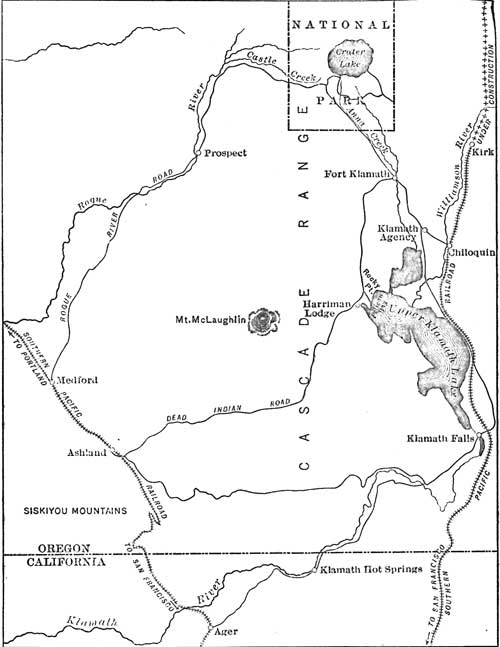
1913 DEPARTMENT OF THE INTERIOR, SIR: The annual report of conditions in the Crater Lake National Park, since the fiscal year ended June 30, 1912, is herewith submitted for your consideration. GENERAL STATEMENT. Crater Lake National Park was created by act of Congress approved May 22, 1902, and is located on the crest of the Cascade Mountains in southern Oregon, about 60 miles from the California line. It is approximately 13-1/2 miles east and west and 18 miles north and south, and contains 249 square miles, including the wreck of Mount Mazama, at one time a giant among the mountains of the world. Subsequently all that portion above 8,000 feet elevation disappeared; sank into the bowels of the earth, leaving a vast crater 5-1/2 miles in diameter, which gradually filled with pure, crystal water to a depth of 2,000 feet, on all sides of which the walls of the cauldron still tower to a height of from 500 to nearly 2,000 feet. It was first discovered by white men on June 12, 1853. There were 22 prospectors in the party, of whom but one survives, Mr. John W. Hillman, of Hope Villa, La., who was also the leader, and was probably the first one to see it. It was scarcely known, even among residents of southern Oregon, when the writer, on August 16, 1885, started a movement for the creation of a national park, which was only successful after 17 years of strenuous labor. Then came a long struggle for development, which is just now beginning to bear fruit. Probably the first step in that direction consisted in stocking the lake with rainbow trout, which was also done by the writer, who, in 1888, carried a few minnows 49 miles and got them in the waters of the lake in good shape. The fishing now is unsurpassed and the fish are of excellent quality. ROADS. Heretofore roads within the park have been of the crudest possible character, there being but little done in the line of construction beyond the cutting of trees and clearing away the fallen timber. Many years ago the Government constructed such a road over the mountains, connecting Jacksonville with Fort Klamath, the latter then being a remote military post in the Indian country, to which it was necessary to transport supplies. This road crossed the mountain range about 5 miles south of Crater Lake. Soon thereafter a few travelers began to visit the lake and a crude road was marked out by the wagon wheels that eventually became the only means of reaching the lake with vehicles. Soon after the creation of the park an appropriation was made by Congress for the construction of a wagon road from the Jacksonville and Fort Klamath road, which was done, but the last ascent had a maximum grade of 33 per cent, which has ever since been the bane of automobile drivers, many of whom were compelled to leave their machines at the foot of the hill, a mile from the rim.
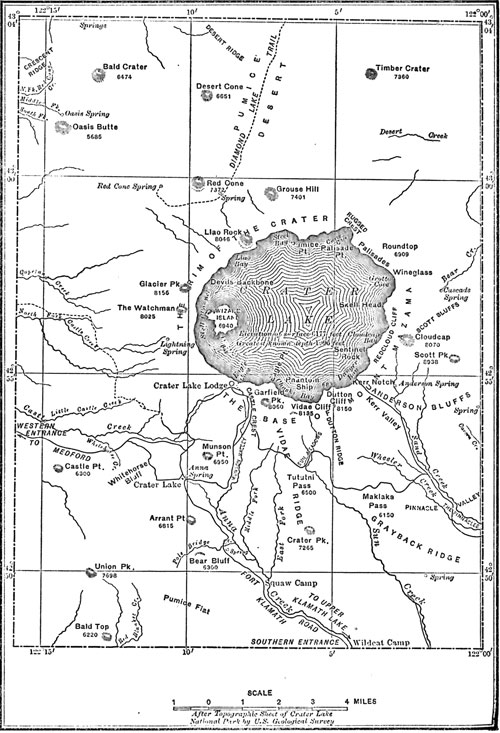
Several years ago an appropriation was made by Congress for the survey of a comprehensive system of roads within the park, the main feature of which consisted in a road entirely around the lake, close to the rim whenever possible. This survey was made under the direction of the Secretary of War, two seasons being required to complete it, and a report thereof was submitted to Congress, estimating the total cost, including $65,000 for a sprinkling plant, at approximately $700,000, and recommending that it be placed under the continuing contract feature, in a manner similar to certain harbors. Of this amount an appropriation was made of $125,000, for use during the season of 1913, of which about one-half was used. A temporary road was constructed from Kirk, the most northerly station of the Southern Pacific extension from Klamath Falls to Natron, to the park boundary at Wheeler Creek, where permanent work was commenced early in the season. From this point the road closely follows, first Wheeler Creek, then Sand Creek, reaching the rim of the lake at Kerr Notch, the lowest place in its walls. Sand Creek is a deep canyon remarkable for the great number of sharp pinnacles within it, because of which the road is known as the Pinnacle Road. The grading and draining of this road has been completed the full length, 6-1/2 miles. Eight miles west of this is located the road heretofore referred to, on which, about 1-1/2 miles from the rim, a second construction camp, known as Camp No. 2, from which operations were directed, was established. From Camp No. 2 to the lake a new grade has been completed, replacing the old 33 per cent one with a maximum of 10 per cent. Between these two roads about 5 miles have been cleared and fully 2 miles have been graded. The connection between these two roads will be completed early in the season of 1914, so that next year there will be three entrances to the park. From Camp No. 2 about a mile of road has been graded toward Park Headquarters, and most of the permanent locating has been accomplished to the Klamath entrance. This portion of the system will be drained and graded during the coming season, as also that portion leading from park headquarters to the Medford entrance. In the report of the Secretary of War to Congress it was estimated that seven years would be required to complete the work of construction, but in my opinion it will be more economical and by all odds more satisfactory to increase the force and complete the work in one-half that time, which can be readily done, if Congress will increase the appropriations accordingly. There is no reason why several large construction camps should no the maintained, now that a way has been opened up to transport supplies and machinery. TRANSPORTATION. A line of automobile stages has been maintained from Medford, a distance of 85 miles, on the main line of the Southern Pacific. It is expected that similar stages will meet all regular passenger trains on the northerly extension of the Klamath Falls-Natron cut-off at Chiloquin. During July, August, and September special excursion tickets are sold to Crater Lake at reduced rates, that will enable the tourist to go one way and return the other. Private automobiles and vehicles will have no difficulty in entering the park from Medford, Klamath Falls, or the northerly points of eastern and central Oregon. HOTELS. There are two permanent camps in the park where meals are served indoors, but in both of which it has heretofore been necessary to sleep in tents. One is located near park headquarters, 5 miles from the lake, and the other directly overlooking the lake. At the latter point a handsome stone building is under construction and to a limited degree will be used during the season of 1914. The kitchen and dining room will be used at the opening of the season, and rooms as fast as they can be finished and furnished. Two wooden buildings heretofore used as a kitchen and dining room will be remodeled and used for sleeping accommodations. Tents will also be provided for those desiring them. Free camping privileges are open to the public, subject only to rules and regulations of the Department of the Interior. FISH AND GAME. There are no fish in any of the waters of the park, except the lake itself and Anna Creek below the falls. The lake is abundantly supplied with a fine quality of rainbow trout and at least one other variety, the nature of which I am unable to determine. No fishing is permitted except by hook and line, and a limit of five in one day is maintained. The fish are large and the flesh is firm. A few have been taken 28 inches long, weighing 6 or 7 pounds. The park abounds in black and brown bear, black-tailed deer, cougar, lynx, timber wolves, coyotes, pine marten, fisher, several varieties of squirrels, ringtail grouse, the common pheasant, and numerous varieties of birds common to the country at large, as also the Clark crow. While there are many deer in the park, the are rarely seen along the roads, for the reason that heretofore dogs have been permitted to run at large and probably chase them, causing them to become shy. However, the department has issued orders forbidding loose dogs to run at large, which order will be strictly enforced, in consequence of which deer will doubtless become a common sight for visitors. FOREST FIRES. During the past season there were several small forest fires, apparently caused by careless campers. In one case they were apprehended, and as the offense was accompanied by the destruction of live trees, the offenders were ejected from the park and warned against a second offense. The season's loss through fires was merely nominal. BRIDGES. On the roads as they heretofore existed were 16 bridges, varying from 16 to over 100 feet in length. They are all constructed of wood, and most of them should be replaced by new ones. However, the construction of any new roads by the War Department sometimes requires that they be moved or even abandoned, in which latter case the planks are utilized elsewhere. Under such conditions I think it would be unwise to undertake to make any extensive repairs until the new roads are at least graded, when the matter of new bridges and bridge repairs can be considered, with this reservation, however, that they may be kept safe in the meantime. BUILDINGS AND FENCES. Buildings and fences in the reserve are in good condition, but when next season opens up it will he found that the fences are broken by the great depth of snow and will require a reasonable amount of repairs. The same may be said of the buildings. During the past season I moved a small cottage forward to the main road and completely remodeled it, making a convenient office building that is greatly appreciated by the traveling public. Heretofore a small room in the superintendent's residence has been used for both living and business purposes, which of itself was unsuited for public use; besides, it was fully 200 feet from the road. Within this office I have installed an excellent vertical filing cabinet and have all park papers and correspondence systematically filed. The front room is used by the chief ranger, who registers visitors and issues licenses to the public, whereas the back room is used by the superintendent. This arrangement permits of the entire upstairs being utilized for storing supplies, as sleeping quarters for employees, or for emergency. All park buildings have been painted and the most important repairs have been made during the season. Trees within the yard have been carefully trimmed and accumulated brush and logs have been removed. Through the middle of the yard from north to south is a low place that ought to be filled, particularly as the new road to the Klamath entrance will be constructed across the lower end of it early in the season of 1914. This work can probably be done at a cost of about $500. PARKING AND REPAIRING ROADS AND TRAILS. As early as possible last season work was commenced on roads, all of which were in bad shape, having been washed out in many places to a depth of two feet and more, so that it was impossible to turn to one side or the other. Instead of cutting out the middle, as has heretofore been done, I cut out the sides and dragged them. The trail to the lake was in very bad shape and required a great deal of work, which was given it. At an expense of probably $200 certain rocks can be removed from the trail so that burros can pass over it, in which case the Crater Lake Co. will keep these little animals at Crater Lake Lodge for the use of guests. Vast quantities of dead and down timber encumber the grounds of the park, affording dangerously inflammable material for spreading fire and destruction. All this should be cleaned up, together with such underbrush as interferes, but the cost would be prohibitive. However, a certain amount of this work can be done every year along the roads, and in the course of time a system of clear places can be established that will reduce the danger of fire to a minimum. I have in this manner cleared the road on both sides from headquarters toward the lake to a distance of about a mile and have carefully trimmed the trees, which not only adds a degree of safety but greatly beautifies the park. SANITARY CONDITIONS. It is the intention of the War Department to install the first unit of a proposed sprinkling system for the new roads close to park headquarters and to establish a construction camp near Anna Creek for the season of 1914. To accomplish this a water reservoir will be constructed on the side of a hill high enough above the base of the park buildings to insure abundant pressure for a gravity system and fire protection. A pipe from this reservoir will pass by the park buildings and will be extended to the proposed construction camp for domestic purposes. The additional cost of piping to and through all buildings under such circumstances will be very slight and should be taken immediate advantage of. Besides this, a septic tank should be constructed at once and a satisfactory sewerage system established on a permanent basis, so that sanitary conditions may be maintained. ELECTRIC LIGHT AND POWER. An electric light and power plant is badly needed, for which abundant water power is available close to headquarters. Not only is the light needed, but power also for light machinery. In this connection it is well to observe that it is unwise and unnecessarily expensive to send out of the park for work that can be produced there. Many things now impossible of production within the park can be easily provided with a little power for such things as saws and lathes. We need more tools, that will probably be secured as they are needed, but we also need a modern, well-equipped woodworking shop, blacksmith shop, and power provided for them. GAME PROTECTION. But two temporary rangers are allowed during the season, one of whom is constantly employed in issuing licenses and registering visitors, so that one man must patrol the entire park. Then is it strange that there is always a report current that deer are slaughtered by poachers, who only need keep track of the ranger to carry on their nefarious practices with perfect impunity? However, hunting in the park is not general by any means, and is only carried on by an irresponsible class of semicriminals. Because of the protection afforded, deer in the park become very tame during the summer and when driven to the lower levels by the first heavy snow fall an easy prey to the despised deer skinners. This entire matter could be satisfactorily handled by creating a game preserve, to embrace not only the park but all that portion of the forest reserve on the north to township 26 and on the west to range 1, Willamette meridian, then giving to it just such protection as is now afforded to other game preserves of a similar character. PATENTED LANDS. There are approximately 1,200 acres of private land within the park, probably all of which is held for speculation. It is covered with excellent timber, and it is only a question of a little time when some speculator or mill man will gather it up, when the next move will be to cut off all the trees and leave it as "logged-off land" is usually left, covered with kindlings but denuded of trees. Early action should be taken to extinguish these titles, either by the ordinary method of condemnation and purchase or by offering therefor other lands located outside of the park. LABOR. One serious difficulty confronts us in the development of the park that ought to be overcome. Owing to the fact that the park is so far removed from the centers of population it is very hard at best to get men to work for the short season, and by the further fact that the Klamath region is a stock country, where haying occurs in July and August, when laborers are in demand at good wages. Particularly is this true when we remember that everybody knows there is no provision for the comfort of the men, who, by the common laws of humanity, are entitled to shelter and the ordinary conveniences, particularly as they pertain to sanitary conditions. To meet this contingency there should be constructed, without delay, a building containing kitchen, dining room, bathroom, and sleeping quarters, all of which can be done for $1,200. DRIVING LOOSE STOCK THROUGH THE PARK. During the season but one permit, to J. E. Pelton, was issued for driving loose stock through the park and but six cattle were driven through. CONCESSIONS. The Crater Lake Co. holds a concession for transportation through the park, for the maintenance of hotels, for operating boats on the lake, and for carrying on a general merchandise business. The Klamath Telephone & Telegraph Co. maintains a telephone line through the park, connecting with the office of that corporation at Fort Klamath. Permits for photographic privileges are held by the Kiser Photo Co., of Portland, Oreg., and the Miller Photo Co., of Klamath Falls, Oreg. AUTOMOBILES. Up to December 6, 1913, there was issued 760 automobile and 13 motorcycle permits, at $1 each for a single round trip through the reserve. During the season one license was issued covering the use of five automobiles for a commercial transportation business, at $10 each. VISITORS. The total number of visitors during the season was 6,253, the travel being divided as follows: June 43, July 1, 144, August 3,002, September 1,637, October 418, and November 9. Last year the travel amounted to 5,235, showing a gain in 1913 of 1,018, which I consider very satisfactory. The total number of guests entertained at the hotels this season was 2,240, or a gain over 1912 of over 60 per cent. Very sincerely, WILL G. STEEL, The SECRETARY OF THE INTERIOR. RULES AND REGULATIONS. GENERAL REGULATIONS OF MARCH 30, 1912. By an act of Congress approved May 22, 1902, the tract of land bounded north by the parallel 43° 4' north latitude, south by 42° 48' north latitude, east by the meridian 122° west longitude, and west by the meridian 122° 16' west longitude, having an area of 249 square miles, in the State of Oregon, and including Crater Lake, has been reserved and withdrawn from settlement, occupancy, or sale under the laws of the United States, and dedicated and set apart forever as a public park or pleasure ground for the benefit of the people of the United States, to be known as Crater Lake National Park. The park by said act is placed under the exclusive control of the Secretary of the Interior, and these rules and regulations are made and published in pursuance of the duty imposed on him in regard thereto. 1. It is forbidden to injure, or destroy in any manner, any of the natural curiosities or wonders within the park, or to disturb the mineral deposits in the reservation, except under the conditions prescribed in paragraph 11 of these regulations. 2. It is forbidden to cut or injure any timber growing on the park lands, except for use in the construction of places of entertainment and in connection with the working of located mining claims, or to deface or injure any Government property. Camping parties and others on the reservation will be allowed to use dead or fallen timber for fuel in the discretion of the superintendent. 3. Fires should be lighted only when necessary and completely extinguished when not longer required. The utmost care must be exercised at all times to avoid setting fire to the timber and grass. 4. Hunting or killing, wounding or capturing any bird or wild animal on the park lands, except dangerous animals when necessary to prevent them from destroying life or inflicting an injury, is prohibited. The outfits, including guns, traps, teams, horses, or means of transportation used by persons engaged in hunting, killing, trapping, ensnaring, or capturing such birds or wild animals, or in possession of game killed on the park lands under other circumstances than prescribed above, will be taken up by the superintendent and held subject to the order of the Secretary of the Interior, except in cases where it is shown by satisfactory evidence that the outfit is not the property of the person or persons violating this regulation and the actual owner thereof was not a party to such violation. Firearms will only be permitted in the park on written permission from the superintendent thereof. 5. Fishing with nets, seines, traps, or by the use of drugs or explosives, or in any other way than with hook and line, is prohibited. Fishing for purposes of merchandise or profit is forbidden. Fishing may be prohibited by order of the superintendent in any of the waters of the park, or limited therein to any specified season of the year, until otherwise ordered by the Secretary of the Interior. All fish less than 8 inches in length should at once be returned to the water with the least damage possible to the fish. Fish that are to be retained must be at once killed by a blow on the back of the head or by thrusting a knife or other sharp instrument into the head. 6. No person will be permitted to reside permanently, engage in any business, or erect buildings, etc., upon the Government lands in the park without permission, in writing, from the Secretary of the Interior. The superintendent may grant authority to competent persons to act as guides and revoke the same in his discretion. No pack trains will be allowed in the park unless in charge of a duly registered guide. 7. Owners of patented lands within the park limits are entitled to the full use and enjoyment thereof; the boundaries of such lands, however, must be determined and marked and defined, so that they may be readily distinguished from the park lands. While no limitations or conditions are imposed upon the use of such private lands so long as such use does not interfere with or injure the park, private owners must provide against trespass by their stock or cattle, or otherwise, upon the park lands, and all trespasses committed will be punished to the full extent of the law. Stock may be taken over the park lands to patented private lands with the written permission and under the supervision of the superintendent, but such permission and supervision are not required when access to such private lands is had wholly over roads or lands not owned or controlled by the United States. 8. Allowing the running at large, herding, or grazing of cattle or stock of any kind on the Government lands in the park, as well as the driving of such stock or cattle over same, is strictly forbidden, except where authority therefor has been granted by the superintendent. All cattle or stock found trespassing on the park lands will be impounded and disposed of as directed in regulations approved March 30, 1912. 9. No drinking saloon or barroom will be permitted upon Government lands in the park. 10. Private notices or advertisements shall not be posted or displayed on the Government lands within the reservation, except such as may be necessary for the convenience and guidance of the public. 11. The act provides that, under such regulations as the Secretary of the Interior may prescribe, the reservation shall be open "to the location of mining claims and the working of the same." It was not the purpose of this provision to extend the mining laws to the park without limitation, but only to authorize the location and working of mining claims thereon, under regulations to be prescribed by the Secretary of the Interior, and in such manner as not to interfere with or prejudicially affect the general purpose for which the reservation was established. It is therefore prescribed: (a) That persons desiring to locate mining claims within the park shall enroll their names and addresses with the superintendent of the reservation and shall file with such superintendent a description, in writing, of the land desired to be located. They shall also file with the superintendent evidence that they are severally qualified to make locations under the mining laws, and before entering upon the park for such purpose they must obtain from the Secretary of the Interior, through the superintendent, a written permit to do so. Such permit will be issued only upon condition that the applicant or applicants therefor, while upon the reservation, will not destroy or damage any game, fish, timber, or natural objects therein, and will strictly observe and comply with the requirements of the law and these regulations. (b) Lands in the park upon which valuable deposits of mineral shall have been or may be found may be located under the mining laws by any person or persons duly qualified and holding a permit such as is described in the preceding paragraph, and such person or persons, his or their successor or successors in interest, may work the claim or claims so located; but in carrying on the work he or they shall in all respects observe and comply with the provisions of the statute creating the park and with these regulations: Provided, such person or persons may, as the proper working of such mining claim or claims shall require, be permitted to use for mining purposes such timber or stone found upon the land located as in the judgment of the superintendent may be so used without injury or damage to the reservation "as a public park or pleasure ground": And provided further, That within 30 days after the location of any mining claim within the park, and before development work thereon shall be commenced, a copy of the notice of location shall be filed with the superintendent, together with proof satisfactorily showing that discovery of a valuable mineral deposit has been made within the limits of the location, and, if it be a placer location, that every 10-acre tract embraced therein has been found to contain valuable deposits of mineral. (c) The statute does not authorize the purchase of or the acquisition of the legal title to lands located as mining claims within the park. The rights of the locator or locators, therefore, will be at all times subject to forfeiture upon breach of any of the conditions mentioned in the permit herein provided for, or upon refusal or failure to comply with any of the provisions of the statute or of these regulations. (d) Upon breach of any such conditions, or upon refusal or failure to comply in all respects with the provisions of the statute and of these regulations, or where locators of mining claims do not appear to be acting in good faith, or who after location do not work their claims in such manner as to show good faith in the assertion thereof, the superintendent will revoke their permits, forthwith remove them from the park, and report the facts to the Secretary of the Interior. 12. Persons who render themselves obnoxious by disorderly conduct or bad behavior, or who violate any of the foregoing rules, will be summarily removed from the park and will not be allowed to return without permission, in writing, from the Secretary of the Interior or the superintendent of the park. No lessee or licensee shall retain in his employ any person whose presence in the park shall be deemed and declared by the superintendent to be subversive of the good order and management of the reservation. 13. Any person who violates any of the foregoing regulations will be deemed guilty of a misdemeanor, and upon conviction be fined not more than $500 or imprisoned not more than one year, and shall be liable for any loss sustained by the United States as a result of such violation, as provided by the act creating the park. 14. The superintendent designated by the Secretary is hereby authorized and directed to remove all trespassers from the Government lands in the park and enforce these rules and regulations and all the provisions of the act of Congress aforesaid. INSTRUCTIONS OF SEPTEMBER 17, 1913, TO PERSONS TRAVELING THROUGH CRATER LAKE NATIONAL PARK. Visitors to the Crater Lake National Park are hereby notified that when dogs are taken through the park they must be prevented from chasing the animals and birds or annoying passers-by. To this end they must be carried in the wagons or led behind them while traveling and kept within the limits of the camp when halted. Any dog found at large in disregard of these instructions will be killed. REGULATIONS OF MARCH 30, 1912, GOVERNING THE IMPOUNDING AND DISPOSITION OF LOOSE LIVE STOCK. qHorses, cattle, or other domestic live stock running at large or being herded or grazed in the Crater Lake National Park without authority from the Secretary of the Interior will be taken up and impounded by the superintendent, who will at once give notice thereof to the owner, if known. If the owner is not known, notice of such impounding, giving a description of the animal or animals, with the brands thereon, will be posted in six public places inside the park and in two public places outside the park. Any owner of an animal thus impounded may, at any time before the sale thereof, reclaim the same upon proving ownership and paying the cost of notice and all expenses incident to the taking up and detention of such animal, including the cost of feeding and caring for the same. If any animal thus impounded shall not be reclaimed within 30 days from notice to the owner or from the date of posting notices, it shall be sold at public auction at such time and place as may be fixed by the superintendent, after 10 days' notice, to be given by posting notices in six public places in the park and two public places outside the park, and by mailing to the owner, if known, a copy thereof. All money received from the sale of such animals and remaining after the payment of all expenses incident to the taking up, impounding, and selling thereof shall be carefully retained by the superintendent in a separate fund for a period of six months, during which time the net proceeds from the sale of any animal may be claimed by and paid to the owner upon the presentation of satisfactory proof of ownership, and if not so claimed within six months from the date of sale such proceeds shall be turned into the Crater Lake National Park fund. The superintendent shall keep a record, in which shall be set down a description of all animals impounded, giving the brands found on them, the date and locality of the taking up, the date of all notices and manner in which they were given, the date of sale, the name and address of the purchaser, the amount for which each animal was sold and the cost incurred in connection therewith, and the disposition of the proceeds. The superintendent will, in each instance, make every reasonable effort to ascertain the owner of animals impounded and to give actual notice thereof to such owner. REGULATIONS OF MARCH 30, 1912, GOVERNING THE ADMISSION OF AUTOMOBILES AND MOTOR CYCLES. Pursuant to authority conferred by the act of May 22, 1902 (32 Stats., 202), setting aside certain lands in the State of Oregon as a public park, the following regulations governing the admission of automobiles into the Crater Lake National Park are hereby established and made public: 1. No automobile will be permitted within the metes and bounds of the Crater Lake National Park unless the owner thereof secures a written permit from the superintendent or his representative. 2. Applications for permits must show: (a) Name of owner, (b) number of machine, (c) name of driver, and (d) inclusive dates for which permit is desired, not exceeding one year, and be accompanied by a fee of $1 for a single round trip through the park, or a fee of $5 per annum for each machine for personal use, and not for hire. Permits must be presented to the superintendent or his authorized representative at the rangers' headquarters on the Government roads. Permittees will not be allowed to do a commercial transportation business in the park without a special license therefor from the Secretary of the Interior. All permits granted at any time when automobiles can enter the park will expire on December 31 of the year of issue. 3. The use of automobiles will be permitted on the Government roads from the southern and western boundaries of the park between the hours of 6.30 a. m. and 10.30 a. m., and between the hours of 3.30 p. m. and 6.30 p. m. 4. When teams approach, automobiles will take position on the outer edge of roadway, regardless of the direction in which they are going, taking care that sufficient room is left on the inside for the passage of teams. 5. Automobiles will stop when teams approach and remain at rest until teams have passed or until teamsters are satisfied regarding the safety of their teams. 6. Speed will be limited to 6 miles per hour, except on straight stretches where approaching teams will be visible, when, if no teams are in sight, this speed may be increased to the rate indicated on sign boards along the road; in no event, however, shall it exceed 15 miles per hour. 7. Signal with horn will be given at or near every bend to announce to drivers of approaching teams the proximity of an automobile. 8. Teams have the right of way, and automobiles will be backed or otherwise handled, as necessary, so as to enable teams to pass with safety. 9. Violation of any of the foregoing rules, or the general regulations for the government of the park, will cause revocation of permit; will subject the owner of the automobile to any damages occasioned thereby, and to ejectment from the reservation, and be cause for refusal to issue a new permit to the owner without prior sanction in writing from the Secretary of the Interior. 10. All persons passing through the park with automobiles are required to stop at the superintendent's headquarters or the rangers' headquarters and register their names. 11. These rules are also applicable to motor cycles, which may use the park roads on payment of a fee of $1 for each machine per annum; permits issued therefor shall expire on December 31 of the year of issue. |
| <<< Previous | > Cover < |
annual_reports/crla/1913b.htm
2-Aug-2006