|
|
Additions to the museum displays this year have been very few due to the fact that Park Naturalist Franke was away during the winter and no one else was here to do the work. Early this Spring, however, a few new displays were added.
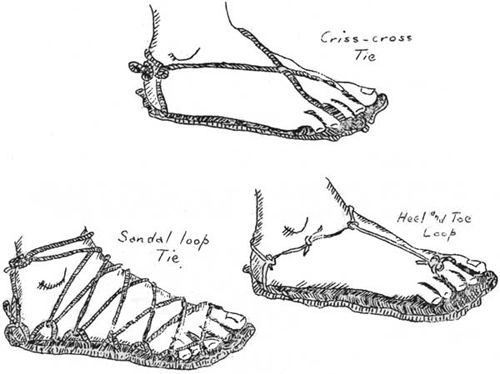
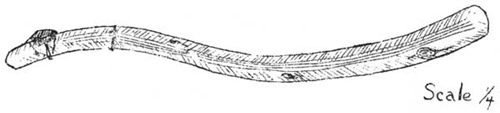
In order to show how the Cliff Dwellers wore their sandals three feet have been made and the principal types of sandal lacings are shown. The feet were case in plaster from the feet of one of the Navajos and are painted to resemble the human foot. They show very clearly how the cliff Dwellers wore their sandals. A piece of twin crystal selenite that was found in one of the road cuts has been added to the geology case. This is a peculiar form of double arrowhead. It is a clear, glass-like mineral, highly prized by the Indians and used for pendants and ceremonial objects. To the Basket Maker II exhibit has been added one of the curved sticks that are so often found in the burials of the men of that culture. This stick is twenty inches long, 1-1/4 inches wide at the handle end, widening to 1-3/4 inches at the opposite end, with an average thickness of 5/8 of an inch; all of the edges are well rounded. The stick has a very slight S-curve. On each side of this stick four V-shaped grooves run from the broad end to a point three and one half inches from the small end where a shallow groove encircles the stick. Nine inches from the small end there is a break of 1/2 inch in the grooves. Two inches from the small end a deep groove encircles the stick. This groove was wound round and round with small cord until it was completely filled, and on one side of the stick the cord was tied and wound into a large knot which was covered with pitchy gum.
Although a number of these sticks have been found no certain use has been ascribed to them. As they are found in adult male burials they seem surely to have been part of the armament of the Basket Maker II men. The sticks suggest somewhat the boomerang, but they would not have had the boomerang action of returning to the thrower. They are also somewhat like the rabbit sticks, which the Hopis use in killing small game, but it is not known whether these Basket Maker sticks were thrown. The edges are never battered or scarred as would have been the case if they had been cast. It has been suggested that they might have been fending sticks with which atlatl darts were struck aside, but this would have been a precarious method of avoiding those speeding missiles. If the fast traveling atlatl dart could have been seen by its intended victim it could have been more easily dodged than struck aside with this thin stick, a matter that would have involved split-second timing. It has also been suggested that one of these sticks was held in the left hand of the Basket Maker II warrior and its curved side used as a support for the front end of the long atlatl dart as it was poised just before being thrown. Certainly the dart must have been unwieldy supported only by the neck at the back and by two fingers of the throwing hand, and some such support might have been necessary. In spite of all these conjectures the use of the curved stick is not definitely known and it must be placed in the class of problematical objects. | ||||||
| <<< Previous | > Cover < | Next >>> |
vol5-1c.htm
14-Oct-2011