|
|
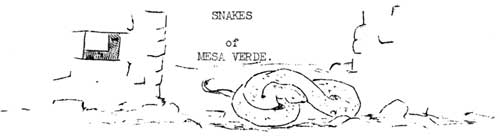
Mesa Verde Notes for 1932 contained a series of articles dealing with the lizards of the Park and this year opportunity has been afforded to publish a series dealing with the snakes of the region. It has been suggested that the first article deal with snakes in general while the second will take up the particular species found on the mesa. The snakes of Colorado fall under the following classification:
The idea that every snake should be killed is giving way to the more reasonable attitude that snakes should be protected. This is due to the fact that we are becoming educated to the value of our wild life in general. The food habits of snakes as a whole make them a most valuable aid to agriculture. Such rodents as Pocket Gophers, Spermophiles, Prairie Dogs, Pack Rats, Kangaroo Rats and all forms of mice are found on the bill of fare of most snakes. It is true that some feed on cold blooded animals like themselves. Their food may consist of lizards, other snakes, frogs, toads, fish, worms, etcetera. Snakes which subsist on these types of life may not be beneficial. Periods of hibernation differ, of course, in different localities depending on the length of the cold season. Unlike man whose temperature remains nearly constant under all conditions, that of a snake tends to equal that of the surrounding atmosphere. With the coming of winter snakes seek out convenient holes or crevices in or under rocks and hibernate until the return of warm weather. In Colorado this period usually lasts from about the middle of October until the middle of April. Snakes are divided into four groups by their fangs. Three of these are represented in Colorado and two in Mesa Verde National Park. First, snakes which have short solid teeth which are not grooved or perforated and are harmless. A good example is found in the Bullsnake. Second, snakes which have one or two pairs of grooved poison fangs in the rear of the upper jaw. Those reptiles are mildly poisonous and not dangerous to man as the poison fangs are very small. In order to bring the poison fangs into use the snake must work the object by chewing into the back part of the mouth. An example of this is the Texas Blackheaded Snake which is found very rarely in eastern Colorado. Third, snakes which have poison fangs in the front of the upper jaw, unlike the rattlesnake, in that these fangs are short and immovable. An example of this type is the Coral Snake. This species, however, does not occur in Colorado. Fourth, snakes with a pair of long, hollow fangs which fold against the roof of the mouth when the jaws are shut. This group is represented by the Rattlesnake. The fangs are like hypodermic needles and are directly connected by ducts with poison glands. Little can be said as to the habitat of snakes as a whole. Almost all types of country in the United States are inhabited by some species of snakes. The farther North one travels, or the higher in altitude, the fewer snakes he will find. This is due to the long cold season in these regions which is not conducive to reptilian life. In Colorado snakes are found from an altitude of 10,000 feet down to 3450 feet, which is our lowest point in the state. On the prairies one finds Bullsnakes, Hog-nosed snakes, and Rattlesnakes. In our streams and on their banks may be found the Water Snake and the Garter Snake. Racers, and King Snakes are found commonly in the foothills. Rocky regions along the southern border are chosen for the home of the Night Snake. In fact if one stays under 10,000 feet in altitude there are few places in Coloredo where some species of snake may not be found. These same points, which have been very briefly discussed with regard to all snakes will be taken up with other points of peculiar interest, in the discussion of the various species found in Mesa Verde National Park, in the forthcoming numbers of this publication. | ||||||||||||||||||||||||||||||||||||||||||||||||||||||||||||||||||||||||||
| <<< Previous | > Cover < | Next >>> |
vol4-1e.htm
14-Oct-2011