|
GRAND TETON NATURE NOTES
|
| Vol. III |
Summer, 1937 |
No. 3. |
|
TREES OF THE GRAND TETON NATIONAL PARK
by Willis Smith
Ranger-Naturalist
The Grand Teton National Park embraces the most spectacular portion
of the Teton mountains. The northern border of this park is just eleven
miles south of Yellowstone National Park. To the east lies the valley of
the Snake River (Jackson Hole) at an elevation of about 7,000 feet. The
peaks rise with precipitous east faces to elevations of from ten to
fourteen thousand feet. The lower slopes of the range and the glacial
moraines that encircle the shores of some six or more beautiful lakes of
the park, are densely populated with the trees that are characteristic
of any other similar area of the Rocky Mountains.
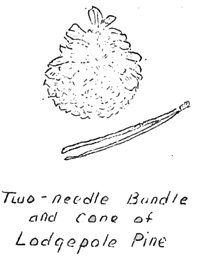
The Lodgepole Pine (Pinus contorta) forms dense black stands in the
more arid and lower areas of the park. This friendly tree grows under
soil and water conditions that no other tree would tolerate and in doing
so serves as a protection to the water sheds of the arid plateaus of the
region. In Grand Teton National Park this forest gives way to the
Engelmann Spruce (Picea engelmanni), Alpine Fir (Abies lasiocarpa),
Whitebark Pine (Pinus albicaulis) association as one travels up the more
moist, shaded canyons or up the slopes of the range.
The Douglas Fir (Pseudotsuga taxifolia) is found on the east face of
Mount Teewinot up to about 8,000 feet. This tree with its fir-like
leaves, its pendant cones that suggest the Spruce, its thick furrowed
bark like that of the Western Yellow Pine (Pinus scopulorum) and a name
that refers one to the Hemlock (Tsuga) leaves the amateur naturalist
somewhat confused, but the common name Douglas or Oregon Fir identifies
it as the most valuable lumber tree in America. It reaches its highest
development in the rain-soaked forest of Western Oregon.
At timberline, about 10,500 feet, the matted, decumbent, Alpine Fir
sprawls across the rocky slopes appearing in the distance like
closely-cropped blue grass lawn. The Whitebark Pine, broken and gnarled
from countless battles with the elements, stands guard on the wind swept
ridges. In the upper reaches of south fork of Cascade Canyon stands one
of these veterans of the ages. It is seven feet in diameter and is as
far as is now known, the largest diameter in the park. Hundreds of
hikers who have walked up the switchbacks to the top of Hidden Falls
have marveled at a dwarfed and contorted specimen of Whitebark Pine
growing from a crevice in an immense granite boulder. No doubt but that
this tree is hundreds of years old.
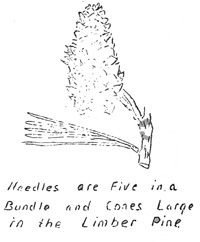
A few Limber Pine (Pinus flexilis) are found in arid and exposed
places at lower elevations. The flexible whip-like branches act as a
special adaptation to wind-swept slopes.
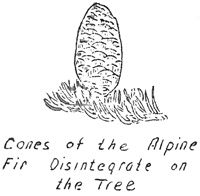
For sheer beauty of form and color the Alpine Fir stands supreme,
although the Engelmann Spruce is a worthy rival to it. The Alpine Fir
is tall and tapers to an extremely narrow spire-like top. The silvery
gray bark vividly contrasts with the dark blue-green of the leaves. The
cones, always borne at the top, are erect and of velvety texture. They
are dark purple in color, and with the sunlight reflecting from the
pitch that has beaded itself on the cone, one can compare them with
nothing other than lighted Christmas candles. However, this beautiful
cone seldom comes to one's hand. On ripening, which takes place in the
fall of the year following its origin in the spring, the cone
disintegrates, scattering seeds and scales to the wind. The fact that a
large fir is oftimes surrounded by a cluster of small ones, much as a
mother hen with her chicks, tends to indicate that the seeds mostly fall
to the foot of the parent tree.
Another interesting characteristic of this tree is the rooting, much
as a strawberry does, of the lower branches as they touch the ground due
to squirrels making caches under them or the snow pressing them down.
This rooting results in the tip of the rooted branch turning up and
becoming a tree. As time goes on this process is successively repeated.
It is not uncommon to see mature snow mats, as these are called, with
the old parent tree dead and disintegrated with the live mat forming a
truncated cone a quarter of an acre or more in extent.
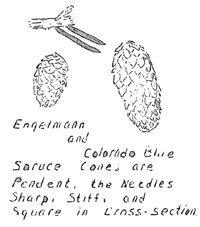
In the short glacial canyons that extend to the east face of the
range and along the west shores of the lakes the Engelmann Spruce is
found at its best. Mature specimens four to five feet in diameter, 100
feet high are found. The tree is pyramidal but not as spire-like as the
Alpine Fir. The lower branches droop as do all the branchlets. This
gives the tree a dense, black aspect. The foliage is dark blue-green,
and contrasts vividly with the reddish brown flakey bark that is found
on the young as well as on the mature trees. The pendant cones are
narrowly cylindrical and borne on the ends of the branchlets, mostly
near the top of the tree. This tree never produces a snow mat.
The Colorado Blue Spruce (Picea pungens) is found only along the
Snake River bottoms. Here the tree is typical of the species, and no
confusion between it and the Engelmann Spruce could arise in the mind of
an observer. The tree is wider in proportion to its height than the
Engelmann. The bark is tough and furrowed, being of gray color. The
cones are large, oftimes five inches in length. The pungent, four-angled
leaves are usually covered with a light blue bloom from which it takes
its common name.
| TREES |
ORIGIN OF
COMMON NAME |
MEANING OF
LATIN NAME |
GENERAL
APPEARANCE |
BARK |
LEAF |
CONES |
HABITAT |
Lodgepole Pine
(Pinus contorta) |
Used as tepee or lodgepoles by the Indians. |
Cones contorted and unsymmetrical. |
Tall narrow stems, devoid of limbs except at summit in dense stands. |
Thin, flaky, brown to black in color. |
Clusters of 2, about 2 inches long. |
Small, woody, persistant, armed with prickles. |
Arid plateaus of mid-elevations. |
Whitebark Pine
(Pinus albicaulis) |
Light gray color of the bark. |
Same as common name. |
Low-spreading, freely branched crown ragged, unsymmetrical. |
Smooth, gray on twigs, furrowed gray on bark. |
Clusters of 5 grouped on ends of branches, about 2 to 3 inches long. |
Three to four inches long, oval, dark purple, does not open at maturity. |
Wind-swept ridges at high elevations. |
Limber Pine
(Pinus flexilis) |
Flexible branches. |
Same as common name. |
Similar to the above species. |
As above |
As above |
Five to seven inches long, tapering, greenish when young, open at maturity, seeds edible. |
As above at lower elevations. |
Engelmann Spruce
(Picea engelmanni) |
Engelmann, distinguished botanist. |
Same as common name. |
Tall, pyramidal, deep blue-green color drooping branches and branchlets giving a dense appearance. |
Flaky, reddish brown in young tree as well as mature tree. |
Single, short, four-angled, not as stiff or sharp as Colo. Blue Spruce, well distributed around twig. |
Oval or oblong, about 2-3 inches long, pendent, brown when mature. |
Mid-elevations to timberline in moist situations. |
Colorado Blue Spruce
(Picea pungens) |
Light blue color of the leaf. |
Pungens refers to the sharpness of the leaf points. |
Beautifully symmetrical. cone-shape, with spreading branches not as tall as the Engelmann Spruce. |
Thick and gray, in old trees furrowed and ridged. |
Single, short, four-angled, very sharp. |
Cylindrical, drooping, light brown, about 3-5 inches long. |
Mid-elevations in moist situations. |
Alpine Fir
(Abies lasiocarpa) |
High mountain species. |
|
Tall tree with extremely narrow, spire-like top. Frequently with snow mat. |
This, smooth, and ashy gray. Cracked in very old trees, many pustules of balsam or pitch. |
Flat in cross-section and blunt on end, flexible |
Erect, near top of tree, velvety texture, purplish brown disintegrate at maturity. |
Mid-elevations to timber line in moist situations. |
Douglas Fir
(Pseudotsuga taxifolia) |
Douglas, distinguished botanist. |
False Hemlock. |
Stately with spreading, rugged branches. |
Thick and furrowed, gray in color. |
Similar to above species. |
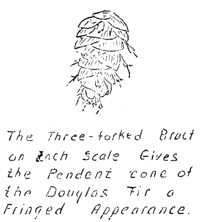
Ovate and pendent, each scale subtended by a three-forked bract, giving the cone a fringed appearance. |
Mid elevations throughout the range. (Reached greatest development in Oregon) |
LEPIDOPTERA COLLECTION - A fine addition to the museum exhibit, as
well as a valuable addition to the scientific collection of the park was
made this summer in the way of a collection of butterflies native to the
region. The collection includes about 130 mounted specimens, and makes
an exhibit second only to the fresh flower display in color and
attractiveness. The work was done by John W. McSwain. The following
genera are represented: Papilio (3 species), Parnassius (2 species),
Danaus, Pieris (2 species) Anthocharis, Eurymus (3 species), Oeneis,
Cereyonis, Coenympha, Epibea, Vanessa (2 species), Argynnis (9 species),
Phyciodes (2 species) Brenthis, Euphydryas (3 species), Basilarchia,
Miletea, Euptieta, Plebius (6 species), Glaucophysche, Heodes (8
species), and Thecla (2 species). - Allan D. Cameron.
|