|
|
|
GRAND TETON NATURE NOTES
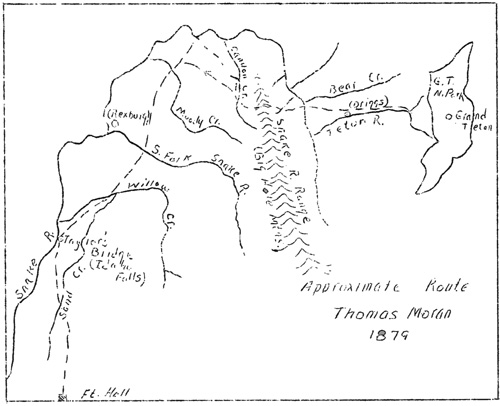
The Grand Teton National Park Museum, through the courtesy of Dr. F. M. Fryxell, has recently acquired Thomas Moran's diary of his journey to the Tetons in 1879. It is contained in a small, 3 inch by 6 inch, cardboard-covered, pocket notebook. Written in pencil, it is still easily read except for a few words which time has blurred. The following is a complete transcription of this interesting account of the journey on which he made the paintings and sketches now in the museum at Jenny Lake. Words in parentheses have been somewhat doubtfully interpreted. - Ed. "1879, August 21. Left Fort Hall with Cap. A. H. Bainbridge and 20 men, two wagons, on way to Taylor's Bridge. * Very hot, mirage, dogs exhausted, Pete ** sick. Reached Taylor's Bridge late in afternoon. 27 miles. Desolation, abandoned town, R.R. bridge over Snake, Anderson's store. Discharged soldier in morning came into camp and made (disturbance). Hughes, highway robber. Dismal camp. Furious wind all night, driving sand everywhere almost blinding. Gray dismal morning. Black basalt abomination. Rushing river like Niagara Rapids. *Taylor Toll Bridge was near the present city of Idaho Falls, Idaho. The bridge, of which only the stone abutments remain today, was built across the Snake River in 1866-67. The timbers were hauled from Beaver Canyon 80 miles to the north, and the iron was obtained from old freight wagons and a wrecked steamboat on the Missouri River. - from Tours in Eastern Idaho, publication of the American Guide Project, Works Progress Administration. **Pete- Peter Moran, brother of Thomas Moran, was also a member of the party. -Ed. "August 22. Left camp at Taylor's Bridge at 7 o'clock. Cold and windy with dust following and blinding all the way. At noon passed Black Jack's on Willow Creek. All sage plain, proposed irrigation. Arrived at 12 at Buck('s) from Connecticut. 7 miles to south fork of Snake. Arrived there at ½ past three. Two hours to get across on the opposite side. Had terrible time to get heavy wagons up embankment and through willows 40 feet. 12 miles, soldiers yelling and beating the mules. Got up all right and went into camp in a beautiful spot on the north bank of the river. Soldiers bathing and watering the stock. Near Taylor's Bridge had our first sight of the peak Teton some 70 miles away. Indian herder seldom speak(s) and keep(s) studiously apart from the other men. The (stagey) Sargent. Amusing to see the mules inquisitively surrounding the teamster who was handling the rations. Fires all over the country. "August 23. An early breakfast and cool. Following foothills surmounted by basalt over a plain covered with fine bunch grass, fine grazing and farming country with means of easy irrigation from the south fork of the Snake which is a splendid current and clear as crystal. We are directly opposite Crater Buttes * across the Snake 15 miles distant. The Salmon River Range, close in the distance enveloped in a delicate blue haze. To the east lies the Snake River Range a low line of mountains separating us from the Teton Basin. ½ past seven. Five, miles. A halt for ten minutes, a good road for the wagons. At 11:20, reached a fine cold stream probably Moody Creek where we rested ½ hour to water the animals. The Tetons are plainly visible but not well defined owing to the mistiness of the atmosphere. They loom grandly above all the other mountains. An intervening ridge dividing us from the Teton Basin stretches for miles to the north of a beautiful (pinkish) yellow with delicate (shadows) of pale cobalt while the distant range is an exquisite blue with but little definition of forms on their surfaces. *Crater Buttes, probably Menan Buttes or Big Buttes, near the confluence of the north and south forks of Snake River. Here a broad alluvial deposit has formed, beyond which the Buttes, broad of base and with gently sloping sides and broad tops, rise to a height of about 600 feet. Each has a well-defined extinct crater in its top about a mile in diameter and 200 feet in depth. - from Tours in Eastern Idaho, American Guide Project, W.P.A. Our Indian Jack has just caught a fine trout of about 3 pounds weight and he says the stream is full of them. "August 24th. Teton River camp. Trout this morning for breakfast. Is a wind blowing nearly as bad as at Taylor's Bridge driving the dust everywhere and covering our breakfast. Cold but bright overhead. The Tetons from the camp are very well defined in an easterly direction before the sun rose, but soon disappeared when the atmosphere lighted up. Bogua whose ranch we stopped at for information yesterday drove over this morning before we left camp and partly under guidance reached Canon Creek at 11 o'clock after a fifteen mile ride over rolling country covered with excellent grass and free from sage. We struck the canyon at a point where it is about 800 feet in depth with very precipitous banks covered with debris from the basaltic columns with which the upper edge is fringed. A large porcupine was killed by Cap. Bainbridge a mile or two from the canyon which has a beautiful stream flowing through it fringed with water elm, pine, cottonwood, etc. The captain and two men (have gone) up the canyon either to find (A). About a mile above we found a depression in the side of the canyon down which we could make our way to a flat space containing a few acres covered with sage and grass. Here the wagons were unloaded and after packing the (material) on the pack mules, the wagons with a (portion) of the mules and 6 or 8 men were sent back to Bogua's to there camp until our return from Teton Basin. We made our camp on the flat in the canyon, Caught a few mountain trout and ascended the canyon again to get a glimpse of the Tetons but from this point only the top of Mount Moran is visible owing to the slope of the hills beyond the canyon. *Mount Moran had been named in 1872 by the Stevenson Division of the Hayden Survey in honor of the great landscape painter who had accompanied the Hayden party to Yellowstone Park the year before as guest artist. -Ed. "August 25. We were out of bed this morning at 5:30. It was very cold, and ice had formed on the tin cups. In another hour we were under way over what appeared to be a rolling but smooth country, but as we advanced we found our mistake. Every mile we found a gulch bordered with aspens in depth 100 to 200 feet but we found no difficulty in crossing any of then. After crossing the divide between Teton Basin and our last camp we found a (gentle) country to the basin. The Tetons have loomed up grandly against the sky and from this point is perhaps the finest pictorial range in the United States or even in North America. After descending the slopes about three miles we came upon a small ice cold stream and determined to camp. Leaving the main body the Cap., Pete and myself and one man proceeded a mile or two toward the Teton valley, but saw no sign of water within five miles. On our return to camp we saw a deer within a quarter of a mile but failed to get close enough to get a shot at it. After camp had been finally disposed of three men and the Indian were sent out to hunt. They had not been gone more than an hour before we heard several shots and concluded that they had found something. Soon after they returned and the Indian had shot three out of five deer they had came upon. One was lost in the packing as the mules objected strongly to carry dead animals so but two were brought into camp. They were the mule deer which may have had something to do with the objections of the mules carrying they. Later in the afternoon 4 men were sent out to search for the lost deer and they soon after brought it back to camp. Of course we (enjoyed) our venison heartily at dinner. This afternoon we made sketches of the Teton Range but the distance 20 miles is rather too far to distinguish the details especially as it is very smoky from the fires on each side of the peaks. This evening it is quite cold but we have a fine campfire and the Cap. and Peter are broiling venison ribs on willow sticks. "26th. From camp this morning our way lay over a smooth rolling country descending gently to the bottom of Teton Basin a valley through which the Teton River flows its banks deeply fringed with the willows common to this region with here and there cottonwoods in small (groves). The Teton River can be forded at almost any point. Soon after crossing the stream we saw a teepe in the willows a short distance away and some horses grazing. Going over there we found it to be Beaver Dick** his Indian squaw and a companion whom he called Tom. He was evidently trapping beaver as he had several skins stretched with pins on the ground. Leaving Beaver Dick's camp we headed directly for the canyon of the Teton River which heads at the base of the Tetons. Dick said it was 17 miles to the camping ground, but we found that it was not more than 10 or 12. At the mouth of the canyon we found a pretty good camping spot on the edge of the banks of the river which are here about 14 feet high. A fine growth of pine fills the river bottom and good grazing for the animals covers the space between ourselves and the hills. It is very hot this afternoon and so very smoky that the peaks can scarcely be seen and at times are entirely obscured so that sketching is out of the question and we spend our tine working up some of our sketches made previously. As the sun goes down it gets quite cold but a roaring campfire gives warmth and cheerfulness to our camp and we all feel in the best of spirits. After a good night's rest we got up on the morning of the 27th at an early hour and after a substantial breakfast of venison we are about to start on our trip up the canyon when one of the men discovered a black bear coming down the hills toward our camp and not more than 250 yards distant. The bear showed much curiosity in regard to our camp and was deliberating whether to come nearer when the Cap. sent Indian Jack and several men out to interview him. Jack got the first shot and hit him in the right foot which seemed to surprise him very much as he threw up his foot and stood still for a few seconds but he was not long in making up his mind to retreat. The men fired a number of shots after him as he ran into the aspen grove at the foot of the hill but failed to hit him. In a few minutes he had disappeared over the top of the hill much to the disgust of the hunters. After this little event the Cap., Pete, myself and two men started on a trip up the canyon. We proceeded over a not difficult way about 6 miles and ascended to the top of a granite cliff about 500 feet to get a good view of the canyon that leads up to the right of the Tetons. The peaks of the Tetons are from this point hidden from view but a number of other fine peaks present themselves in view. The view is very magnificent. The opposite mountain rises 5000 feet above the river with a granite base surmounted by sandstone and capped by tremendous precipices of limestone. The slopes are covered in places with a growth of large pines but the summit is nearly bare of vegetation. We remained on the shelf for sone three hours sketching and afterwards amused ourselves by rolling down great granite boulders over the precipice upon which we stood and watched their descent as they went bounding from rock to rock and crashing through the branches and dead timber at the base with a noise like the report of musketry end reverberating through the canyon. Descending to the valley we found red raspberries and black currants plentiful with which we regaled. A large beaver dam stretches across the the canyon at this point and the animals' industry is here exhibited on a large scale, the trees having been cut by them hundreds of feet above the water and brought down to the dam. Game of all sorts is very abundant in the canyon. Elk and deer tracks are seen everywhere. We returned to camp early in the afternoon the fires in the surrounding mountains had become so dense as to almost obscure the peaks of the Tetons and the sun went down in fiery redness. A strong and cold wind began to blow soon after and during the night a violent thunderstorm continued until nearly daybreak accompanied by rain in the canyon and snow on the peaks. Heavy storm clouds hung over the range dropping snow or rain occasionally and a cold wind blew from the southwest. **Beaver Dick, Richard Leigh, trapper and one of the guides of the Hayden expeditions into Jackson Hole. Leigh Lake and Jenny Lake in Grand Teton National Park were named for Beaver Dick and for his Indian wife by the Hayden party of 1872. - Ed.
"August 28, We broke camp and left the canyon at 6:30 after an uncomfortable breakfast prepared under difficulties of rain and cold wind. As we left the canyon and came into the open plain the sun broke through the dense clouds that overhung the mountains for a time and showed his face (fitfully) all day. On our way back we called at the wickiup of Beaver Dick and after a little talk we proceeded to the Teton River near its junction with Bear Creek where we intended to camp but after a rest of a couple of hours during which a number of fine salmon trout were taken, we concluded to go some 8 miles to our old camp on the other side of the Teton valley where we arrived about 4 o'clock. Beaver Dick and his companion Tom (showing) us part of the way. It was cold and windy part of the evening and considerable snow fell on the mountains during the day. Indian Jack as usual was the (lucky) hunter and brought in a young antelope many of which we saw between Beaver Dick and our camping ground. A roaring campfire dispelled the cold and our camp being in a sheltered spot we slept comfortably and next morning August 28* we followed our old trail toward Canyon Creek for some time when we were again joined by Beaver Dick who guided over a new route to Bogua's but not an improvement over our own as we came over to the basin. The Cap. was very desirous of bringing into Fort Hall a hostile Bannock Indian named Pam-Pigemena who was, by the way, father-in-law to Beaver Dick and Dick said he knew where he was and would bring him to our camp in the morning. We journeyed along and reached Bogua's ranch early in the afternoon and found that the party we had left in charge of the wagons was camped on Moody Creek near its junction with the south fork of Teton River some four miles farther on. Wo proceeded on the way and reached there about 3 o'clock after dinner. Beaver Dick started out for the Indian (promises) to bring him in in the morning. It was very cold during the night, heavy ice forming on the water in our buckets. On the morning of the * August 29 "29th* as we were at breakfast Beaver Dick came into camp with the information that his father-in-law and his mother-in-law also would be in very soon. The Cap. ordered the start but left three men in the camp to wait for the Indian and his wife. We proceeded on our way toward the south fork of the Snake River and when about 8 miles on our way we (descried) the men with the Indian coming along. We halted for half an hour until they came up. They had all their worldly goods with them packed on three horses consisting of beaver, otter, deer, bear and other skins. They were about 60 and 50 years of age and seemed entirely indiferent to their position as prisoners. We bought some otter skins from them, but a coveted gray bear skin the squaw would not part with as she said Beaver Dick gave it to her. We recrossed the Snake without accident and arrived at Willow Creek at 3 o'clock and went into camp. Cedars, cottonwoods in the bottoms and a beautiful day. The ever present Crater Buttes (occur) right all day backed by the Salmon River Range. Poor camp with no grass for animals." *30th | |||||||||||
| <<< Previous | > Cover < | Next >>> |
vol3-2b.htm
14-Oct-2011