|
|
FROM LOW TO HIGH By Frank E. Lutz, THE outstanding scientific features of Grand Canyon National Park are admittedly the geologic ones. Nevertheless, animals and plants, the biologic features, of any of our parks are of great interest. This is certainly true at Grand Canyon. Thanks to the efficient work of Park Naturalist McKee and his staff we have a good record of most of the larger plants and of the backboned animals in and near the Canyon but the insects are still practically unknown. Small collections of insects have been made from time to time, chiefly on the South Rim, but, in view of the several thousand species that certainly occur there, barely a start has been made. Furthermore, because highly specialized knowledge is needed to identify correctly this wealth of life, relatively little is known concerning the collections already made. Since cooperation is needed for such work the entomological department of the American Museum of Natural History welcomed the opportunity of doing its bit by sending the writer and three volunteer assistants, Messrs. E. L. Bell, David Rockefeller and P. E. Geier for a season's work in the Canyon and on the neighboring San Francisco Peaks. The party spent very little time on the readily accessible Rims.
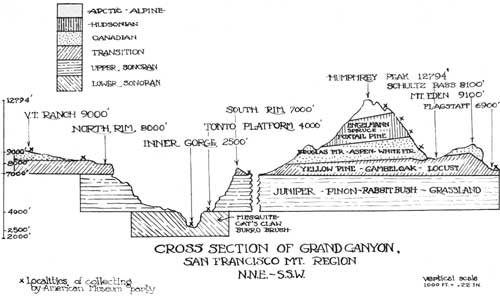
It is evident to anyone who has been at all observant in regions where there is a great diversity of altitude that animal and plant life change with a change in altitude. As we go up the mountains the fauna and flora become more and more "northern". This has been mere carefully worked out for plants, mammals and birds than it has for insects. At any rate, this is one of the interesting biological features at the Canyon where the altitude varies from 2,500 feet along the Colorado River to more than 12,000 feet in the San Francisco Peaks. Accordingly, in spite of the heat and drought at one extreme and of the chilliness and rain at the other, our party paid most attention to these extremes, going from the low to the high. Through the courtesy of the Park Service we spent sufficient time at three principal stations, the mouth of Bright Angel Creek, Indian Gardens, and Supai, inside the Canyon, to get quite satisfactory samples of the adult insect life at those places and times. So far as we know, ours were the first insect nets to swing at Supai in the wonderfully beautiful and interesting Havasu Canyon some miles west of Bright Angel. Also, with the help of Dr. Harold S. Colton of the Museum of Northern Arizona we established camp at about 9,500 feet altitude on the San Francisco Peaks and worked both ways from there, getting to the summits of the four major peaks and to the bottom of Walnut Canyon with its abundance of Cliff Dweller ruins and its rich animal life. Our collections are so large and so varied that we shall be a long time in completing the study of them but even they represent only a fraction of what is to be found at other times and places. The Canyon with all of its branches is vast and so are the surrounding mountains. And then there are the fascinating plains which Man calls deserts, chiefly because he finds it difficult to live there in large numbers but which are home to many an insect that has solved the problem Man has not solved. However, we hope that we shall have made at least a small contribution to a better knowledge concerning the biology of the Grand Canyon region and we thank the Museum's friends who have made this contribution possible.
| ||||||
| <<< Previous | > Cover < | Next >>> |
vol9-7c.htm
14-Oct-2011