|
|
By Park Naturalist, Edwin D. McKee*
The flora of the Grand Canyon National Monument represents several distinct plant associations, each of which is different and in contrast to that, with Saltbush predominating, along the approach road across the great alkaline plains to the northeast. The main groups of plants in the Monument are controlled principally by factors of soil and climate and for the most part are rather distinct in their constituents although gradational along their borders. They are listed by the writer as (1) the high mountain type, (2) the valley wall type, (3) the open valley type, (4) the inner canyon rim type, and (5) the lava bed type. In the first two of these, representing the high altitudes, plants are almost if not entirely the same as those found in corresponding life zones in Grand Canyon National Park to the east. In the lower two, many of the plants are of species unknown in eastern Grand Canyon, while the open valley type is intermediate in its status. HIGH MOUNTAIN TYPE, REPRESENTED ON MT. TRUMBULL AND NEIGHBORING VOLCANIC PEAKS, ALTITUDE 6,250 - 7,500 FEET: This type corresponds to the upper part of the upper Sonoran and to the Transition Zones as found on the Kaibab and Coconino Plateaus to the east and essentially all of its plant species are found in those areas. A few typically Canadian Zone species are found in sheltered places on the mountains. List of conspicuous plants in lower part. 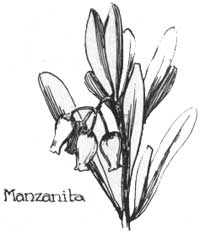 (c) Pinyon Pine - Pinus edulis (c) Sagebrush - Artemesia tridentata Gambel's Oak - Quercus gambelli Live Oak - Quercus wilcoxii Manzanita - Arctostaphylus pungens Scarlet Bugler - Pentstemon torreyi Mountain Mahogany - Cercocarpus sp. Cliff Rose - Cowania stansburiana Gooseberry - Grossularia sp. Hollygrape - Berberis fremontii Ponderosa Pine - Pinus ponderosa
 Elderberry - Sambucus sp.
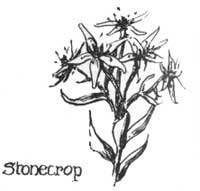
(c) Gambel's Oak - Quercus gambelli (c) Ponderosa Pine - Pinus ponderosa Quaking Aspen - Populus tremuloides Meadow Rue - Thalictrum sp. New Mexico Locust - Rubinia neomexicana Apache Plume - Fallugia paradoxida Big Blue Pentstemon - Pentstemon Wild Buckwheat - Eriogonum sp. (c) Stonecrop - Sedum stenopetalum
This type corresponds closely to the upper Sonoran Zone as found on the Coconino and Kaibab Plateaus to the east, with essentially all of its species also found in those areas. A few typically Lower Sonoran species are also found in this association on the more open slopes. Both because of a lack of time and because the flora was so similar to that of the National Park area, a rather incomplete list was made of this type. Partial list of conspicuous plants: 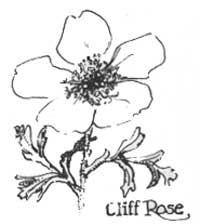 Rabbitbrush - Chrysothamnus sp. Snakeweed - Guterrezia sp. Cliff Rose - Cowania stansburiana Mormon Tea - Ephedra viridis Barrel Cactus - Ferocactus lecontei Sagebrush - Artemesia tridentata Cucumber Cactus - Echinocereus sp. Leadbush - Lopagyrea argentea Pinyon Pine - Pinus edulis Utah Juniper - Juniperus utahensis
Since this valley includes most of the area to be developed as an antelope range, its flora is of considerable interest. At the present time it is very badly overgrazed and includes a surprisingly small number of species. Indeed there are only four or five different plants that can really be considered common in this area. Partial list of conspicuous plants. 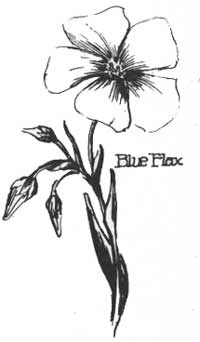 (c) Sagebrush - Artemesia tridentatum (c) Cholla - Opuntia sp. (c) Bread-leaf Yucca - Yucca baccata Narrow-leaf Yucca - Yucca baileyi Saltbush - Atriplex canescens Snakeweed - Guterrezia sp. Pincushion Cactus - Mammalaria sp. Hollygrape - Berberis fremontii (c) Mormon Tea - Ephedra sp. Blue Flax - Linum sp. Red-stemmed Filaree - Erodium cicutarium Evening Primrose - Oenothera sp. (upper end) Thistle Poppy - Argemone sp. (upper end)
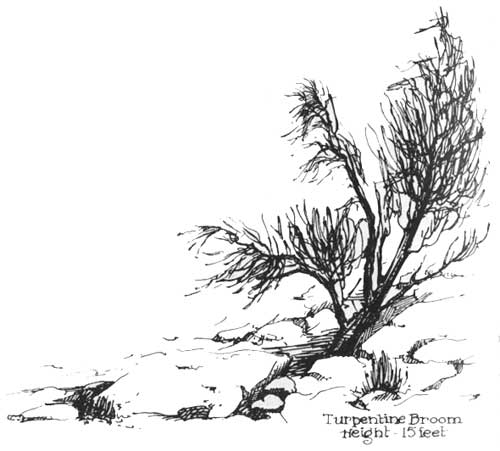
This type is characterized by a peculiar mixture of fairly well developed Upper Sonoran species together with a great number of those typical of the Lower Sonoran Zone. Many of the latter are of species not represented farther east in Grand Canyon, even at lower altitudes, and others have attained a remarkably large growth. The apparent excessively favorable conditions for the development of Lower Sonoran types in this area seem incongruous when it is considered that fairly large Pinyons, Junipers and Sagebrush occur mixed with these. From this it would seem evident that the temperature is not the principal controlling factor in this area. Probably a more favorable supply of moisture explains this phenomenon, however, no concrete evidence was obtained to substantiate this suggestion. Specific example of plants illustrating the unusual conditions represented in this area are the Ocotillo and Creosote Bush, plants that have not been recorded from farther east in Grand Canyon, and the shrub Thamnosmia which in one place has actually developed into the proportions of a tree, 15 feet high and with a basal trunk diameter of 14 inches, looking strangely similar to a huge broom pointing skyward. The exceptionally great size of the Broad-leaf Yuccas and the rigidity of their leaves are also noteworthy local developments. Partial list of conspicuous plants. 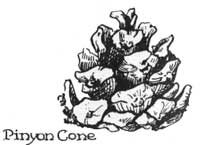 (c) Live Oak - Quercus wilcoxii Pinyon Pine - Pinus edulis Utah Juniper - Juniperus utahensis (c) Mountain Mahogany - Cercocarpus sp. (c) Turpentine Broom - Thamnosma montana Rabbitbrush - Chrysothamnus sp. Century Plant - Agave utahensis Yellow Mustard (c) Indian Paintbrush - Castilleja sp. (c) Broad-leaf Yucca - Yucca baccata Narrow-leaf Yucca - Yucca baileyi Beargrass - Xerophyllum tenax 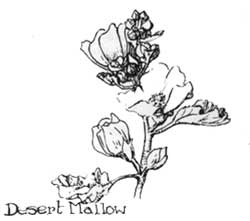 Cucumber Cactus - Echinocereus sp. Gray Prickly Pear - Opuntia chloritica Big Prickly Pear - Opuntia sp. Paper Flower - Psiliostrophe sparsiflora Sagebrush - Artemesia tridentata Squawberry - Rhus trilobata Creosote Bush - Covillia trdentata Ocotillo - Founquieria spendens Blue Flax - Linum sp. 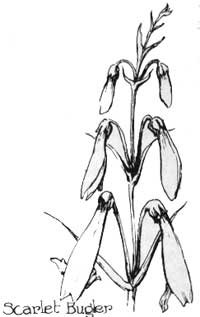 Rabbitbrush - Chrysothamnus sp.
Desert Mallow - Sphaeralcea sp. Wild Four O'Clock - Quasmoclidion Phlox - Phlox caespitosum Pincushion Cactus - Mammalaria sp. Apache Plume - Fallugia paradoxida Singleleaf Ash - Fraxinus anomala Rock Rose - Petrophytum caespitosum Scarlet Bugler - Pentstemon bridgesi Evening Primrose - Oenotheria sp. Devil's Claw - Martynia louisiana (Some others which appeared to be different from any found in eastern Grand Canyon but which have not yet been identified, were collected.) LOWER LAVA BED TYPE, REPRESENTED BY BASALT FLOWS FROM VULCAN'S THRONE AT LOWER END OF VALLEY INTO INNER CANYON, ALTITUDE 3,250 - 5,000 FEET: This area, although representing about the same altitude as the preceding, is characterized by a very distinct plant association. Like the preceding, however, it contains many species not found in eastern Grand Canyon and many Lower Sonoran types which have attained exceptional size. Most noteworthy in the latter group are the Barrel Cactuses which grow to a height of four feet and the Chollas which appear in clumps, 25 to 30 feet in diameter and as high as a man. Since among the plants not known to the writer were several of the most common species, the following list loses most of its value until determinations make it possible to supplement the names of these. Partial list of conspicuous plants. (c) - very common. (c) Snakeweed - Guterrezia sp. (most numerous plant in upper section.)(c) A feathery plant not yet determined. (c) A plant with bulbous leaves not yet determined. (Most numerous in lower section.) Yellow Daisy - 3 species Mormon Tea - Ephedra sp. Barrel Cactus - Ferrocactus lecontei Cucumber Cactus - Echinocereus sp. Cliff Rose - Cowania stansburiana (c) Sagebrush - Artemesia tridentata (common in section) (c) Broad-leaf Yucca - Yucca baccata Apache Plume - Fallugia paradoxida (c) Indian Paintbrush - Castelliga sp. Blue Pea Cholla - Opuntia sp. Loco - Astragalus sp. Prickly Pear - Opuntia Mesquite - Prosopis
| ||||||
| <<< Previous | > Cover < | Next >>> |
vol9-6c.htm
14-Oct-2011